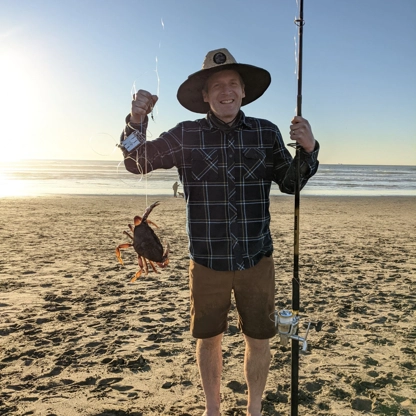
Brian Schwartz is a Professor of Medicine at the University of California, San Francisco (UCSF) in the Division of Infectious Diseases. At UCSF, he is the Course Director of the first-year medical student Pathogens and Host Defense course and the Program Director for the Infection Diseases Fellowship. His scholarly interests are focused on medical education and include faculty development of clinician-educators and strategies to enhance the learning of infectious diseases topics across learner groups. He is the present Chair of the IDSA Medical Education Community of Practice Executive Committee.
Please describe your educational roles and interests.
I have always enjoyed teaching, primarily as an outlet to do art and be creative. I love to draw, paint (any medium), so whether writing on the blackboard or making PowerPoint slides, teaching gave me a creative outlet. I also like simple communication and am a stickler for short emails. Therefore, I like the challenge of stripping down concepts to their core to get across the key information. I think these traits set me up for a career in education. Also, my mom was a kindergarten teacher, so education always had a prominent place in my upbringing.
How do you transform interest in medical education into a career?
I was able to move my career forward in medical education through a combination of luck (right place, right time), having great peer mentors, working at an institution that supports medical education, and a strong personal belief that advancing medical education in infectious diseases was needed and would benefit many learners and educators. The first “right place, right time” moment was after volunteering as a small group instructor for several years in the medical student microbiology/immunology course at UCSF. The course director retired, and Peter Chin-Hong and I were offered the opportunity to co-direct the course. Through this role, I:
- gained access to the medical education community at UCSF, learned from many others, and
- I became very curious about how others were teaching and assessing, which led me to make connections within IDSA, NBME, and create a national survey. Once my work in undergraduate medical education took hold, I began to apply what I learned to our infectious diseases fellowship and became program director.
What innovative educational program or process are you most excited about currently?
Don’t get me wrong, I hate the pandemic, and I hate being online for teaching/learning. That being said, I have loved to see all the innovation happening to ensure successful learning. I love learning from others on ways to be successful in Zoom, using podcasts, and watching others find innovative ways to teach via social media. In particular, I have really enjoyed learning about the innovations presented via abstract at IDWeek 2020 in Med Ed via the [**@IDSAMEDEDCOP**](https://twitter.com/idsamededcop?lang=en) Twitter feed. Some big picture changes that excite me are the move of USMLE Step 1 to after the pre-clinical years at many schools and moving it to pass/fail. I am hopeful this will promote learning for understanding and application to patient care as opposed to just memorization to do well on an exam. We have also moved our pre-clinical summative assessments to open-ended questions, which I really like. This has helped me determine what students are really understanding and allows me to adjust my teaching accordingly.
How have you transformed your medical education work into scholarship?
A lot of the day-to-day creativity of the infectious diseases educator can be created into scholarship. I keep the Kern 6-Step Model of Curriculum Design in mind as I work to create scholarship. Often a needs assessment (whether local or national) can be ripe for scholarship on its own, while other times, it is actually looking at the curriculum's outcomes. It is critical to think about what outcomes you are hoping to achieve early on so you can collect the data you need before you design a new curriculum. I have been very fortunate at UCSF to partner with many other brilliant ID educators as well as a cadre of experts in medical education research to get guidance. I took a year-long program on medical education at UCSF and educational leadership training through the AAMC. I try to attend local and national conferences as well as read to find ideas for inspiration.
What is your vision for medical education in the field of infectious diseases?
My goal, in partnership with the IDSA Medical Education Community of Practice, is:
- Help all ID teachers enhance their effectiveness through sessions both at IDWeek and throughout the year as well as through online resources that are being developed.
- Creating programs within IDSA that help support the career development of ID clinician-educators.
- Support ID clinician educators to create scholarship in medical education to help determine what are the most effective ways for us to teach all levels of learners.
You’ve talked about the importance of “partnering with your learner”- can you elaborate on what that looks like?
Building a trusting relationship with your learner allows them to feel comfortable giving you feedback and receiving feedback -- making you a more effective teacher and them a more effective learner. I am constantly asking the students, residents, fellows, and faculty I teach – “how can this be better, clearer, or more concise?” I go into all my teaching as though it is a version that needs change and that the learners will be able to help me get to version 2.0. Consider asking learners before a session, “I am worried that this part of my talk will be confusing. Can you please be sure to give me feedback on how that goes?” The learners want to help and often have great ideas!
What is one piece of advice you’d give a trainee interested in a career in medical education?**
I think that the key steps to build a career in medical education are:
- let your interests be known to division leaders, mentors, peers, etc.,
- obtain mentorship (internal and external, senior and peer) and sponsorship (may be same as mentors but often different),
- gain skills in medical education through workshops (local, regional, national),
- practice and get feedback on your teaching, (5) approach new projects through the lens of scholarship, and
- consider leadership opportunities in education (be prepared for your interviews and ask for help from your mentors).
What changes related to COVID have you made in education that you would like to retain post-pandemic?
Continue to use video conferencing to bring folks together locally across campuses and nationally. Keep working to make it as effective as possible. Continue to learn from podcasts and experiment with creating. Using COVID/SARS-CoV-2 as an exemplar for teaching much of micro/ID!