
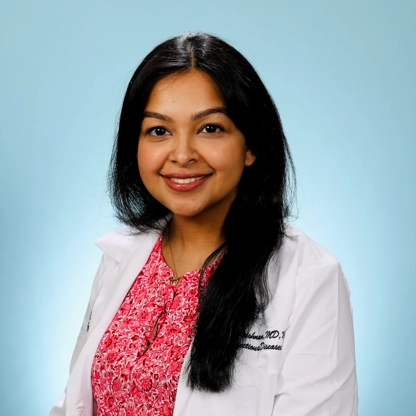
As a faculty, Dr. Gayathri Krishnan serves as the site lead for the ID Ambulatory Immersion rotation, faculty advisor for the ID student interest groups (IDIG), President and Curriculum Chair for the DOM Fellows Council and Core Faculty for IM Residency. She strives to raise awareness on gender inequities in medicine and amplify, advocate for, and support women trainees and their career development. Locally, she serves as the Director for the WashU Forum for Women in Medicine Trainee Leadership Development Program (FLDP) which aims at training and equipping women trainees with critical leadership skills. Nationally, this passion of hers has lead her to develop the @women_in_ID group in X (currently suspended). Through participation in the IDA&E and the Mentorship workgroup, she strives to promote resources and support for women and other underrepresented minorities in medicine.
How did you get interested in medical education?
As an immigrant woman in medicine, I recognized the need for mentorship, support and innovative educational curricula to advance trainees in medicine. My work as a resident was small, but innovative, and along with my colleagues we created a residency research committee for residents to identify mentors and future projects. Later as the educational Chief Resident, I was able to create several innovative educational curricula (including our first POCUS curriculum) and increase resident engagement in didactics through gaming and other avenues. The feedback from trainees, colleagues and faculty members and the impact of having innovative and well structured educational resources really strengthened my passion for pursuing medical education. As an ID Chief Fellow, I was able to organize our division's first Research Symposium and also a national twitter (now X) platform for women in infectious diseases. Through mentorship and support from senior faculty members, I was able to focus more on medical education and make that an integral part of my training and future faculty position.
How have you integrated medical education into your career?
As a clinician educator, most of the education and teaching has been integrated into my clinical workflow. However, I cannot underscore the importance of divisional support and mentorship in creating a faculty job that supports ongoing med ed activities.
How did you transform your interest in medical education into a career?
Seeking more focused Med Ed training and certifications, to educate myself as well as develop my Med Ed skills, really supported this goal. Mentorship was crucial in figuring out how to integrate MedEd as a career trajectory.
What is one medical innovation that makes you the most proud?
Creating an asynchronous online curriculum for med students rotating through ID electives, as well as, creating a leadership development program for women trainees in medicine at WashU.
How have you transformed your medical education work into scholarship?
This took a lot of time, training, experience and mentorship. Creating a curriculum, incorporating appropriate assessments, designing a program evaluation all constitute scholarship. Most of my earlier Med Ed innovations were passion projects, however as I gained more training (two year Masters program, several other certificate trainings), I developed the skills and knowledge to incorporate scholarly aspects to all projects.
What are some of the most rewarding aspects of your career as an educator thus far?
As an educator, our trainees are our legacy, and their successes are our biggest rewards.