
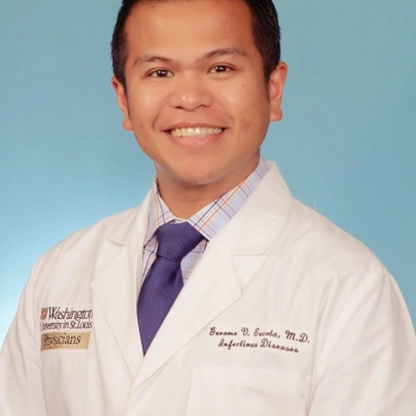
I served as Co-director of the Infectious Disease Fellowship Program from 2020-2021 and Clerkship Director for Internal Medicine from 2018-2021 at Washington University School of Medicine in St. Louis. I was also the inaugural Chair of the Teaching and Learning Resources Committee of the IDSA Medical Education Community of Practice from 2019-2021. I am a co-author of one of the bestselling books in infectious disease Comprehensive Review of Infectious Diseases. My main area of interest is medical education through innovative platforms such as social media.
How did you get interested in medical education?
I have always loved teaching. In fact, I remember telling my mother when I was a kid that I wanted to be a teacher. I have always enjoyed tutoring in high school and in college. Thus, in many ways, I was a teacher first before I was a doctor. So when I finished my training in infectious disease, it was natural for me to gravitate toward a career in medical education. I did not realize that one can have a career in medical education. I owe it to my mentor then, Dr. William Powderly, who gave me the opportunities to explore it as a career and to hone my skills in teaching.
How have you integrated medical education into your career?
Teaching comes naturally for me. So, it was not hard to integrate it into my career and day-to-day practice. Over time, I learned that knowing how to teach well is not enough when you want to venture into a career in medical education. You have to have the necessary skills as well. I learned these skills from attending seminars that focused on medical education, from experts in the field that I work with both at Wash U and at IDSA, and from my mentors. I integrate these skills not just into my day-to-day practice of teaching students and trainees, but also into the many leadership roles I had been fortunate to have. Mentorship, feedback, assessment, curriculum development, program evaluation, and many more are the skills I have been able to integrate into my career.
## You are the creator of @WuidQ - a free, open access medical education Twitter-based account. Tell us about what you have learned from creating this platform.
I stumbled into teaching through social media by happenstance. I tweeted a poll back in 2018 about a case presented in Grand Rounds and to my surprise, people started answering as if the poll was a multiple choice question. They also started to interact using the chat function. This gave me the idea to use Twitter as a powerful tool to teach and engage a bigger audience. Since then, I think @WuidQ has inspired many ID educators on social media. Over the course of 4 years, I learned many things. I learned that social media, if used properly, is one of the most powerful tool to teach and learn. I learned that it is a great canvass to practice and integrate medical education skills. I also learned that when used properly, social media allows you to find a community of like-minded individuals who share your passions and interests. One of the greatest honors of my life is meeting, working with, mentoring, and learning from these individuals.
What other strategies do you utilize to engage learners in the field of ID?
It is always important to know who your learners are so you can tailor how and what to teach them. It is also important to have situational awareness when you teach so you can adapt and adjust. Approachability also goes a long way. It automatically pushes the student-teacher barrier away no matter how wide it maybe. I also think that when you love and enjoy teaching, and when somehow your learners see this every time you teach, engaging your learners becomes natural.
What strategies have you used to transform your medical education work into scholarship?
Collaboration and mentorship are key to transforming your medical education work into scholarship. I knew I wanted to transform my work on @WuidQ into scholarship. So I reached out to Dr. Brian Schwartz who then introduced me to Dr. Emily Abdoler. And the rest is history. Also, seek out opportunities where you can learn how to navigate medical education scholarship. Attend seminars and talks, don't be afraid to reach out to people within and outside your institution to run your ideas by and get feedback. Be comfortable as well to look outside of Infectious Disease not only for potential mentors and collaborators but also for ideas that you can apply to infectious disease.
How has the COVID-19 pandemic transformed your teaching and what role does technology play in this for you?
At the start of the pandemic, it was hard to regularly engage on social media because most of us in the hospital have been mobilized to take care of patients with COVID. But as we learned to adapt, ultimately, in hindsight, the pandemic brought people from across the globe and from across generations into one shared conscious experience. Many turned to social media for real-time updates on how people take care of COVID patients. Students and trainees have turned to it too to learn about new COVID articles that were being published online in warp speed. The pandemic, in a lot of ways, served as a catalyst to find innovative platforms outside of traditional technology to teach and learn. It's still it its relative infancy but I think innovative formats like podcasts (shout out to the Febrile team and especially to Sara Dong), tweetorials, blogs, chalk talks, and others are here to stay, for good. And these forms of technology, no matter how unconventional they maybe, are part of how the current and future generations of health professionals learn. Our recent publications on CID and OFID hope to provide training programs and societies a roadmap on how these technologies can be better incorporated into curriculum and improve ID education.
What advice do you have for someone who is starting a career in medical education?
First, seek out mentors who know how to navigate a career in medical education. Don't limit yourself with one. Be brave to look outside of your institution and outside of your field too. Seek opportunities to meet mentors through the many IDSA activities. Joining the Medical Community of Practice for example, is a great first step. Also, seek out opportunities to gain medical education skills through formal or informal training. Practice what you learned. Have someone give you feedback on how you teach, how your write, how your mentor. If you want to hold leadership roles, make sure to express it when you're given the opportunity. Most importantly, stay grounded. Be true to yourself, your purpose, your goal. Seek your happiness and everything follows with it.
What other innovative educational program or process are you excited about currently?
I am currently excited about publishing the 2nd edition of our ID Review book. Now that I have joined community practice, I am excited about the prospect of marrying medical education and private practice which seem to be two separate careers when you look at it in plain sight. I am bursting with ideas. No matter where I am, as I said before, I was a teacher first before I was a doctor.