
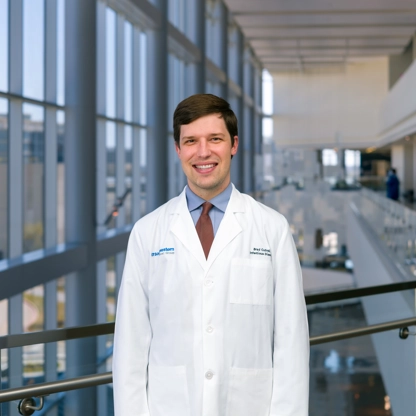
Brad Cutrell currently serves as the Adult ID Fellowship Program Director and HIV Medicine Fellowship Program Director at UT Southwestern. He also co-directs the ID Hybrid rotation for the IM Residents. Outside of UTSW, he is the Vice-Chair of the IDSA In-Training Exam Test Development subcommittee and is a member of the IDSA Medical Education Community of Practice Executive Committee. Clinically, Brad serves as the Medical Director for Antimicrobial Stewardship at UT Southwestern University Hospitals and Clinics. His areas of scholarly interest focus on leveraging technology and other innovative strategies to teach antimicrobial stewardship and general ID content to graduate medical trainees.
How did you get interested in medical education?
I have always had a passion for medical education, starting as a medical student providing tutoring and course reviews for my peers and then receiving several teaching awards as an intern and resident in Internal Medicine. However, it was my year serving as a Chief Medicine Resident that crystallized my goals to incorporate medical education as a major area of focus for my career in academic medicine. One of the most exciting parts of my job is getting to watch learners at all levels start to make connections during the learning process as “the light bulbs turn on” and to have a front row seat as they mature into the next generation of physicians and educators.
How have you incorporated an interest in medical education into your career?
One of my main roles is serving as the Medical Director of Antimicrobial Stewardship at our academic university hospital, which is a natural fit for medical education. I relish the opportunity to challenge learners to hone their diagnostic testing skills and grow their confidence in antibiotic prescribing at this critical stage where they are still forming their identities and habits as clinicians.
From the beginnings of my academic career, I have also been fortunate to receive several medical education leadership opportunities at my home institution of UT Southwestern in Dallas, Texas. I first served as the Associate Program Director and now the Program Director of our adult ID fellowship program in addition to leading our newly created HIV Medicine fellowship. At a higher level, I serve on our institution’s Graduate Medical Education executive committee which allows me to contribute to our overall vision and strategic plan moving forward for medical education. More recently, I have also broadened my involvement to the national level by serving on the IDSA Medical Education Community of Practice Executive Committee and the IDSA In-training Exam Test Development Subcommittee.
What innovative educational program or process are you most excited about currently?
Recently, I have enjoyed implementing the use of a mobile phone-based App to do ID Board Review questions for our fellows based on interval spaced learning technology. I continue to learn and incorporate new and innovative strategies to more effectively teach the “digital natives” who are in medical training today. I also recently led a campus-wide task force to evaluate the ability of trainees to raise concerns without fear, which has led me to think more deeply about the importance of psychological safety in building effective teams and creating a positive learning climate.
How have you incorporated social media into medical education?
Social media platforms like Twitter have become my go-to resource for staying up-to-date on the latest in the ID medical literature but also networking and learning from MedEd thought leaders and innovators. I also follow several podcasts –Key LIME Podcasts and The Clinical Problem Solvers—to stay current on the latest MedEd research and to hone my skills in teaching clinical reasoning. Finally, I have had the privilege to serve as one of the co-moderators for ID Journal Club (@IDJClub), a synchronous Twitter journal club that connects a cross-disciplinary, geographically diverse group of individuals to critically appraise the ID medical literature in an interactive and stimulating platform.
How have you transformed your medical education work into scholarship?
One of my first forays into medical education scholarship came from a Twitter poll that I conducted on the top reasons for residents to go into ID fellowship training. The enthusiasm and reception from this led to a publication in Open Forum ID highlighting this work (https://academic.oup.com/ofid/article/6/10/ofz403/5584298 [[academic.oup.com](http://academic.oup.com/)]). Since then, I have also been part of several teams to present oral abstracts at ID Week related to educational initiatives including an ID hybrid rotation for internal medicine residents and the ID Twitter Journal Club. Finally, I have collaborated with other colleagues from the ID Program Directors meeting to create content such as the recent paper on remediation for the struggling ID fellow.
What are some favorite ways to teach ID to learners at multiple levels?
I enjoy leading topical teaching sessions during rounds that engage learners from the student level to the resident and fellow levels with interactive cases or questions. I also like to provide learners the opportunity to take key articles from the primary literature, review them and then present them for discussion the next day in terms of how they can be applied to patient care. Finally, I try to create situations where every member of the team, including the ID pharmacist, the ID fellow, the residents, and the students (and sometimes even a medical librarian!), gets a chance to learn something new and to teach the rest of the team, which helps solidify the long-term retention of the content.
What changes related to COVID have you made in education that you would like to retain post-pandemic?
COVID has introduced a number of challenges but also accompanying opportunities to rethink and innovate in the education space. The flurry of pre-prints, press releases, and publications has emphasized the critical importance of teaching critical appraisal of the medical literature as an essential skill for trainees through journal clubs or other means. The rapid increase in telemedicine and “Zoom” conferences has also required a rethinking of our ID fellowship and residency curriculum but has created a natural opening to disrupt the status quo and try out new content or strategies to deliver content outside of the traditional in-person lecture. Finally, the need for focused attention and intentionality related to learner and faculty wellness as essential to both academic success and patient outcomes is an emphasis that I hope remains long after the pandemic is in the rear view mirror.