
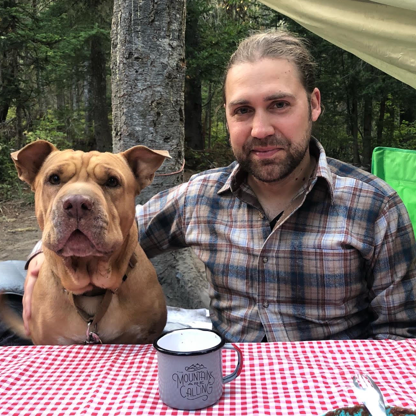
I’m the Associate Program Director for our OHSU Infectious Diseases Fellowship, where I’m fortunate to work with and learn from our Program Director, the amazing Erin Bonura. For the last five years, I have also directed our fellowship program’s weekly HIV curriculum. Additionally, I’m currently the co-director of our own IDSA MedEd COP’s IDWeek Clinician Educator Coaching Program along with Andrea Zimmer (who was featured here in Nov 2021!) and just cycled off our Mentoring Workgroup. Some of the best parts of my career are the longitudinal mentoring relationships I’ve had with trainees and junior faculty at OHSU and other institutions and opportunities to provide coaching or sponsorship. I’m very interested in integrating structural determinants of health concepts into medical education and have been teaching about this to multiple different learner groups over the last few years.
How did you get interested in medical education?
I started tutoring 1st-year medical students as a 2nd-year medical student and loved being part of those lightbulb moments that support another’s growth. When I started residency. I was lucky to be placed in a firm at BIDMC with two amazing medical educators, Robert Shmerling and our MedEd COP’s own Wendy Stead (our featured educator of Oct 2022!). Wendy was also my residency advisor, and in Wendy, I saw an example of someone I wanted to be like (I’m even reading her Featured Educator profile as I write this to help make mine better!). I tried to convince myself to pursue a K and research career in fellowship, but I think the amazing educators I was surrounded with in the UCSF ID Division reminded me by their example that this was my real love, and so I came back to the medical education career path.
How have you integrated medical education into your career?
I try to find and center the educational components in the diffuse array of work I do. Ideally, my work as an educator and mentor is happening when I’m interacting with primary teams, writing consult notes, working on practice guidelines, writing book chapters, leading quality improvement projects, and collaborating on research projects and not just when I’m rounding, giving talks, and designing curriculum. I think this gives me a niche in these other activities, and I hope the focus on communication, information processing, and inspiration makes me more effective. I also teach outside the traditional ID/IM/SOM settings, which has helped some of the interdisciplinary collaborations below develop and grow.
You have led some important initiatives nationally and at your institution (IDSA Clinician Educator Coaching program, implementing social determinants of health into the fellowship curriculum). Tell us about some of the challenges and successes of these various initiatives.
One of the challenges in work focused on mentoring/coaching as well as structural determinants of health work is that for it to be effective, it involves a lot of different people’s time – and no one has enough time. Academic medicine hasn’t prioritized mentoring and structural determinant work by supporting people to do it, and so this creates barriers to sustainability and growth. As a concrete example, optimally implementing and assessing certain educational elements of our structural determinants of health curriculum requires core faculty time, so something like the ACGME walking back the FTE support recommendations for subspeciality fellowship core faculty represents a barrier to this process in our program.
But this is work worth doing, and there are successes. Part of creating a structural determinant of health focus for our fellowship program has been revising how we evaluate and recruit applicants. Over the last couple of years, I’ve worked with Erin Bonura as we implement a holistic review process that attempts to recognize the way structural determinants impact our applicants. We interview a different group of applicants and rank them differently than we used to, and I think this fundamentally changes our program as a whole. We are starting to see our fellows suggest ways to better incorporate structural determinants of health into our educational sessions or bring up these frameworks on rounds. I think this is one of the downstream consequences of how this holistic review process impacts our curriculum.
The Clinician Educator Coaching program is great partly because it allows a very needed process in junior faculty coaching to happen with a limited time investment by our incredibly busy coaches and mentees. I think the feature enhances its potential for sustainability and growth, which is one of the reasons I am very excited to be part of the leadership team. One challenge for this program which I hope we can improve in the coming years, is increasing all the types of diversity present in our coaches and mentees so that this program represents the learners and patients we serve.
Interdisciplinary collaboration is an important focus of your clinical and educational work. Can you share with us how you have managed to develop these collaborations?
I think it is essential to care about the success and impact of the work more than who gets credit for the work. For me, also looking for ways to mentor and sponsor in these activities has helped create more successful and enjoyable collaborations and represents an example of integrating that educational focus we discussed above. I think it is essential to value diversity and how different voices, including trainee and nonphysician voices, improve projects. The OPTIONS-DC care model I’ve been involved with developing at OHSU is a good example of an interdisciplinary clinical program that wouldn’t be half as effective if it had been an ID faculty enterprise instead of developed and led by our ID/OPAT nurses, addiction medicine social workers, and patient peer mentors. Lastly, I think it is important to see structural determinants everywhere and how they impact the priorities and view of the “success” of my multidisciplinary collaborators. I’m trying to learn to do this better, but I think interdisciplinary collaboration often gets bogged down when structural determinants create a lack of alignment. Focusing on these determinants rather than the individual people who aren’t doing exactly what you want is likely far more productive as well as more accurate.
What has been one of your biggest challenges as a clinician educator?
One hundred percent managing my time and bandwidth. I like a lot of things and have intentionally chosen not to pick a niche since I’ve defined my medical educator niche as applying to everything, and like many of us, I have a hard time saying no. This has negative consequences as I’ve had challenges in my ability to move projects forward, disseminate work and adequately provide mentorship. There are many structural reasons most of us don’t have enough time as well (not just our questionable bandwidth decisions!), but knowing how to address those as an individual can be challenging and may require collective action from our educational community.
What advice do you have for someone who is starting a career in medical education?
You and your work are incredibly valuable, and that value extends outside the traditional domains of what constitutes “educational work.” It is easy to be made to feel that you need to do more things or do different things to prove your worth, but that has led me to be far less happy and effective than when I’m thoughtful about identifying the elements of educational work that I love and find valuable and then focusing on doing those things. I think at least annually re-evaluating my time commitments and things I am involved in is helpful, and I encourage making time to do this reflectively and honestly. Pursuing longitudinal mentorship relationships and focused coaching interactions for yourself can greatly support the above. I find it hard to see and honestly reflect back on some of the above for myself, and the mentorship of Andy Luks, Wendy Stead, Brian Schwartz, and Erin Bonura, amongst others, has been tremendously helpful in my own career development. In this vein, sign up for the IDWeek Coaching Program next year if you haven’t done the program yet – my experience with David Riedel as my coach was very impactful!
What other innovative educational program or process are you most excited about currently?
Despite some of the above-mentioned barriers, I'm excited to continue expanding the integration of structural determinants of health content into our fellowship and institutional training programs. As part of this, I’m hopeful we can create new opportunities for community-based engagement and advocacy for our fellows as we broaden the understanding of what fellow “academic projects” can look like and the impact our fellows can have on their communities. Lastly, and then I’ll finally stop typing, I’m motivated to continue working towards increasing the diversity of academic ID physicians we retain, mentor, and promote through increasing the diversity in the IDWeek Coaching Program, including by cycling off the leadership team myself at some point in the not-too-distant future to elevate and support others and the fabulous leadership they will provide in this work.