
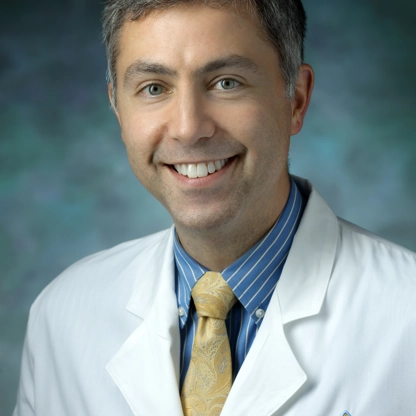
I've been the director of the Johns Hopkins ID fellowship training program since July 2015 after having served as the associate director beginning in January 2010. I've served as the Chair of the IDSA training program directors’ committee since October 2019 - my term ends at IDWeek 2021. I'm also the current Chair of the IDSA Medical Education Community of Practice IDWeek Workgroup - that term also ends at IDWeek 2021. I'm an associate director within the Osler Medical Housestaff Training Program, focusing on faculty engagement and house staff coaching.
How did you get interested in medical education?
That seed was planted long ago by the many incredible teachers from whom I've had the privilege of learning. My fellowship program mentor, the incomparable Dr. Wendy Stead from the Beth Israel Deaconess Medical Center, helped move that interest from seedling to firmly planted tree. Watching her improve the lives of her learners and her patients through individualized, relationship-centered teaching and care was inspirational. She remains a role model and paragon of personal and professional excellence to which I continue to aspire.
What strategies have you used to transform your medical education work into scholarship?
Dave Kern's seminal text "Curriculum Development for Medical Education: A Six-Step Approach" is a must-read for anyone interested in med ed scholarship. Its thoughtful, comprehensive approach empowers educators to bring their curriculum innovations into existence in a way that benefits learners and the med ed community at large. I can't think of another med ed scholarship resource with the same return on investment. It's fantastic!
What are some of the most rewarding aspects of medical education?
I have experienced - and will continue to experience - rejections, and receiving funding for med ed roles and projects can be a daunting task. Overcoming these challenges is never easy. I've found that continuing to put oneself out there - both for me and for mentees and advisees with whom I've worked - is an approach that often meets with success. Finding a mentor and advocate to help navigate these and other challenges can be really helpful as well.
You have led some faculty engagement and development initiatives. Can you briefly describe some of those initiatives?
Joining the Med Ed Community of Practice has provided an excellent opportunity to work alongside incredible, passionate educators on projects such as a webinar + small group discussion on best practices for (med ed) abstract review, a chalk talk (podcast panel discussion) on effective moderation of an IDWeek session, best practices for fellowship program virtual recruitment, and a workshop on Curriculum Development for Medical Education: A Six-Step Approach. Each of the first three is archived for review, and we hope to continue to offer med ed workshops at future IDWeeks!
## What innovative educational program or process are you most excited about currently?
For IDWeek 2021, the submitter of each med ed abstract was provided with feedback on their abstract. This is the first time that's happened! Now that the abstracts selected for presentation at the meeting have been assembled, we look forward to studying that process to learn what worked well and where we can improve in the future. We plan to use that feedback to inform our plan to provide feedback on every abstract submitted for IDWeek 2022. Stay tuned!
What strategies do you utilize to engage learners in the field of ID?
I find infectious disease exciting because of the range of topics it touches. The field of ID interacts with so many disciplines, including basic science, microbiology, clinical medicine, diagnostic reasoning, administrative leadership, medical education, infection prevention and control, antimicrobial stewardship, hospital epidemiology, public health, and global health. So, one can pursue so many different paths after completing training in infectious diseases! The ongoing COVID-19 pandemic has truly demonstrated the importance and value of all types of ID clinicians everywhere.
You currently chair the IDSA Training Program Directors Committee and have spearheaded the incorporation of scholarly work into national PD meetings. Can you speak to that process?
The PD community is filled with such incredible, thoughtful, and dynamic educators and leaders. My predecessor as PD Committee Chair, Emily Blumberg, had the innovative and brilliant idea to organize the annual PD meeting at IDWeek around a theme of relevance to our work as PDs. We've worked to synthesize the content from the small group discussions at those meetings into white papers to serve as a resource for ID PDs and hopefully PDs in other specialties as well. We aim to do the same for this year's meeting, for which the theme is Diversity, Equity, and Inclusion in our work as PDs. I can't wait!
You also currently chair the IDSA Med Ed Community of Practice IDWeek Workgroup. What are some of the medical education events you are excited about at IDWeek 2021?
Thanks to the leadership of Brian Schwartz and the tireless contributions of so many people, med ed has fully arrived as a foundational component of each IDWeek meeting. This year there are symposia on re-envisioning ID curricula through a non-oppressive, anti-racist lens, developing and maintaining ID expertise through deliberate practice, and the integration of inclusive language into med ed and patient care. And that's not all! There are MTP sessions on equity in assessment and optimizing your ID case conference toolkit, plus truly incredible oral abstracts and posters. It's a spectacular portfolio. I look forward to (virtually) seeing you there!