
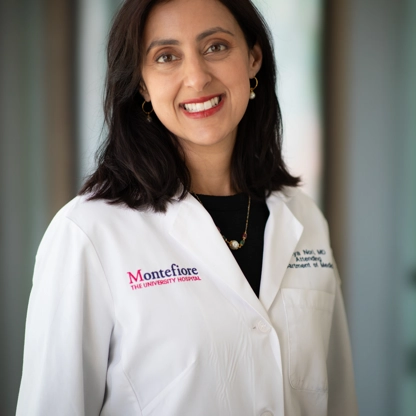
My passion is to educate all types of learners on antibiotic use best practices, pandemic preparedness and emerging infections. I love to integrate educational technology, like smartphone apps and EMR decision support tools into the day-to-day functions of a clinician. As stewards and ID providers, our role is to support the frontline and make their lives easier with our innovations. I also consider myself a "friend-tor" to several fellows and junior faculty. My #1 advice to them is: find your passion and go all in. Immerse yourself in it, learn as much as you can, and strive for the best.
How did you get interested in medical education?
Medical education seemed to be a natural fit for my outgoing and friendly personality. Med students and residents have told me that I'm approachable, relaxed, and create a lower-stress environment. I hope I've inspired young doctors to explore medical education as a career path. The joys of teaching medicine and ID increase personal connections and can help mitigate things like fatigue and burnout, in my humble opinion.
What strategies have you used to transform your medical education work into scholarship?
A common mistake we all make at the start of our med-ed careers is to implement an educational innovation without considering the best way to measure its impact. Thankfully, in 2016, my division chief, Liise-anne Pirofski, connected me to Wendy Armstrong. Wendy provided me with excellent advice about curriculum design, which was something like, "before you jump in, make sure you've created something that is measurable, and evaluable. The goal is to scientifically measure outcomes from your innovation to prove that it worked." Thanks to IDSA and the IDSA Med-Ed COP, I've been fortunate to work with pivotal leaders in ID Med-ED, like Vera Luther, Wendy Stead, Brian Schwartz, and Jennifer Spicer. I've also learned a tremendous amount working with IDSA learning specialists, like Ashleigh Logan. Another strategy I've learned and try to impart on others is to never underestimate an awesome set of learning objectives, which can drive the success of your entire educational program.
What are some of the most rewarding aspects of a career in medical education?
The most rewarding aspect for me is to help foster the career development of others. Perhaps it starts with one lecture invitation from mentor to mentee, which may become a sustaining educational intervention, a new curriculum, a research project, and eventually a publication or series of publications establishing your mentee as the authority in that particular area. Nothing is better than sharing in that individual's success and helping them actualize their potential as an educator and innovator.
What are some challenges you’ve encountered as an educator and how have you overcome these challenges?
As a new educator, I wish I had more tools to get started and harness my enthusiasm for teaching. I required significant guidance to help put me on the right path (I was sort of all over the place). Thankfully, within a few years of becoming ID faculty, I found the IDSA MedEd COP, which provides educators with a solid foundation in medical education and the tools to take it to the next level with educational scholarship.
How have you incorporated your work in antimicrobial stewardship into your work as an ID educator?
Antimicrobial stewardship and medical education is the perfect career marriage. Stewardship provides so many avenues to develop your skills in medical education. Being a better educator makes you a better steward and vice versa. I feel that all antimicrobial stewardship training should include fundamentals of medical education, curricular design, and assessment. It's all about taking your game to the next level. Thankfully, the IDSA Antimicrobial Stewardship Curriculum Workgroup has provided me an outlet to do just that. In the process, I've received mentorship from exceptional educators like Vera Luther, and others.
What are some of your favorite strategies for incorporating inter-professional education into your practice as an ID educator?
My division chief, Liise-anne, says "meet people where they are." In stewardship, this may mean "put yourselves in their shoes as a learner." Therefore, when I provide feedback to learners on the phone or on the wards, I try to use examples they can relate to. This may be different for the medical intern vs. the ED physician assistant, vs. the fellow in the ICU. Negotiation in stewardship can be more successful when we recognize an individual's unique experiences. The IDSA stewardship curriculum does a great job of teaching this and other behavior stewardship strategies, in my opinion.
What advice do you have for someone who is starting a career in medical education?
Join the IDSA Medical Educator's Community of Practice ASAP. Never hesitate to reach out to those with aspirational careers in ID Med-Ed. These are some of the nicest folks around who will always take the time to provide valuable advice. We are all here because someone took the time.
What other innovative educational program or process are you most excited about currently?
Our local chapter of IDSA (IDSNY) hosts a pre-meeting workshop every year since 2013 for trainees and junior faculty seeking careers in stewardship, hospital epidemiology, and public health. I've been fortunate to serve on the planning committee since fellowship. This year, we're hosting a high-powered career panel and mentor/mentee workshop featuring prominent IDSA members. It's going to be very memorable!