
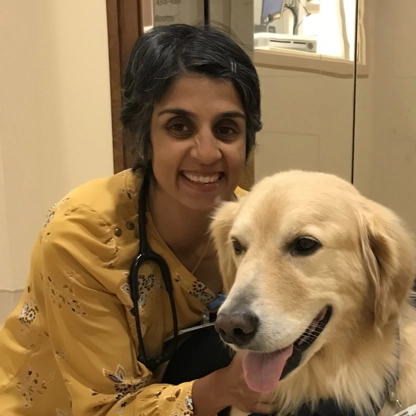
Tara Vijayan currently serves as the Medical Director for the Antimicrobial Stewardship Program, Associate Director of Scientific Foundations of Medicine, Director of the Health Equity Pathway for the Internal Medicine Residency, and Director of the Medical Education Pathway for the UCLA Multicampus Fellowship in Infectious Diseases. Her passions are health equity, implementation science, and combating the global threat of antimicrobial resistance. Outside of UCLA she loves doing puzzles, reading, and hiking with her two wildlings, her husband and her 11-year-old hound.
How did you become interested in medical education?
A few of my role models during training were Chip Chambers, Harry Lampiris, Harry Hollander and Lisa Winston. They were well known at UCSF as "master clinicians" and I absolutely loved hearing them walk through different clinical problems out loud- not just differentials, but really how they approached management. I knew early on that the only way I could approach such mastery was through deliberate and reflective practice. I did not fully appreciate the concept of medical education as a "specialty" in and of itself until much later. My only real concept of being an educator was as the "guide by the side." I cherished my own guides and hoped to slowly become one over time.
How do you transform interest in medical education into a career?
Really it was through the help of my current boss, Judy Currier. When she 1st offered me this job, she made it clear that the role initially would be one of a clinician-educator, big "C little e." I was at the time a community-based clinician, again still just focusing on my own practice of medicine. But Judy encouraged me to explore various roles in education, to place the "E" on equal footing as the "C." Among many things, she advocated for me to take on the role of the co-chair of our microbiology/immunology block in the pre-clinical curriculum. Despite having a completely different career trajectory as a renowned HIV researcher, she really helped me carve out my own niche.
What opportunities have you sought out as a medical educator to further develop your skills?
I did take part in a medical education fellowship to become more familiar with the theory and the language of medical education. I did this on my own time during my first two years here at UCLA. I have taken part in some really fantastic CMEs, including an ACGME-UCLA interactive session on developing faculty competencies in assessment. I have been fortunate to have been supported to take part in several national conferences, including the NBME Invitational Conference for Educators.
How have you transformed your medical education work into scholarship?
I have to thank Chris Graber, our fellowship program director, for really providing both moral support and mentorship in this process! Medical education scholarship is hard work- much harder than anything else I have published. Some of the work I have done is creating an antimicrobial stewardship module for 2nd-year medical students and surveying program directors on the effectiveness of our current ACGME milestone-based evaluations. But perhaps my greatest effort was a paper I started when on maternity leave with my 2nd baby in 2016 on how to integrate social determinants of health, particularly discrimination, into a pre-clinical micro curriculum. It took 4 years to publish!
What are some of the most rewarding aspects of your career as an educator thus far?
There is no question that being recognized for my work has been incredible. When I received my first Golden Apple from our medical students, I definitely had a Sally Field moment- they really like me! But in all sincerity, the single best thing to have happened to me is the incredible people I have met and the deep friendships I have formed through my journey. This was always true for me but has only deepened as I took on this path. One such highlight was when I was invited to take part in the Healer's Art course here at UCLA and found out that the 8 other folks in the group were close friends (and peer mentors) I had made over the last 5 years. It was such a special moment.
What are some challenges you've encountered as an educator, and how did you address those challenges?
Hands down getting paid for the work I do, which has everything to do with the way physicians are reimbursed. I had very little "protected" time for a long time. During the early part of my career, I would spend most of my week doing clinical work or catching up on my clinical work- because that was what paid my bills. And all the other things I loved (writing, creating curricula, etc) I did whenever I could. Even for someone who loves clinical medicine, there was no question I was approaching a hard and dark place for a bit. Things are better- I have space to tuck away some of the small frustrations I experience with each component of my job and I am better compensated for my work. I persisted!
What are some ways you've promoted diversity, equity, and inclusion in your work as an educator?
Equity was always part of my life's work as a physician. But as an educator, soon after arriving at UCLA (now 6 years ago!), I was able to connect with Christina Harris, who is now one of my dearest friends and a peer mentor and we began to create interactive seminars on understanding biases in medicine. Christina and I have since written a paper on teaching concepts of discrimination (along with the tireless Nico Cortes-Penfield) and have created a working group on equity research during the Covid-19 pandemic. Christina has been my support as I lead our fellowship through holistic review and has advocated for me to take on the role of co-director of the health equity pathway.
What innovative educational program or process are you most excited about currently?
I am fundamentally a clinician and part of what I value in teaching is clinical decision making. And the breadth of clinical decision-making includes nuanced discussions on race and racism and how cognitive biases play a substantial role in our thought processes. This has been my focus throughout the continuum of education, from UME to GME. In many ways, I feel I have come full circle- as someone who studied post-colonial literature and theory in college, I can now start to re-frame the theory I learned over 20 years ago (yikes) in a deeply profound way in medicine. It is so humbling and gratifying to be able to put all that I value together, in my everyday work, and in my deliberate practice.