
Community of Leaders nomination process
As a Leadership Institute alum, you have the opportunity to help future participants understand the impact of the program. The Community of Leaders nomination process allows members to identify and endorse prospective applicants through a brief nomination form. Nominees are invited to apply; do not need to submit a separate recommendation letter; receive recognition of their nomination during application review; and, if accepted, receive $250 off the program registration fee.
Can we feature your Leadership Institute story?
We would love to hear your story! Alumni testimonials help showcase the impact of the program and inspire future participants. Your testimonial may be featured in Leadership Institute and IDSA marketing materials, including websites, publications, social media, email communications and presentations.
Joshua D. Hartzell, MD, MS-HPEd, FACP, FIDSA
Dr. Hartzell is a member of the faculty for the IDSA Leadership Institute. He is a board-certified internist and infectious diseases physician. He served 25 years in the United States Army, including a deployment to Afghanistan as a battalion surgeon with the 82nd Airborne Division, before retiring in 2023. He has held multiple academic roles including assistant dean for faculty development at the Uniformed Services University and program director for the National Capital Consortium Internal Medicine Residency. He completed a Master of Science in Health Professions Education at the MGH Institute of Health Professions, where he continues to teach leadership development. Dr. Hartzell’s current academic interests include leader and faculty development to empower leaders to create positive change in their spheres of influence at work, home and communities.
Hello everyone!
Hopefully, you enjoyed an amazing summer. The past couple of months have been packed with learning! I had the opportunity to give a talk on “delegation” in September to a group of medical education leaders, and it reminded me of how important the topic is and how little we are taught to delegate. It also makes we want to sing, “Delegate good times, come on!”
Here is the seven-step process for delegating I shared with the audience.
- Ask: “Should I delegate?”
Is this a job that only you can do? Is this someone else’s work? How could you use this task to invest in someone else’s professional development? Also consider: Could this task be automated? Could AI perform the task? - Identify the right person for the task.
Who generally would do this job? Who has time to do the task based on the deadline? Who is overwhelmed with work that you should avoid delegating to? - Define expectations.
Be clear about what is expected. Define what success looks like. Set specific deadlines. Establish agreement over what success is, and the process. - Delegate authority.
When you delegate, give the person you delegate to the authority to make decisions. They should not have to run every decision by you. This also helps to avoid micromanagement. - Provide the support and coaching necessary.
Proactively coach and provide insights that set the person up for success. Be available for challenges but not always in their face. - Avoid micromanaging.
Give them the task and let them figure out how to do it best. Establish predetermined check-ins so you can keep tabs without frequent intrusions. Set a must call list for things you want to know about immediately. - Give and share credit.
Recognize your people for a job well done. Don’t steal credit for their work.
Here is a short article that gives 77 ideas about delegation for those who want to do more reading.
Invest in people: Mentor, coach and sponsor
You all know I love investing in people. When we invest in people, it is good for them and for our organization. It also builds incredible influence. I want to share an article from Family Medicine, which is one of the best articles I have read on the topics of mentoring, coaching and sponsoring. The paper points out main actions that a sponsor should take. Importantly, as leaders we should know what our people are good at and then look for opportunities to sponsor those we lead. Once we sponsor them, we should offer coaching and help so they can be successful.
One strategy I like to use is to tell people I am leading to let me know if there is an opportunity they want so that I can sponsor them. As leaders, we will not be aware of all the opportunities, so encourage your people to communicate these opportunities. I know many of you have great people that work for you. Be explicit and tell them you are willing to sponsor them.
“No” is a complete sentence!
Are you still struggling with saying “no” and taking on too many things? This podcast is a short but excellent resource on setting boundaries and being able to say “no.”
The Brave Enough Show for Women Physicians: Episode Four: Saying No to Others to Say Yes to Yourself
Lead well, my friends!
Josh
Coaching corner with Julie Trivedi, MD, CPCC, FIDSA
Julie Trivedi, MD, CPCC, FIDSA, is a board-certified infectious diseases physician, mom of two girls and a certified professional Co-Active Coach. She is actively involved with the Society for Healthcare Epidemiology of America and is currently serving as an elected councilor on the Board. She has completed the Co-Active Training Institute Leadership Experience, was part of the IDSA Leadership Institute Community of Leaders program in 2022 and serves as the lead coach for the Rising Leaders Program. She actively coaches women and physicians in medicine away from burnout and overwhelm and toward fulfillment and joy. Dr. Trivedi’s interests include faculty and leader development through mentorship and professional coaching.
The big, scary world of emotions
One of the most insightful interactions with my coach was when she introduced me to an emotion wheel. This tool singlehandedly can influence how we show up in our relationships and our commitments (both personal and professional). When we are unaware of what we are feeling inside, we are more likely to be reactive to the situations around us. The opposite is also true: Being aware of our emotions and overall state allows us to respond to the situations in which we find ourselves.
-
Scenario
It’s the monthly faculty meeting. Your clinical chief is presenting data on division metrics, such as relative value units for various service lines, different clinics and the division as a whole. Everyone has been working so hard — fellows, faculty and APPs, with increasing consult volumes across the board. The clinical chief validates all the effort everyone has been putting in. And then there’s an ask: an institutional initiative to reduce the time between hospital discharge and outpatient clinic follow-up, with a specific request for everyone to add on an extra clinic session in their template.
You notice yourself feeling irritated — angry perhaps — and immediately blurt out, “That’s ridiculous. We are all so overworked; asking this of us is ridiculous, and I’m not doing it.”
You notice the room go quiet. When you look around the room, you see that others are nodding their heads ... and yet, no one else says anything.
The faculty meeting is nearly over, and you quickly gather your belongings to head to the hospital to begin seeing patients.
Later that day, you receive an email from your clinical chief asking you to meet with them specifically to address your behavior in the meeting.
-
“You can only manage what you measure”
This is a famous quote in the operational management space.* If we want to change our caloric intake, then we need to monitor what our caloric intake is. If we want to improve patient outcomes, then we need to be able to measure those outcomes. While we tend to this type of measurement quite well regarding professional tangibles, we tend NOT to do this when it comes to our emotional state.
*Although the quote seems to refer to the benefits of measuring progress toward goals and performance outcomes, it is a clip from a larger quote by Peter Drucker actually referring to the dangers of measuring everything, especially when it may be harmful to the organization to do so. -
Emotional thermostat or thermometer
Let’s break this down into two components:- Your emotional temperature (on average and at any given point in time)
- You as the thermostat, not the thermometer (being able to intentionally shift the emotional temperature of a room).
Feel free to refer to the Feelings Wheel as you go through the following exercises.
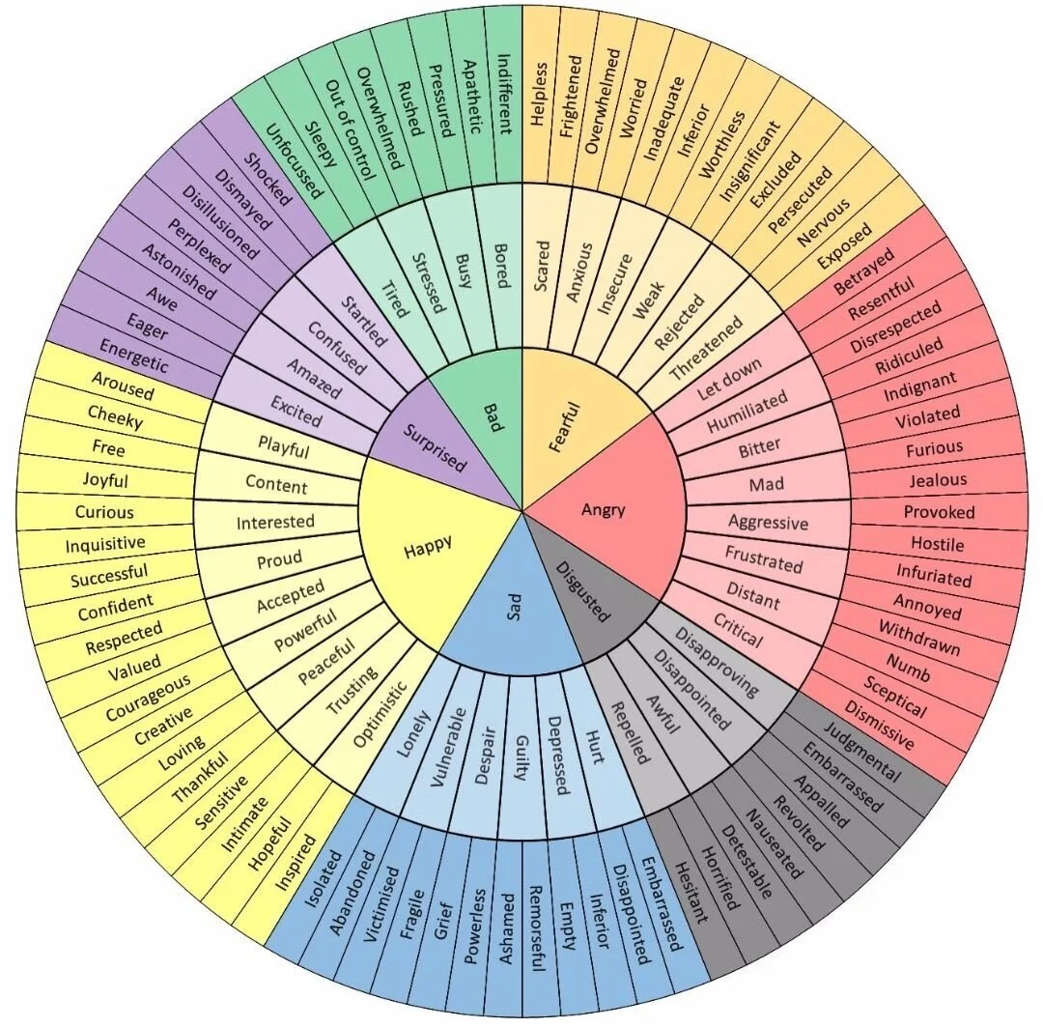
Emotional temperature
How often are you aware of what you are feeling? Your emotions may change throughout the day. You may wake up excited for your day, only to hit traffic and be late for a presentation, leading you to feel stressed. However, your presentation goes really well and you feel excited with all the positive feedback. In the afternoon, you discover a patient experienced an adverse outcome because of a medical error, leading you to feel guilty. After a busy commute, you get home, accidentally trip over some toys and get upset with your family.
What are the emotions you tend to experience most often? Do they tend to be positive or negative? Your emotional temperature is an average of your most commonly experienced emotions.
You may say, “Well, Julie, I’ve always been a little cynical with everything in life. Doesn’t mean I’m not happy. Maybe this is just the way I am.” Or you may say, “I’m usually in a good mood. Nothing seems to phase me. Maybe I was born this way.”
While there may be an element of truth to those statements, I’m here to tell you that you can directly influence your emotional temperature.
Emotional thermostat
Let’s explore what it means to be the thermostat. In our homes, when the temperature goes above or below the set point, either the heat or air conditioner kicks in to bring it back. Being an emotional thermostat requires us to first be a thermometer to determine the temperature in the room (tense, relaxed, playful, etc.) and then, from there, use our language (verbal and physical) to create a shift toward a more effective state.
-
Debrief of the scenario
Let’s reflect on these questions as we revisit the scenario at the beginning of this article.- What was the predominant emotion you were experiencing BEFORE the clinical chief announced the change in clinical expectations?
- How did your emotional temperature change with the request?
- What was the emotional temperature of the ROOM with the announcement?
- What was the emotional temperature of the ROOM after you said your part?
- Are you pleased with your response in the meeting?
- If a colleague reacted this way in the meeting, how would you approach them afterwards? What might you say or do to shift their emotional state?
- What is the opportunity here? Especially for personal accountability?
- How would we like to shift the emotional temperature of the division in light of this news (i.e., more collaborative, encouraging, hopeful, optimistic, etc.)? What would you change about your tone or body language?
- How do you want to approach your meeting with the clinical chief? A template that can be helpful when we have contributed toward creating tension or escalating the temperature is the following:
“What I learned…”
“What I’ll do…”
For example, “What I learned is that hearing the request upset me and I reacted in an unprofessional way. What I’ll do is acknowledge the impact of my reaction and be a better steward of my emotions in the future.”
-
Call to action
Through regular reflection, we can become more attuned to our emotional state. We can become aware of our tone, our body posture and our energy in various emotional states.
Ask yourself, “Will this emotional state get me closer toward my goals?”
If the answer is “no,” ask yourself, “What is a more resourceful emotional state?”
Identify a state you want to experience — calm, curious, collaborative, appreciative, playful, kind, etc. — and ask yourself the following:
“If I want to be ______, what does that feel like in my body? What would my body posture look like? What would my thoughts be like? How can I tap into this emotional state more often?”
This is actually the underlying premise of the famous quote “BE the CHANGE you wish to see in the world.”
Wishing you all a happy, healthy fall, and it was great seeing you at IDWeek!