
IDSA Leadership Institute Leadership Bolus
Issue 20: August 2026

Attend our next IDSA Leadership Institute alumni webinar
Continue building your Leadership Institute network by joining us for an interactive alumni networking webinar Thursday, Aug. 27, 1-2 p.m. ET.
This 60-minute session is designed to connect Leadership Institute alumni across career stages through facilitated small-group discussions. After a brief welcome and interactive discussion, participants will choose one of three career-focused breakout rooms to exchange ideas, share experiences and learn from fellow alumni.
Breakout session topics:
- Clinical leadership & career advancement
- Research careers & grants
- Teaching in medical education
Meet the contributor, Retired Col. Joshua Hartzell, MD, MS-HPEd, FIDSA
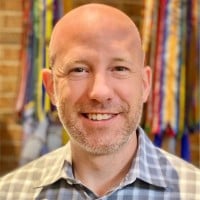 Dr. Hartzell is a member of the faculty for the IDSA Leadership Institute. He is a board-certified internist and infectious diseases physician. He served 25 years in the United States Army, including a deployment to Afghanistan as a battalion surgeon with the 82nd Airborne Division, before retiring in 2023. He has held multiple academic roles, including assistant dean for faculty development at the Uniformed Services University and program director for the National Capital Consortium Internal Medicine Residency. He completed a Master of Science in Health Professions Education at the MGH Institute of Health Professions, where he continues to teach leadership development. Dr. Hartzell’s current academic interests include leader and faculty development to empower leaders to create positive change in their spheres of influence at work, home and communities.
Hello!
I hope that you are enjoying your summer and recharging your batteries! The past couple of months have been filled with many leadership lessons for me. It seemed like everywhere I turned, I was finding something valuable. I will share a few of the top lessons here.
As you are getting these leadership emails and finding your own lessons, are you sharing them with your team? How often do you send your team ideas and resources to lead more effectively? You could send a monthly summary email or send things intermittently. This has two specific impacts for your organization: It shows an ongoing investment in your team’s development, and it emphasizes a culture of leadership development.
How many of you are good at multitasking? Well … the data would say none of us are!
Multitasking is not really a thing. Instead, we are task switching — and every time we do that, we decrease our productivity and effectiveness. I would recommend checking out this short article published in Psychology Today.
Two strategies I find helpful:
- Time blocking
a. Cal Newport, who wrote the book Deep Work, talks about how he schedules his day in this short article. I recommend setting aside 1-2 or 2-3 hours based on the task you are trying to complete. How many of you have put off something for weeks, only to find that when you sat down for a dedicated 60-90 minutes, you were able to knock it out? The key is proactively setting aside that time and avoiding putting it off. If you want to learn more about "deep work", check out this podcast.
b. Pomodoro Technique
i. This is a classic strategy that uses shorter periods of time.
ii. Spend 25 minutes on a task, take a 5-minute break and repeat three more times. After four periods of 25 minutes, take a longer 10- to 20-minute break.
c. Know your time
i. When do you do your best work? For me, this is in the morning, so I set aside my time blocks early in the day and use the afternoons for email and other less cognitively demanding work.
ii. If you have a busy clinical schedule, you will have to think about how to incorporate the above into it.
2. Schedule email
a. Set up time to check your email — and otherwise shut it off. If you are like me, the urge to check and respond to email is high. Shutting it off allows you to focus on the task at hand, especially if you’re time blocking as outlined above. You could have 3-4 times during the day that you set aside blocks to check and respond to email.
I will say there are exceptions to multitasking. I can ride my Peloton and watch a video or listen to a podcast. I can walk and hold a meeting at t
Are you getting your “exercise snacks”?
Someone introduced me to the idea of taking short breaks during the day to get exercise. I loved these and thought I would share them with you. Not only are these “snacks” good for your health, they might also help with your productivity. You can take an exercise break between your time blocks above.
Here are two articles on the topic:
- Why Even Small Amounts of Movement Can Transform Your Health – Lifestyle Medicine
- Exercise Snacks: 24 Ways to Fit in Tiny Bursts of Activity Throughout the Day | The Health Sessions
Do you have a cornerman?
I recently finished reading the book, Mattering: The Secret to a Life of Deep Connection and Purpose by Jennifer Wallace. The book highlights the importance of mattering in our lives and at work. It is well worth reading and the best book I have read this year. We know that mattering at work can help prevent burnout and motivate people. While not the point I want to emphasize today, I want to ask you to think about two questions: How do you help people at work know that their work matters? What are you doing to help people feel valued?
Ok, back to the concept of a cornerman. Boxers have a cornerman that helps train them, coaches them and guides them. In life, Wallace argues that all of us need a cornerman to face our challenges and reach our full potential. Who is always in your corner? Who always has your back? Who wants the best for you and helps you to achieve it?
Do you have a cornerman in your life? I hope you do — but if you don’t, consider who might be that person for you? Can you be a cornerman for someone else? Who can you support and help to achieve their full potential personally and professionally?
Leadership is hard, so having a cornerman — or a few of them — can help us reach our full potential.
Lead well, my friends!
Josh
Coaching corner with Julie Trivedi, MD, CPCC, FIDSA
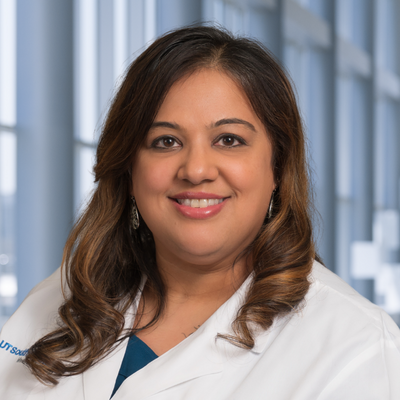 Julie Trivedi, MD, CPCC, FIDSA, is a board-certified infectious diseases physician, mom of two girls and a certified professional Co-Active Coach. She is actively involved with the Society for Healthcare Epidemiology of America and is currently serving as an elected councilor on the Board. She has completed the Co-Active Training Institute Leadership Experience, was part of the IDSA Leadership Institute Community of Leaders program in 2022 and serves as the lead coach for the Rising Leaders Program. She actively coaches women and physicians in medicine away from burnout and overwhelm and toward fulfillment and joy. Dr. Trivedi’s interests include faculty and leader development through mentorship and professional coaching.
Life’s a journey: What I learned on my six-day road trip to Wyoming and back
- The universe blesses us in its own timing.
- The universe blesses us in ways we may not understand at the moment.
- If you are OK with your choices, it’s OK if others are not.
- I can do hard things.
- Fear is designed to keep me safe. Keeping me safe means keeping me comfortable. Keeping me comfortable means staying with what’s familiar. Even if it is uncomfortable.
- There is a thrill and a beauty that is found in the unfamiliar.
- Uncertainty is where we grow.
- God speaks to us when it is quiet and we are not distracted.
- Strength is not given. It is built.
- Courage is not given. It is found.
- Love and kindness and compassion are always an option. So are judgment and anger and resentment.
- When we slow down, we see the world around us. When we move fast, we only think of ourselves.
- Expressing appreciation to others for who they are and what they do is what makes this world beautiful.
- Taking the time to talk to others gives us a glimpse into their lives. You never know what stories you will hear ... especially stories that may never have been shared with anyone else.
- Enjoying life comes when we no longer resist what happens and learn to be in the moment.
- Traveling by yourself puts you in direct experience with nature, your body, your thoughts and other people. There is no one else to distract or influence or override what you want — it doesn’t matter how much you love and enjoy the person you are traveling with; as women, we always put a lot of stock in keeping others comfortable.
- So much of our life is planned and predictable. Live life a little less planned.
- Be in the moment. Do not let future worries steal away current joys.
- Sometimes, we will be the first in our families to do things no one has done before. That means it’s imperative that you trust in yourself and in the journey.
I came back a different woman than when I was planning to leave for my trip. It’s hard to believe that a car accident on June 13 in which my SUV was hit and likely declared a total loss would result in me taking a Ford Mustang convertible on my road trip with no clear destination in sight. I was driving to an Ikebana flower-arranging class, just three minutes away from my destination on a sunny Saturday morning, when a car making a left turn across five lanes of traffic hit mine as I was almost through the intersection. I was stunned. I could see it all in slow motion. Seeing my light turn green. Having this clear thought that there were no cars in front of me and so I accelerated as I approached the intersection.
When I saw this white Audi coming close to my vehicle, my mind went numb in disbelief. Wondering what this person was thinking when they thought they could clear the intersection. My Apple Watch, having detected a crash, called emergency services. I was able to get out of my vehicle and then quickly got back in for safety. The fire trucks arrived and escorted us off to a gas station at the corner. The police then arrived to fill out a report. I was annoyed. Irritated. I was angry that someone else not paying attention led to my life being inconvenienced.
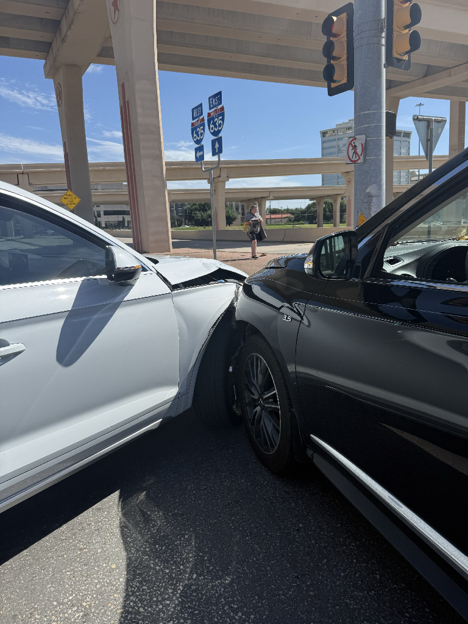
1: Car accident, June 13
I was able to drive my car home and parked it in my garage. The insurance company helped arrange for a rental car. I went to Enterprise and what was covered was a small compact type of vehicle. I knew there was no way I could drive that—especially not when I was planning to go on a road trip. The agent offered a lady before us a Ford Mustang, which she passed up in favor of a Jeep. When it was my turn, I asked if there were any other vehicles available besides the Nissan Versa — I was offered a small SUV and … the Mustang at a higher price. I had thoughts in my head about “the types of people who drive around in Mustangs” — certainly not me. And leaning into that, imagine my surprise and uncertainty when I found myself driving the convertible off the rental lot — at the same rate the insurance was offering to cover (#1).
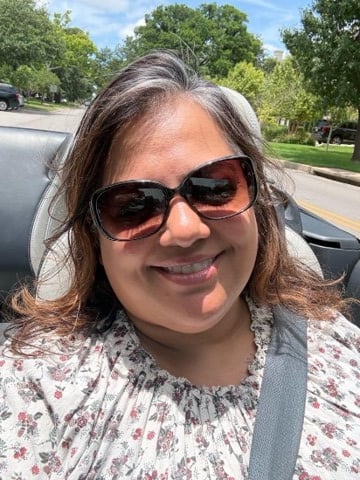
2: Me in the convertible, June 13
Later that day, I spent the evening with my significant other at an outdoor spa. We were on our way home around 11 p.m., driving with the top down, when I found myself being propositioned to race at a traffic light by two kids in their 20s driving a Corvette. My immediate gut reaction was to say, “No.”
Little did I realize how much that accident, and then driving the Mustang on a 2,000+ mile road trip, would change me. How it cracked me open. Over the next two to three days, I reflected on how much I had let fear rule my life. How I had chosen the safe, predictable path. The one promising stability and security under the guise of being responsible, practical, logical, reliable, sensible. And how much I had stopped myself from taking chances to be validated for all those qualities (#5).
When the accident happened, I wondered whether I should still go on my trip. Whether it was “a sign.” Whether the Mustang would be OK on the mountain roads I was possibly going to be driving through. All the thoughts. All the fears. All the worries. All the what-if’s. I chose to go anyway.
And now, let me tell you about this trip. I had been wanting to do a multiday solo trip when I made the decision to move to Dallas from Maryland in 2017. I wanted to drive through Tennessee and the Smokies and didn’t get a chance to do so due to the timing of the movers, etc. So, this desire to be out on the open road remained buried within me for the past nine years. Losing one of my best friends in April while he was on a road trip visiting friends spurred me on further — he always encouraged me to do bold things.
I did not plan this trip like I would plan a vacation with family. I packed a shoulder bag with seven days’ worth of clothes, a backpack with a journal and some books to read, and then some snacks and water. A few rules I lived by — I did not book any hotels until the day of. Each night, I planned my destination for the next day. I spent six days driving across the wide-open road from Dallas to Amarillo to Denver (two nights) to Saratoga, Wyoming, to Canon City, Colorado, and back to Dallas.
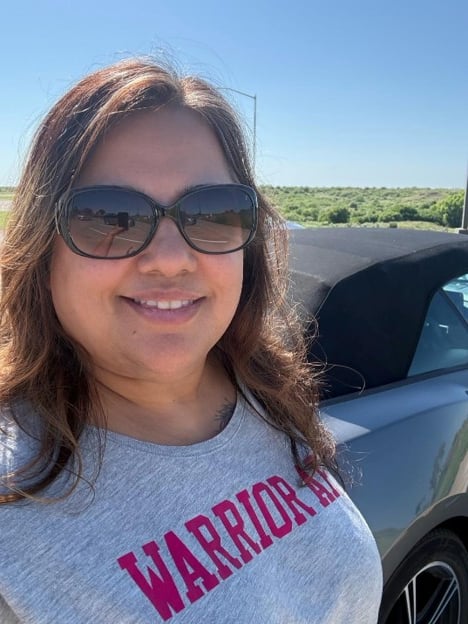
3: Rest stop in Amarillo, Texas
The day before I left, I dropped my crashed SUV at the collision repair place for an estimate. Just on appearances alone, there was a big chance my car was going to be considered a total loss — in which case, I’d be in the market to look for a new vehicle. Which I wanted … but didn’t want at the same time. I was two car payments away from owning my SUV outright, and now I’d need to consider my options. (#1, 2). I left on a Friday morning — it was Juneteenth. My parents did not understand my rationale for taking a road trip by myself with an unknown destination (#3), and I had to be OK with that. I drove five or six hours out to Amarillo and spent the night.
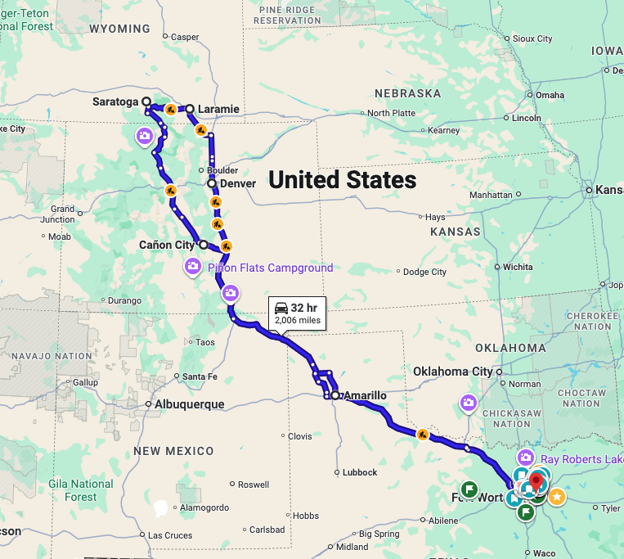
4: Map of my roundtrip journey
The next day, I left for Denver — to visit a friend who recently had a baby. The road from Amarillo to Denver is one of contrasts as it takes you through northeastern New Mexico — a long stretch of dry reddish-brown desert with stationary boxcars from a freight train no longer in service — to winding roads through lower elevations of the mountains, and then to a multilane highway passing through a large city. I arrived on Saturday, June 20, and decided to spend two nights with my friend — just slowing down and helping her with her newborn.
I left to go north June 22, leaving Denver to eventually land in Saratoga, Wyoming. I was nervous. I’d never been to Wyoming. I didn’t know what to expect. I had planned to drive through Medicine Bow National Forest along the Snowy Range Highway on my way to Saratoga. As I entered Wyoming, the roads again cleared out, with my car being the only one for miles at a time. The grass was green. The mountains loomed in the distance. And I broke open. I cried — releasing my fears and just talking to God. Asking God for the strength to navigate all the uncertainty in my life. To which He replied, “Strength is not given, it is built.” I then asked for courage and was met with, “Courage is not given. It is found.” (#9, 10). I landed in the town of Laramie (home to University of Wyoming) for a delicious lunch at Sweet Melissa’s cafe.
About an hour later, I made it to Medicine Bow, stopping at the visitor center to pick up a few little souvenirs and a map of the park. I drove through the mountains, noticing the changes in the treeline as I climbed higher, eventually reaching an elevation of 10,800 feet as I looked out all around me. It was windy, about 61 degrees, with many large patches of snow on the ground. I drove onward to Mirror Lake, taking my time to sit out on a rock and notice the rippling of the water in the wind. Noticing others who were fishing and yet others out on a kayak. I took a short walk to Lake Marie and marveled at these two beautiful alpine lakes, reminding me of my time in Banff and Yoho National Parks, Canada (#16). I learned about the history of the region, with many prisoners from Germany and Italy held in camps in this region during WWII.
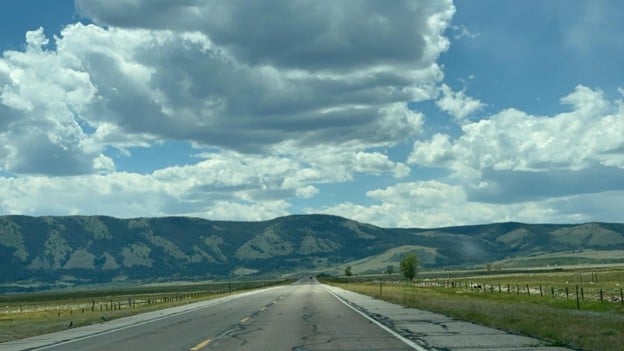
5: Road to Medicine Bow National Forest, Wyoming
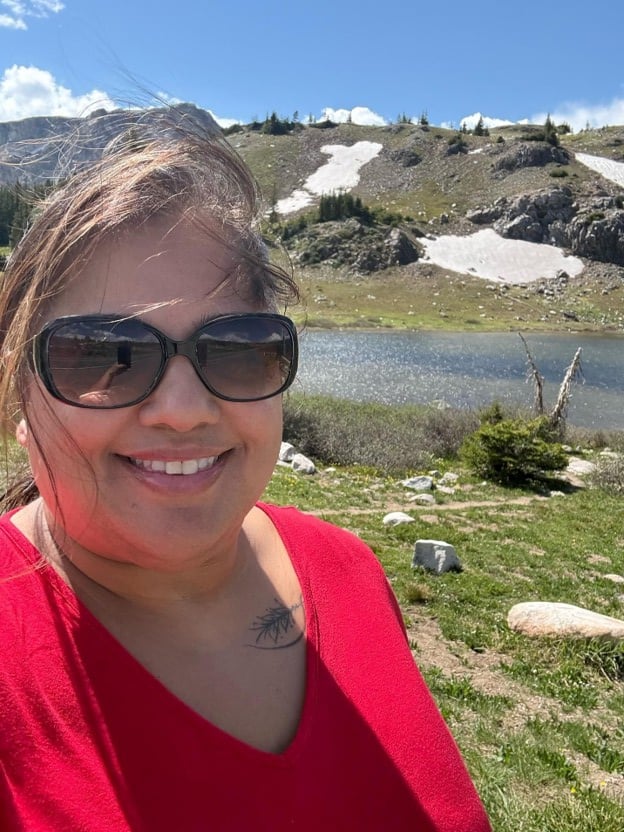
6: Snow in the Snowy Range Mountains, ~10,000-foot elevation
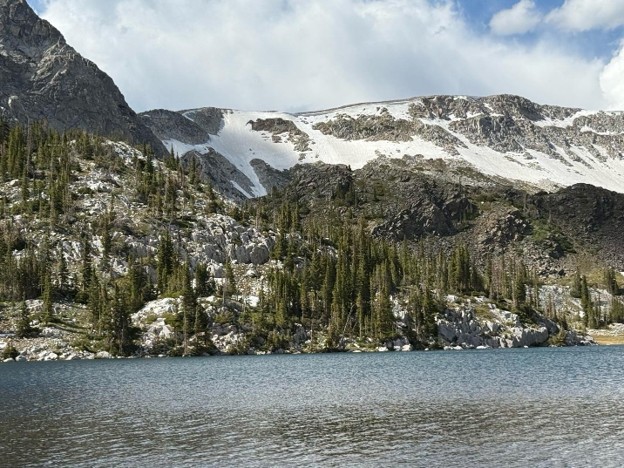
7: Snow on the Snowy Mountains overlooking Mirror Lake
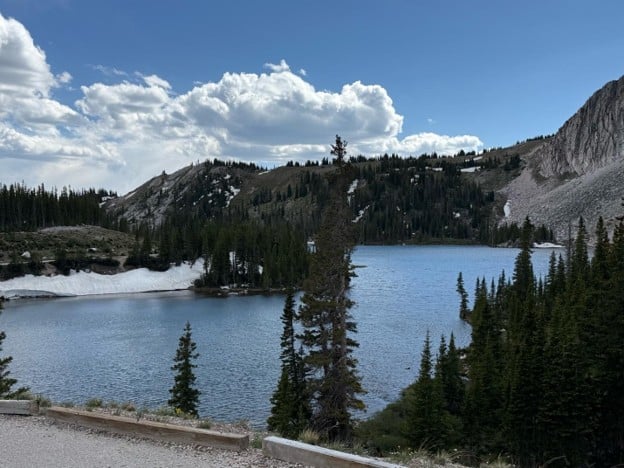
8: The walk along Lake Marie
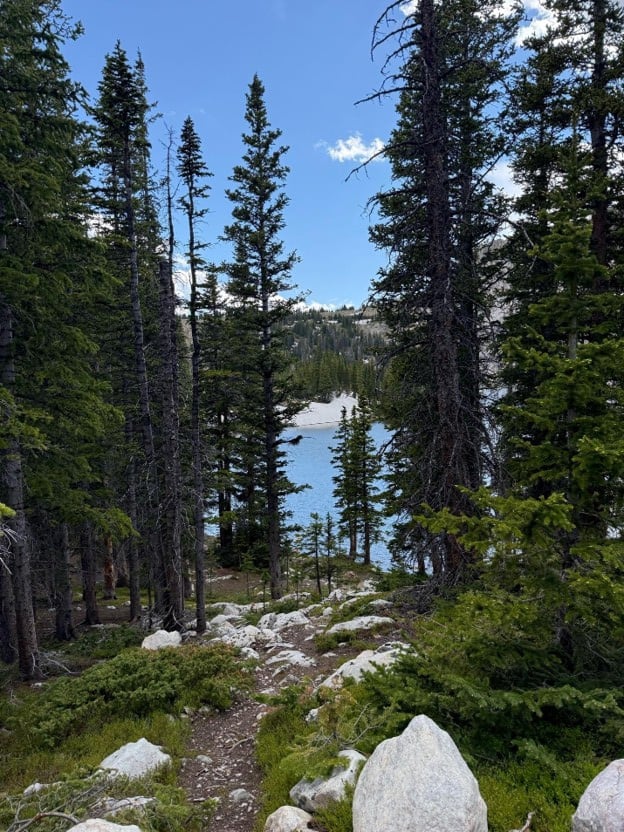
9: Peeking through the trees to Lake Marie
I drove on and found my way out of the National Forest, expressing my gratitude for nature, the trees and the courage of the early settlers who ventured out into unknown lands when so many other threats to their existence were present. Saratoga was named after Saratoga Springs, New York, due to the presence of hot springs in the town. These springs also had a rich history of being used by the Northern Arapaho, Cheyenne and Ute tribal nations and fell out of favor during a smallpox epidemic in 1873 when they were thought to be “bad medicine.” When I was ready to leave Saratoga on the morning of June 23, I chatted with the front desk clerk of the Riviera Motor Lodge. Her name was Judy, and she shared how she had lost her husband recently. How he was a veteran. How painful his end-of-life experience was, mainly due to the bedside manner of the treating physician. She shared how her family had come to Wyoming decades ago and where she raised her children. She opened her heart and as I hugged her, I shared in her grief (#14).
We parted ways and I went on my way, driving through the wide-open roads of Wyoming and resort towns of Colorado, this time on the western side of the Rockies. I saw bison and prairie dogs and deer running along the two-lane “highways.” I ended my day with a relaxing scenic train ride on the Royal Gorge Railroad in Canon City alongside the Arkansas River, making friends and watching folks go rafting down the rapids. I learned of the history of the railroad and how prisoners built the earliest water viaducts to the city.
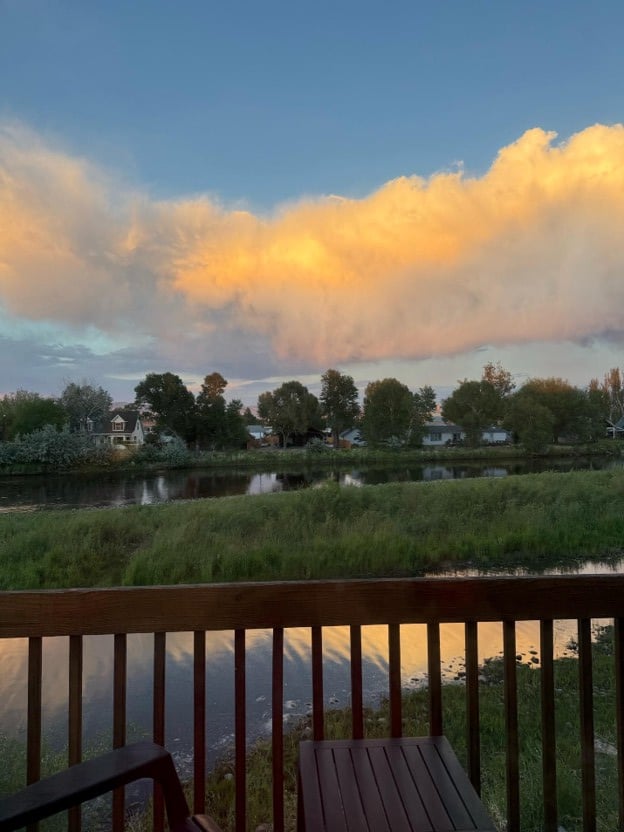
10: Sunset along the North Platte River, Saratoga, Wyoming
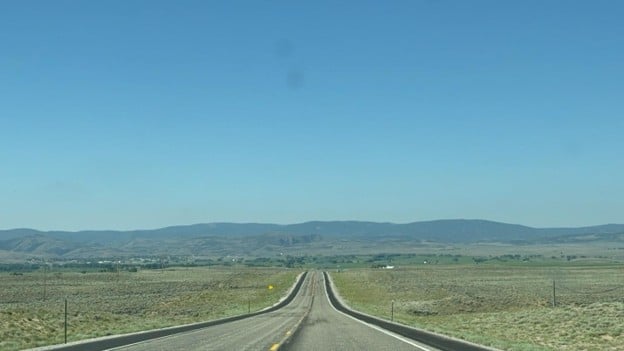
11: Wide-open prairie in Wyoming
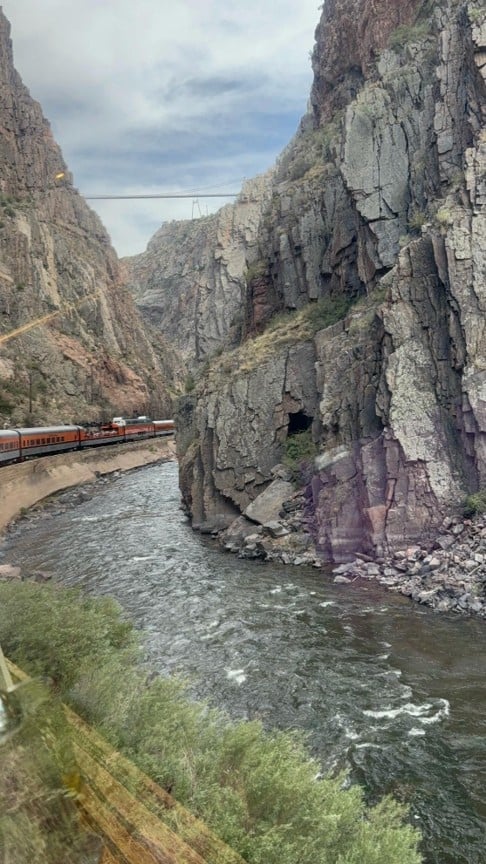
12: Royal Gorge Bridge as seen from the Royal Gorge Train along the Arkansas River, Canon City, Colorado
On June 24, I left Canon City, Colorado. I drove 12 hours through the hairpin turns in the Colorado mountains, the dry desert of northeastern New Mexico, the open farmland of the Texas Panhandle, and the widespread cities of Amarillo and Wichita Falls before finally arriving in Dallas around 11 p.m.
I left Dallas June 19 with a heavy heart and worries clouding my mind and returned to Dallas June 24 with lightness, an inner resolve, and trust in myself and in my future. I want to thank you for reading this story of mine. I share it because little did I realize how much I would grow and change over the course of 11 days in June of 2026. Be open to what may come. You never know how it will impact your life.