
Calvin Kunin: A Life in Infectious Diseases (Pt. 2)
View Transcript

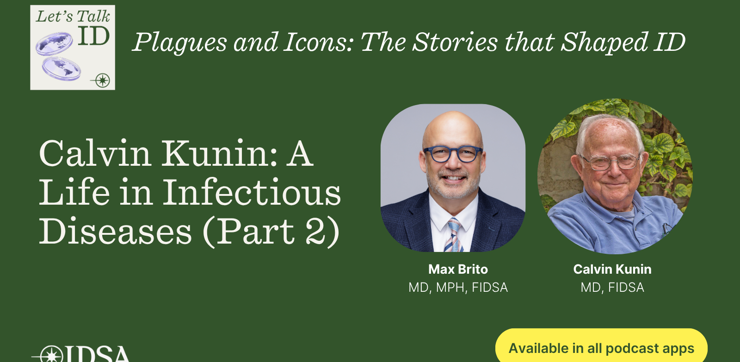
In Part 2 of Plagues and Icons: The Stories That Shaped ID, IDSA President-Elect Max Brito, MD, MPH, FIDSA, continues his conversation with Calvin Kunin, MD, FIDSA, 97, about his pioneering UTI research and remarkable career in infectious diseases.
Details


Calvin Kunin: [00:00:00] The chairman of the committee said we cannot approve this drug. There is not sufficient evidence of efficacy of this drug. And I shouted out, we have no course other than to approve this drug. Imagine you could.
Max Brito: [00:00:14] Walk back into Professor Ryan's lab or to Cornell Medical College in 1941 and sit down beside the young Calvin Kunin. What would you tell him?
Calvin Kunin: [00:00:26] I wouldn't tell him anything. I'd ask him.
Max Brito: [00:00:33] Hello, welcome back to Let's Talk ID and to the second part of my conversation with Doctor Calvin Kunin. As part of our new series, Plagues and Icons: The Stories That Shaped ID. In our first episode, we explored Doctor Kunin's early life, his formative years in medicine, and some of the remarkable events that shaped his career. After completing his research fellowship at Boston City Hospital, Doctor Kunin joined the faculty at the University of Virginia in 1959, rising to the rank of professor and chairman of preventive Medicine and internal medicine. He then moved to the University of Wisconsin, where he served as associate chairman of the Department of Medicine and Chief of medicine at the William Middleton, VA. In 1979, he joined the Ohio State University as chairman of the Department of Medicine, eventually becoming Professor emeritus. Throughout his career, Doctor Kunin made pioneering contributions to our understanding of urinary tract infections. He conducted large scale epidemiological studies of asymptomatic bacteriuria in school children, adult women, and religious communities. Perhaps most notably using E coli Serotyping, he was the first to demonstrate that recurrent UTIs were caused by reinfection rather than relapse, a discovery that fundamentally changed our understanding of this common clinical problem.
Max Brito: [00:01:59] His work helped lay the foundation for the modern management of urinary tract infections. And influence generations of clinicians and researchers. But Doctor Kunin's distinguished career extended well beyond academic medicine. Among the many fascinating chapters of his life, he even served as a physician to the King of Morocco. An extraordinary experience that speaks, that speaks to the breadth of his career. Over the decades, his contributions have been recognized with numerous prestigious awards and honors. Of course, one hour is hardly enough to summarize Doctor Kunin's extraordinary career. His many achievements and the numerous honors he has received. But rather than simply recounting a long list of accomplishments, I hope this conversation gives gives you a glimpse of the man behind them. His curiosity, his experiences, and the people and events that shaped his remarkable life. So let's return to my conversation with Doctor Calvin Kunin.
Max Brito: [00:03:02] So at some point, I guess from doing pharmacokinetics on, uh, renal and renal function, you become enthralled with urinary tract infections and it becomes a seminal part of your work. Uh, do you remember the patient or observation, uh, that made you think, hmm. There's something here. This is a very interesting field.
Calvin Kunin: [00:03:30] Sure. Well, first I have to go one back step. Ed Kass was just full of asymptomatic bacteria. Yeah.
Max Brito: [00:03:40] And Kass has been a seminal, uh, you know, being a very important figure in infectious diseases in the-
Calvin Kunin: [00:03:46] That's right. His big thing was, was that. And, uh, I used to talk to him once a week about what he was doing. And so I had a good idea about his conceptualization of this topic. And it was in the back of my mind. But when I went to the University of Virginia, which was my first job. I wanted to be a virologist. And so I was working on, uh, pathogenesis of, uh, of enterovirus infections. And that's terrible work. Working with viruses all by yourself is. One day I was sitting in, um, the office of the, uh, of the Department of Preventive Medicine where I was, uh, assigned. And a, uh. School nurse, uh, by the name of Teresa Southall, came into the office. I was sitting in a booth over here, and she was talking to the secretary in the booth next door. And Teresa was a very nice person. Uh, was talking to the secretary, who she knew very well. The secretary of the department, and she said, well, I'm bringing some kids once again from a little town in Virginia over the mountains to, uh, be cared for at the University of Virginia. And it's, it's nice to see you again. And they began to chat. They said, the only trouble I have is I don't have enough to do as a school nurse. When I heard that, I jumped up and I said, I'm Catholic, Mrs. Southall. How would you like to collect urine from all the school children in Waynesboro, Virginia? Okay.
Max Brito: [00:05:53] And what were you trying to achieve with that? With collecting the urines.
Calvin Kunin: [00:05:57] The frequency and epidemiology of urea in children. Kass didn't touch that.
Max Brito: [00:06:04] Yeah. So you wanted to to you. So you wanted to characterize. A cohort.
Calvin Kunin: [00:06:09] All I wanted to do was to see what the frequency of asymptomatic bacteria was in children.
Max Brito: [00:06:15] What did you find?
Calvin Kunin: [00:06:16] Before I tell you that, my intellectual process goes from one step of sophistication to another step. So I was it was a simple question. And then that gets to be more complicated later on. Uh, what I found was that we did 3059, uh, urine cultures. We found, uh, in this, in subsequent studies that 0.4% of little girls would have a, uh, significant bacteria with counts above 100, uh, 100,000. We were able to, uh, verify this as being real by having them seen by, uh, by urology, uh, friend at Virginia who, uh, did a cystoscopy and look for physical urinary functions and did a urine culture at the time of catheterization, confirming what we saw just by culture, by, uh, voided urine. So every case was confirmed by that method. So, uh, the frequency, uh, was about 0.4% at that time in girls, only one case in boys. And that one boy had vesico ureteral reflux underlying renal problem. Now, that paper was published in New England Journal. And then I said, well, maybe I can get more information if I did this in Charlottesville, Virginia. The school board, I talked to the school superintendent who was just wonderful. I said, I'd like to get your unconscious. All the children in the school, he says. Doctor, we'd be very happy to be happy to help you. Perhaps you can explain this to some parents at Parent Teacher Association and and the doctors at their meetings. And all these people said, wonderful. Go ahead. That's why I love radio.
Max Brito: [00:08:24] Yes, yes, yes. You had a had a population to work with.
Calvin Kunin: [00:08:29] Well, we, we did, uh, urine cultures. Uh, I was helped by a CDC nurse who was assigned to me, by the way, for, for one of the years and every year for ten years, we studied, uh, we collected urine of a culture from all the children, virtually all the children in the schools in Charlottesville and in, uh, surrounding county. From that, there's just a wealth of data, as you can imagine. We saw a constant rate of 0.4% per year of new cases. And the key of all this was that if you accumulate that, you say, what is the risk of a girl having a urinary infection being colonized, at least between kindergarten and high school? It's about 4.5%. So that's about the same rate as you see in young women, in college women. And so what? It seems fairly clear that the genesis of urinary infections in young women thereafter had its genesis earlier in life.
Max Brito: [00:09:38] It starts early, huh?
Calvin Kunin: [00:09:39] It started earlier. It didn't start with honeymoon cystitis. It started earlier. And this was the susceptible population waiting for the next trigger to occur.
Max Brito: [00:09:51] So in other words, girls who were colonized were more likely to have.
Calvin Kunin: [00:09:54] That's right. They were the ones that. That was the substrate. But among those, uh, um, Um, the director of, uh, urology, a good friend of mine, again at about 20 years. I'm breaking on his name, but I hope you forgive me for that. He said, I like to follow up what happened to the girls at 20 years. And, uh, I said, I said, can you tell me, uh, anything, how I should find them? I said, well, I have cabinets full of every single girl and exactly where they sat in what class at one year. And so I'll give you the name of each girl where she sat, and the two girls that sat next to her as as. How's that?
Max Brito: [00:10:46] How's that for mapping and tracking? Oh, wow. Were you able to find them or.
Calvin Kunin: [00:10:52] Yeah, he found them, and a few of them had a urine infection and complications. Most were fine.
Max Brito: [00:10:59] Oh my God. It sounds like the Framingham of the urinary tract.
Calvin Kunin: [00:11:03] Yeah, it was a one person study. By the way, we had no grants.
Max Brito: [00:11:09] No grants? So how do you how did you finance any of these grants?
Calvin Kunin: [00:11:12] This is financed completely by my own salary. And, uh, I then believe it or not, uh, personally took care of each of the girls who were positive and then followed them sequentially, uh, to see how they did after antimicrobial therapy.
Max Brito: [00:11:29] But so you did treat them.
Calvin Kunin: [00:11:33] I treated them and followed them and found out that, uh, recurrence rate would be 80%, but there'd be a 20, a 20% group that dissected away and became free forever. So it's got a fractional extraction of the population, uh, with therapy. It's very interesting stuff.
Max Brito: [00:11:54] And this was treatment regardless of symptoms she was treating.
Calvin Kunin: [00:11:57] Yeah. It was just to understand.
Max Brito: [00:11:59] It was just to understand what happened. We later understood that maybe asymptomatic. You know.
Calvin Kunin: [00:12:04] That's right. But that was based on this studies.
Max Brito: [00:12:07] This data. Yeah. Yet yet again, another one of your contributions.
Calvin Kunin: [00:12:12] I just have to go a little further on this. We also did a we also measured the antibody to, uh E coli O antigens during that time. There are 140 different E coli antigens. Only certain ones are uropathogenic. And the question is if you're doing serologic tests, you want to be sure that you're not dealing with cross-reactions. What you think is this is really something else. So we made a pattern of the 130 antigens against the 130 of antibodies from the CDC. Found it, one of them cross-reacted with everyone. And that was 014. And I said, I've got something very interesting here. I have a common antigen. And so I did the chemical work designed to extract and purify that antigen. And it's now known as the common antigen of Enterobacteriaceae.
Max Brito: [00:13:15] Very nice. Very nice work.
Calvin Kunin: [00:13:17] I stole somebody else's lab.
Max Brito: [00:13:19] Yeah. Well no. Well, yeah, but you said you went from the simple idea and you were, you know, building on it.
Calvin Kunin: [00:13:25] You see what I mean by increasing?
Max Brito: [00:13:27] Yeah. I see your life is has such a cadence. I can see that. And I, as I learned about you, I could I could definitely see that. Thanks for bringing it up. Then in 1987, uh, and you become the 24th president of the IDSA, our beloved society. And you were probably one of the society's early members. Uh, you were part of the formative years at least. Can you describe what IDSA looked like in those days or, and whether you ever imagined that it would grow into a global organization of nearly 14,000 members with members from approximately 100 countries.
Calvin Kunin: [00:14:06] And we had no idea. I was, uh, a number 104 in the 125 people that met at early house. And, uh, all I was, was a kid in the back of the room listening to the, uh, outstanding experts sort of wide eyed and watching them maneuver among each other. What they wanted to do was to replicate what was not uncommon at that time. And that was a specialty organization of the elite people in the field. And we can go into other organizations like that. The American Epidemiologic Association was like that. Only so many people can join the group, and they actually decided that they're going to have 250 limit to 250 people elite. And these elite would meet once a year and have the very best presentations in depth with great discussion. This sounded terrific, but it left out everybody else, and it took an evolution over, over time for the organization to open up and open up and open up. Uh, but it was originally it was some fights, some difficulties in that.
Max Brito: [00:15:32] Yeah. As it always happens in organizations of this type.
Calvin Kunin: [00:15:35] So I had no idea that it would be it would be anything different.
Max Brito: [00:15:39] But you had fond memories of the time your time there. The collegiality and the networking. Yes. Um, and then you've had a, a very interesting jobs consultant to the King of Morocco and consultant to the National Health Research Institute of Taiwan for more than 20 trips. What was that all about?
Calvin Kunin: [00:16:00] Well, I'll tell you about the king of Morocco is sort of fun. I was at, uh, Madison at the time and got a telephone call from, uh, the consulate general asking me to come to Morocco to take care of a patient with urinary infections. And I said, well, why do you call me? He said, well, because we couldn't reach Ed Kass.
Max Brito: [00:16:26] [laughs] Serendipity again. It's a constant in your life as well.
Calvin Kunin: [00:16:31] So, uh, uh, I had a remarkable experience there. Um, the, uh, it takes a story by itself. You can't, uh, relate that here.
Max Brito: [00:16:44] Other than to say that you took took care of it.
Calvin Kunin: [00:16:46] Yeah. It deserves its own, uh, story.
Calvin Kunin: [00:16:55] Taiwan,excuse me.
Max Brito: [00:16:56] Oh, Taiwan. Yes.
Calvin Kunin: [00:16:57] There was a fellow who, uh, was one of the earliest fellows who was named Monto Ho. And Monto left Ed Kass abruptly and decided to work in virology, uh, with, uh, one of their fellows who's a Nobel laureate, uh, in tissue culture in virology. I'm blocking out his name. And Monto discovered interferon independently of, uh, with a different name at that time. And he became a distinguished person. When he retired, he decided that he would go to, uh, Taiwan and help develop infectious diseases in Taiwan. And with Monto, who invited me and others to teach there for a month at a time. Well, I did it the first month. And then I said, this is wonderful and went 20 more months, 20 more years doing it. Everybody else dropped out because they were just wonderful people. And, uh, I then participated in their research, wrote their papers well, revised their papers, and, uh, they were, they were just a wonderful civilization. Actually, the way, the way they, uh, seduced me to write the papers was, uh, I'm a bird photographer. And one of them said, I will take you on birding trips in Taiwan if you do my manuscript.
Max Brito: [00:18:36] That's right. Yes. We're going to talk about birding in a little bit. Uh, and we're actually that's a good segue to the last part of the interview, which is more about your personal life.
Calvin Kunin: [00:18:52] Do we have time for one more, uh, accomplishment?
Max Brito: [00:18:56] Okay, go for it. Tell me about it.
Calvin Kunin: [00:18:59] Uh, when I left out of my, uh, bibliography was my time as the chairman and then a member of the Anti HIV Active Virus Committee for the Food and Drug Administration.
Max Brito: [00:19:12] Oh.
Calvin Kunin: [00:19:13] I was on the committee that approved the first drug for Aids.
Max Brito: [00:19:19] Oh, AZT, correct?
Calvin Kunin: [00:19:21] AZT in 1987. And the chairman of the committee said, we cannot approve this drug because it has not been there is not sufficient evidence of efficacy of this drug. And I shouted out, we have no we have no course other than to approve this drug. And they approved it. I thought you'd be interested in that point.
Max Brito: [00:19:45] It is interesting, especially since I'm interested in HIV. I know that AZT was the initial.
Calvin Kunin: [00:19:51] I'll leave that for that.
Max Brito: [00:19:53] But we've talked about your remarkable career and the work that consumed most of your life. But alongside us, there is your life with Eileen, your wife. What role did she play in making your career possible? And when you look back, what did the two of you sacrifice for that?
Calvin Kunin: [00:20:14] Oh, okay. Well, first of all, we don't sacrifice anything. Uh, because, uh, we we have great respect for each other. And Eileen has their own projects that she likes to do. Uh, and gardening. In the house. She's a fabulous cook. She's has a nice social life with wonderful women. And so she can do anything she wants to, uh, she can, uh, have total freedom in relationship to finance and so on and, uh, have room. And there's a long history of, of that critical importance for a woman to be able to do what she can do well. And so she's been wonderful in that regard. At the same time, she leaves me alone and I do my thing, uh, birding, whatever else I do. So she has her office, I have my office, and then and we're friends all the time. And we do everything together beyond that.
Max Brito: [00:21:25] So there is democracy in the House, and there is understanding between the peoples.
Calvin Kunin: [00:21:31] And respect.
Max Brito: [00:21:33] And respect, which is a word.
Calvin Kunin: [00:21:35] She has special skills. Uh, she was raised on a farm in Iowa, and she can do anything. She can build. She can, uh, she can put furniture together. She can, uh, sew, she can weave. Uh, she's just a wonderful, talented person.
Max Brito: [00:21:56] Yeah. I saw that you were active in the arts there in Ohio.
Calvin Kunin: [00:22:00] The public arts.
Max Brito: [00:22:02] The public arts, yeah, yeah, yeah, yeah, the concerts and stuff. Yeah.
Calvin Kunin: [00:22:06] We go to concerts together. We enjoy the same.
Max Brito: [00:22:07] Yeah. And how old is she now?
Calvin Kunin: [00:22:10] Uh, she's, uh, 89.
Max Brito: [00:22:12] 89. Okay. All right. That's great. Now, you've been married for more than 50 years, you said.
Calvin Kunin: [00:22:18] 50 years.
Max Brito: [00:22:19] Oh.
Calvin Kunin: [00:22:19] She's wonderful. We have traveled together all the time.
Max Brito: [00:22:24] I know, for birding. And you still spend summers in or winters in Arizona?
Calvin Kunin: [00:22:30] We have a home in Arizona the winter time, and, uh, it's. And I could do birding and travel.
Max Brito: [00:22:36] Okay. Well, my last question is to close. Uh, Doctor Kunin, imagine you could walk back into Professor Ryan's lab or to Cornell Medical College in 1941 and sit down beside the young Calvin Kunin, who was just beginning his medical career. What would you tell him?
Calvin Kunin: [00:22:57] I wouldn't tell him anything. I'd ask him. The reason I'd ask him is because people have different motivations for going into medicine. Uh, this is not again, uh, a uniform group. And so you have a large number of people who want to be practitioners and they want to care for patients. You have a lot of, uh, many of them who don't want to see a patient. They want to be pathologists, uh, radiologists. They're a small group who want to be scientists. And, and so on. You can just divide them. Some want to have hard work, but plenty of free time. Emergency medicine. And so you have to look at what they what they want. I can't put my feelings onto them. I'm different. It's a very small group than a sub subgroup who are interested in science. And that group, uh, I can talk to you easily because then there's experience. I know what I'm talking about. I know general internal medicine quite well because I've been in that setting. But I don't pretend to be able to tell these fellows what to do. You know, in their subdiscipline. People go to specialization because they want less and less to know. They want to focus on I don't want to know all this medicine. I want to just focus on a small area where I feel competent and comfortable. The thing that drives physicians is the fear of failure, the fear of not being able to be competent at a time of need. And so they divide themselves into protective cocoons that relate to that. So I can't advise them other than, uh, uh, to tell them fun stories.
Max Brito: [00:25:03] Or what would you tell Calvin? Did you tell him, hey, buddy, we made it?
Calvin Kunin: [00:25:07] I thought that years ago. I thought that. But, uh, I've had a lot of disappointments, uh, in terms of, uh, my own life and, uh, where I could have done a better job in many situations. And so I had to take that into account. So sure, I made it, but I didn't make it as well as I would like to. I would like to have done a more polished job, if you will.
Max Brito: [00:25:36] Dr. Kunin, it's been a true pleasure to meet you, to learn about your life over the past 1 or 2 weeks, and now to sit down with you to, um, you know, uh, show everyone else what, uh, I had just witnessed. It's been a true pleasure, sir. Thank you for joining us.
Calvin Kunin: [00:25:54] Thank you so much. I appreciate it.