
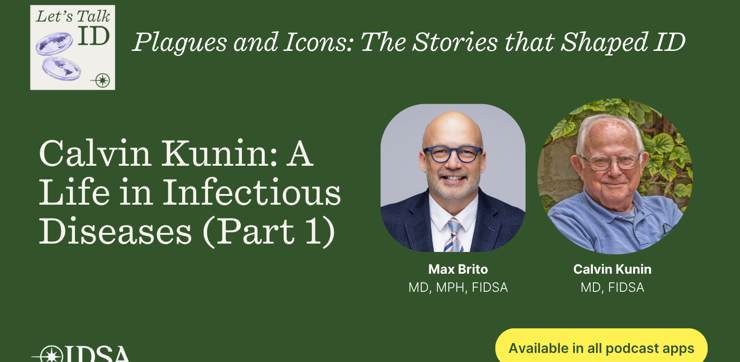
Calvin Kunin: A Life in Infectious Diseases
View Transcript

In this episode of Plagues and Icons: The Stories that Shaped ID, a new series from Let’s Talk ID, IDSA Vice President Max Brito, MD, MPH, FIDSA, speaks with Calvin Kunin, MD, FIDSA, 97, about his pioneering research on urinary tract infections and the experiences that shaped his career.
Details


Max Brito: [00:00:14] Hello. Welcome to Let's Talk ID, the podcast of the Infectious Diseases Society of America. I'm Max Brito, vice president of IDSA. I am delighted to introduce a new series that we're calling Plagues and Icons The Stories That Shaped ID. In this series, we'll explore infectious diseases through the people and events that have shaped our field. In some episodes, we'll revisit the great epidemics and infectious diseases of the past the plagues, pandemics, scientific discoveries, and public health challenges whose effects continue to resonate today. In others, I'll have the privilege of speaking with some of the remarkable people who helped build the modern field of infectious diseases. We'll hear their stories in their own words, not only about their scientific contributions, but also about their experiences, people, and historical moments that shaped their careers. And I can think of few people better suited to begin this series than Doctor Calvin Kunin. Doctor Kunin is one of the pioneers of modern infectious diseases. He served as an epidemic intelligence officer at the CDC during the era of the introduction of the polio vaccine and later trained in infectious diseases with the legendary Maxwell Finland at Harvard. Before embarking on an extraordinary academic career, he became an internationally recognized authority on urinary tract infections. He served as the chair of the Department of Medicine at The Ohio State University, and as the 24th president of our beloved Infectious Diseases Society of America. Doctor Kunin is now 97 years old. He's in good health, intellectually active, and still remarkably curious about medicine, science, history, and the world around them. I reached him at his home in Columbus, Ohio, where we had a wonderful conversation spanning nearly a century, from growing up during the Great Depression to the fear of polio and the arrival of the Salk vaccine, to the evolution of infectious diseases into the specialty we know today. It is both a personal story and a history of our field.
Max Brito: [00:02:29] Doctor Kunin. Welcome to the podcast.
Calvin Kunin: [00:02:31] Thank you.
Max Brito: [00:02:33] Before we talk about medicine, I would like to travel back to Brooklyn, Brooklyn, New York in 1929, the year of your birth. Your father was a Belarusian immigrant, a kosher butcher in Brooklyn, and your mother was a teacher who was originally from Vermont. And I learned that you were born in Vermont. But very quickly, a couple of months later, went to New York City, where it's your home where you grew up. By all definitions that I've looked at, you are a child of the depression. What are your earliest memories of that time? Did the depression affect your family? And looking back, do you think those experiences shaped the person you later became?
Calvin Kunin: [00:03:18] They were very powerful forces that shaped my life. We had a lovely home. Uh, thanks to the US government's, uh, grant to my father. As a veteran, we had good food. Uh, we had, uh, uh, a good relationship between myself and my brothers. The problem we had was no cash. So we we we could not extend ourselves economically outside of the family. This is a tremendous inhibitor. When you see the kids drive around with their cars can go anywhere. Eight girls. The dates. We couldn't do any of that. And so, uh, I had to start work to get cash at age 12. I worked in grocery stores and bakeries. Uh, I worked in a pharmacy. I worked as an usher in the movies for $0.10 an hour. And then I began to work as a bellhop in a hotel, uh, in new Jersey. And then as a busboy and then as a waiter, uh, in the Catskill Mountains. And I had to do all of that, uh, throughout college. So, uh, that was my means of extra money. This was insufficient, however, to, uh, allow me to live on campus when I was in Columbus, Columbia University. So I had to take the subway and bus each way from my home to 116th Street. This is about an hour and a half each way. Fortunately, I could read one New York daily newspaper going one way and the afternoon newspaper going back. So it wasn't really a torture. Uh. And I absolutely loved being at Columbia. I just it was a new world to escape from, uh, the ghetto of Brooklyn to the world wide world of Columbia. It was wonderful. I even sang in the chapel choir.
Max Brito: [00:05:38] You did? Yes.
Calvin Kunin: [00:05:39] Yes, I did. I wanted to know what Christians do. And I just don't like chapel choir. That kind of music is. That was wonderful. As you. As you know.
Max Brito: [00:05:49] So let's talk about Columbia, then. Following in the footsteps of Arthur, because Arthur had been at Columbia and had been wounded in World War Two. Right.
Calvin Kunin: [00:05:59] Arthur, um, essentially, uh, demanded to be enrolled in Columbia as a veteran. And, uh, he was accepted and he did well. And it was, uh, he did so well that I was admitted. Then my cousins were admitted. And so about four or 5 or 6 of us were Columbia graduates. Thanks to Arthur.
Max Brito: [00:06:26] He passed away recently, correct?
Calvin Kunin: [00:06:28] Yeah.
Max Brito: [00:06:28] He died last year.
Calvin Kunin: [00:06:29] At almost 100.
Max Brito: [00:06:32] Almost 100.
Calvin Kunin: [00:06:32] Years. Burlington.
Max Brito: [00:06:34] Yes.
Calvin Kunin: [00:06:34] And, uh, he's very well loved. Wonderful person. And now at Columbia, uh, as I mentioned, I, I enjoy everything, I enjoy everything, I love anything that's. Interesting. I'm interested in, uh, but something very, very important happened. And that was at the time that I finished early and was admitted to medical school for four months later. I saw my advisory counselor at premed advisor.
Max Brito: [00:07:09] Yeah. You were thinking of moving to Florida when you went to him?
Calvin Kunin: [00:07:13] Where did you learn this?
Max Brito: [00:07:14] I don't know, I think I become you become my passion for the past two weeks.
Calvin Kunin: [00:07:19] You're fantastic. [laughs] That is amazing.
Max Brito: [00:07:23] And so then what happened? You have you have the encounter with the advisor. And what did he tell you? How did how did that change your life?
Calvin Kunin: [00:07:30] Right. Well, uh, this is, uh, Doctor Francis Ryan, and, uh, he had trained in molecular biology in Caltech and so on. And, uh, I, he asked me what I was going to do, and as you presently found out, I thought I would become a, uh, uh, a waiter in, uh, in Florida. So I had have some money for medical school. And he said no. Uh, come to my laboratory, which I did, and worked on Neurospora crassa, which was an interesting, uh, uh, organism. Learned the tools of microbiology, how to plate, how to culture and so on, and learned there was an outside world there of, uh, uh, remarkable new advances in biology. So at that point, instead of thinking of medical school as a place, just as a safe haven economically, I want to be a scientist.
Max Brito: [00:08:33] And what you learned in the lab inform your research years later, did it?
Calvin Kunin: [00:08:40] Absolutely. As a matter of fact, the nature of his study related to, uh, osmolality, the environment of osmolality for the microorganism. And 60 years later, I realized that osmolality was critical for growth of bacteria in the urine, and that osmolar compounds would permit the bacteria to grow. So that came exactly from that Neurospora study all those years ago.
Max Brito: [00:09:11] Yeah. That's why E coli thrives in hypertonic urine, doesn't it?
Calvin Kunin: [00:09:16] That's right. Very good. You really did your homework. [laughs]
Calvin Kunin: [00:09:21] And there's probably why only one strain of E coli infect asymptomatic women, doesn't it?
Calvin Kunin: [00:09:29] Exactly. That was an experiment that Ryan did. And Ryan had two very closely related strains and grew them serially and found that only one survived just first mine and minor advantage. That's correct. And that's why exactly, as you say, uh, in urinary infections that are not interrupted externally. In other words, they're spontaneous. Uh, there's always one organism that dominates.
Max Brito: [00:09:57] So there was serendipity there, wasn't it? Meaning something you learned 30 years earlier. Inform your research.
Calvin Kunin: [00:10:03] Yes. Serendipity is driven by scientific life. You know, there's some people who start on one topic. I want to solve cancer or I want to get a drug for such and such. I didn't work that way. I worked with somebody told me something and I listened to it and I said, huh, I'm a bridge person. I have a very broad knowledge. And I said, we can take this and make something out of it. That's even better. And that's serendipity.
Max Brito: [00:10:33] Yeah, yeah. Very important for people doing science today, right? Yeah. So then now you're in medical school. You went to medical school at Cornell 1939. And when you're a medical student and young physicians, a young physician. Antibiotics were relatively new. Correct. So you so you met people, uh, who worked with you that have been around in the era of the pre-antibiotic era. Do you remember ever seeing, um, the first time you saw a patient treated with antibiotics?
Calvin Kunin: [00:11:07] Well, the key, the key example of that is tuberculosis. I mean, that is the disease that, uh, uh, as you know, is rampant throughout all the world and still is. And, uh, could not be treated with antibiotics. Uh, and streptomycin was discovered, uh, about 1940, 44. Uh, and, uh, that of course was the first big drug. But then I did see patients who could not be treated with antibiotics. For example, uh, a child, uh, had, uh, uh, an infection with Pseudomonas meningitis infection. And, uh, there were no drugs for that child. And we saw many cases, um, later on of, uh, staphylococci, uh, for example, staph pneumonia, bacteremia, where they smelled drugs because of resistance. But, uh, my main experience was on the Navajo Indian reservation as a senior student. This, this was set up by Walsh McDermott, who was the head of, uh, public health, if you will, at Cornell. And, uh, Walsh McDermott was a big shot and he set up a program for trials of anti-tuberculosis therapy in, um, at the Navajo reservation. As a matter of fact, uh, it was the major report that came out was the ability of streptomycin and possibly isoniazid at that time to cure TB meningitis in children.
Calvin Kunin: [00:12:53] And they were surviving. So I was at the, uh, uh, TB stand that, uh, we had set up, uh, to do studies. And, um, this was fascinating because it's all tuberculosis, all the complications of tuberculosis, and even saw some reactions to some of the newer TB drugs that never came to market. There was a good experience. The only part of that was that, um, halfway through that experience, uh, there was a hospital across the street from the TB San, a general hospital, and the pediatrician there who was a very smart fellow said, you know, I'm leaving for a vacation. Would you take over pediatrics for me at the, uh, Navajo Hospital, I saw amazing. The child who came in, uh, bitten by a rattlesnake who was in shock. A child with a severe TB, meningitis, and a fellow who had fallen off a Hogan and had a complicated pyemia with. Eventually Canada as a last organism because of the multiple antibiotics used and so on.
Max Brito: [00:14:10] Okay, so well, let's talk about your epidemic intelligence service. After medical school, you join the EIS, right? And you were involved, as I understand it, in analyzing data for the new polio vaccine, wasn't it?
Calvin Kunin: [00:14:24] That's right. The first year of my, uh, uh, tour, I was at the, uh, uh, at the health department of the state of Utah. Utah as an allergist assigned there. And one of the jobs the CDC EIS people had was to verify the cases of polio who did or did not receive the vaccine. So we went out in the field to follow those in the second year. Alex Langberg assigned me to the polio vaccine evaluation center where we were evaluating the data, the very final part of the data to close the book on this. Um, and, um, I was asked to sort of help out in that effort and I really didn't help out very well. Uh, because I didn't know anything. I was just a kid and, uh, uh, so, uh, um. The I forget his name. Uh, he, I said I was useless, and he was right because I was. I didn't know what to do. Uh, this is sophisticated analysis. I did do one thing that was useful. I found out why the 16-year-old kids, uh, or the six-year-old kids, I'm sorry, did not seem to have been helped by the polio vaccine. There was a bike there. I wasn't useless. Actually, I found out something interesting and the reason was I had to find out why these six-year-olds didn't respond. And the reason was, as you look at it, they had non polio virus disease.
Max Brito: [00:16:20] Yes orphan viruses.
Calvin Kunin: [00:16:23] Orphan viruses, Coxsackies and so on. Coxsackie A, Coxsackie B. And so that that did answer the question of the six-year-olds, but I was still considered useless.
Max Brito: [00:16:38] Well, you know, once in a career. [laughs] Who's counting?
Calvin Kunin: [00:16:41] But you see this this is very helpful. He said, you go to the laboratory and fool around there for the rest of your term. Well, that was wonderful, because they told me how to do molecular virology of retroviruses. As I said, well, what I'm going to do is find out, find a virus that will be like polio, but will not, uh, uh, there'll be no resistance to it. And so I went out to, uh, the, the, uh, dairy farms in, um, uh, in Michigan and collected the stools from the animals as a, uh, uh, as you arranged in milking shed and then, uh, put them into tissue culture, actually cow kidney tissue culture and isolated an enterovirus. And this was, uh, we call orphan virus.
Max Brito: [00:17:45] Orphan virus. Yes. Well, I think that was probably interesting that that experience is that you remember seeing patients with polio when you first started your career, and now there is this vaccine, uh, that comes and prevents polio. Do you remember first, the fear of folks, uh, in the population about polio was a disease that it was fear back then. And then the reaction of the people after the vaccine came with kind of a miracle that seeing that would prevent polio.
Calvin Kunin: [00:18:18] It's amazing. Uh, if you, if you would take the Covid vaccine story and turn it upside down, you'd have what happened then? People were afraid you couldn't. You couldn't be a social life without seeing somebody who had the residual of polio.
Max Brito: [00:18:36] They're everywhere, right?
Calvin Kunin: [00:18:38] Faculty members and health staff were walking around with shriveled legs. Uh, we had, uh, to use the iron lung to, to save them. The fear of polio was enormous. Uh, the pools were closed in the in the winter and the demand in cry was fabulous, and the work that was done of by government and by private agencies was fabulous. Uh, it was perfect. It's just amazing how different it is from, uh, the Covid story. Just amazing how a population, uh, could do this. Now, Doctor Finland told me something about this. It was an outbreak of in a in a, uh, army base back in the 70s, where a case of influenza that resembled that of 1918 was isolated from a soldier. The CDC really revved up for that and got that whole population vaccinated and excited the country about this. Unfortunately or fortunately, there was not a second case. So this whole evolution crashed. The direction of the CDC lost its position and so on. And Doctor Finland said, you know, when you have an epidemic like this, the first thing to do is nothing. Wait for the population to demand it. Don't be so helpful. And I'll never forget that.
Max Brito: [00:20:26] [laughs] Well, that's a nice anecdote. I don't know that we would do it like that right now. Huh? It's okay. But no, you bring an interesting perspective. Now, you've lived long enough. You've seen the fear of polio in people's faces. You saw the miracle of the vaccine, and you witnessed how this disease was eradicated, essentially eradicated from the United States.
Calvin Kunin: [00:20:51] Absolutely.
Max Brito: [00:20:52] Today, however, we are seeing increase in vaccine hesitancy. So when you see people choosing not to vaccinate their children, what goes through your mind?
Calvin Kunin: [00:21:03] Well, you know, there are two thoughts. You know, you have two simultaneous thoughts. One of the first thoughts that comes to your mind is you're crazy. You know, that's the first thought. The second thought is they just don't know. They just have not been told. They, they have been, uh, uh, brainwashed basically. And, uh, because these are good people and they want to do the right thing, but they've been brainwashed by fear.
Max Brito: [00:21:38] They probably don't have the memory of people who had polio.
Calvin Kunin: [00:21:41] There's no memory. No, no, there will be a memory, of course, but it's going to be disguised by, you know.
Max Brito: [00:21:48] So we're victims of our own success, if you will.
Calvin Kunin: [00:21:51] There's a problem there with that statement. Victims imply they're all the same. We are victims. We. There is no way. There are categories of we. There are various kinds of we. Within the we, there's a group that have done this to the other we's. I don't think we should take the blame. People say civilization is disappearing because of what we are doing. It's not we. It's among us, but not we.
Max Brito: [00:22:28] It's an island. It's a portion.
Calvin Kunin: [00:22:29] Yeah, that's an epidemiologic epidemiologist would say, you can't use the word we.
Max Brito: [00:22:35] Yeah. No, no you can't. You're right. You're absolutely right. We. It's some among us. Let's put it that way. Okay. Well, at some point you decide to go into infectious diseases and we're all so lucky that you decided to do that and you go to Boston to work with Maxwell Finland. For folks who are not infectious disease aficionados and may not know who Doctor Finland is, he is kind of considered accredited as one of the fathers of the specialty. What was it like to walk into his laboratory as a young investigator? What was he like?
Calvin Kunin: [00:23:13] Doctor Finland was a very private person. Very, very private person. He was a totally dedicated person. He lived at the Boston City Hospital of many, many years because he wanted to be so close to his laboratory. He did have a home outside, but he lived there. He started in pediatrics, actually, and then went that became part of the what's called the Thorndike Laboratory with really, truly great scientists aggregated there from the Harvard Group. But he was a quiet, very, very thoughtful, scholarly person. And one of his interests was mathematics, as a matter of fact. He, uh, first began to study, uh, pneumonia and became very involved with very intimate patient care because they were treating pneumonia with, uh, antisera. Horse antisera. So he had to be very, very involved in patient care. And he had that devotion to the patients in a very quiet, quiet way. Uh, he could write a manuscript directly on a yellow pad without any changes from one to the end. A tremendous memory. He was, however, quiet and shy and, uh, seemed a bit moody. But he wasn't moody. He was just thinking. So you didn't really get to know him as a person because he was private. But there's a certain sweetness about him that you sort of appreciate it. And one of the examples of the sweetness, and I was reading the history of the society was how why was he elected the first president of the IDSA? Say there were many other people who were very well qualified. And actually he was concerned about the nature of the IDSA and they said to him, he said to them, why are you asking me to be the president? And they said, Max, because we love. Even though he was so quiet, there was something about him that made you want to work with him. After I finished my fellowship over the years, he would call on me many, many, many times for special jobs. Special things I had to do for him. So I was like his longest lasting fellow.
Calvin Kunin: [00:25:57] Oh that's great, that's great. So maybe that maybe that quiet demeanor engender respect. Um, the people around you.
Calvin Kunin: [00:26:05] Yeah.
Max Brito: [00:26:07] Then some time after that, you go into a research career or your own with him. You work on antibiotics, right? Antibiotics, genetics.
Calvin Kunin: [00:26:16] No, no, it was it was again one of those useless things. We didn't do any consultations. Uh, infectious diseases as fellows because the house staff was so smart that they knew everything. They even did gram stains on the wards. So we were really not really necessary. All we really did was some experiments of absorption and distribution of absorption of antibiotics, new antibiotics, and went on, um, a special duty for both the uh, outbreak of influenza in 1977. But otherwise we had really nothing to do and or I or I felt we had much more to do, but I didn't know what to do because it was spaces there and it has to do with a project. We could do it by bang and plenty of time left for one day. A one of those Harvard, uh, um, house staff presidents. His name is Doctor Bush. Uh, said to me, look, I, I would like to consult you about a problem. I said, wonderful. I've never been consulted before. I have a patient who has tuberculosis, and she also has kidney failure. And I want to treat her with streptomycin. And I'm afraid I don't want to have toxicity. How should I change the dose or what dose should I use? So I said, well, reduce the dose. And he said, well, how much? I said, well, I'll ask Doctor Finland. So I asked Doctor Finland. I said, Doctor Finland, how much should I reduce your dose? He says, just reduce it. I asked Doctor Kass. Doctor Kass should I? What should I do? He said reduce the dose.
Calvin Kunin: [00:28:06] And Bush said, how much? So I said, I've got to answer Bush's question. And that's why we did the. I did all the pharmacokinetic studies of antibiotics. Uh, with all the antibiotics, uh, in relation to renal and hepatic failure. Now, I did all those studies by myself. I injected the drug, got the permission, went to the Brigham. So I found the patients with renal failure. That's why I mentioned the Brigham, the fellows with, uh, uh, liver disease because of the alcoholism at the Boston City Hospital. And, uh, I gave the drug, I took the samples, I, and I did all the assays now, and I had all this information. One of the fellows said, you know, why don't you present your data logarithmically by half life? Because if you do that, you'll overcome that curve and you can have a straight line. Bless his heart. He never spoke to me about anything else, but he told me that. And so that's how the half life situation where we talked about half life, that's what it was. Now from that, I, uh, uh, wrote three papers that summarized all this work. The reason for the three papers was to dilute the effect of the people who want their names on the paper were more famous than me, and would overwhelm the nature of the document. Okay. So I could name first of all three. And they can have their own names.
Max Brito: [00:29:49] You started the, the, uh, the, uh, talking about your fellowship, saying that it was that it was kind of useless, but it doesn't sound like it seems like you created the foundation of, you know, antibiotic adjusting and what our pharmacists do day in and day out.
Calvin Kunin: [00:30:07] That's right. Well, Doctor Francis, who I work with in Michigan, the other useless guy, called Doctor Finland, he says Doctor Finland asked him, is this guy any good? You know, he says, watch out for him. He'll take over your laboratory.
Max Brito: [00:30:22] Thank you for joining us for part one of Plagues and Icons, The Stories that Shaped ID. It was such a fascinating conversation and we're just getting started. Please join us for the second episode where we continue to explore Doctor Kunin's extraordinary career and remarkable life.