
Evaluating the Impact of Pre-Vaccination Analgesics on Influenza Vaccine Response
View Transcript

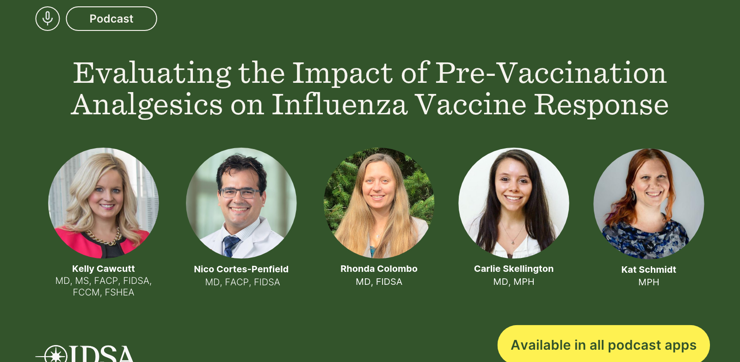
Let's Talk ID hosts Drs. Nico Cortes-Penfield and Kelly Cawcutt are joined by Rhonda Colombo, MD, FIDSA, Carlie Skellington, MD, MPH, and Kat Schmidt, MPH, to discuss their research published in the Journal of Infectious Diseases, examining whether pre-vaccination analgesic use affects influenza vaccine immunogenicity and effectiveness.
Details


Nico Cortes-Penfield: [00:00:14] Welcome to our second episode of Let's Talk ID research, a podcast from the Infectious Disease Society of America, where we highlight exciting new research published in IDSA journals and explore what it means for clinicians, researchers, and patients. I'm Doctor Nico Cortes Penfield.
Kelly Cawcutt: [00:00:29] And I'm Doctor Kelly Cawcutt. Today we're discussing a practical vaccine question that many clinicians have probably heard from patients or perhaps wondered about themselves. Does taking acetaminophen, ibuprofen, or another analgesic before an influenza vaccine affect the immune response or the vaccine's clinical effectiveness?
Nico Cortes-Penfield: [00:00:49] Yep. Today we're going to Journal of Infectious Diseases, or JID, which I must say is often a little out of my comfort zone as a clinical researcher. But I think we found a really nice example of how translational work can inform a real practice. Our featured paper is the effect of pre-vaccination analgesics on influenza vaccine immunogenicity and effectiveness, a secondary analysis from the pragmatic assessment of influenza vaccine effectiveness in the Department of Defense or the "PAIVED" study.
Kelly Cawcutt: [00:01:16] And we're joined today by three of our study's authors, Doctor Schmidt, Doctor Colombo and Doctor Skellington. So welcome and thank you all for joining us today.
Nico Cortes-Penfield: [00:01:25] So before we begin, we want to provide some important information about our guest affiliations. Um, Doctor Schmidt and Colombo are contractors employed by the Henry M Jackson Foundation for the Advancement of Military Medicine, or HJF, which is an administrator of the program and award in support of the Uniformed Services University's Infectious Disease Clinical Research Program, or ID CRP. And Doctor Skellington is an active duty physician and a PGY-3 in the Public Health and Preventative Medicine Residency at Madigan Army Medical Center. And Doctor Colombo is also a staff physician at Madigan Army Medical Center. Now, because our guests work for Uncle Sam, we have to make some additional specific disclaimers. The statements made by our guests reflect their own viewpoints. They're not necessarily the views, opinions, or policies of the Department of Health Agency, the Department of War, the Department of the Army, the Uniformed Services, University of Health Sciences, the Infectious Disease Clinical Research Program, or Madigan Army Medical Center. Our guests aren't speaking on behalf of the ID CRP or the Uniformed Services University and their potential future work and their potential effects on forest health protection policy are all outside of the scope of today's discussion.
Kelly Cawcutt: [00:02:28] Now, let's get to know our guests a little bit more before we really dive into the study. Nico, I think you had a great question you wanted to ask, so why don't you kick us off?
Nico Cortes-Penfield: [00:02:39] Sure. So since you guys are joining us from the Uniformed Services University and Madigan Army Medical Center, I'd like to know something you find interesting or unique about working in military medicine that our audience, which is mostly civilian ID professionals, might find surprising or just enjoy hearing about?
Carlie Skellington: [00:02:56] Yeah, that is a great question. So there's a few things I want to say. Um, the fun thing that everybody's kind of, you know, all excited about is that ma'am and sir are often said all over the hospital in military medicine. It's just part of, you know, the military civilian way. And, uh, whether you're a patient, you're a doctor, you're a colleague. That's just, you know, what's coming out when you're addressing people. So that's kind of fun. Um, but in regards to more serious things with military medicine, uh, you're not just treating the individual patient in front of you, you're often treating their families and you're also thinking about population health and how it's affecting military readiness. The unit, um, we get deployed, we go places. So that really matters. And that's what makes this study with influenza vaccine very relevant.
Rhonda Colombo: [00:03:41] Carli really covered the one that I was thinking of. I came from a civilian physician background, and even though I'd worked in the South and worked at the VA previously, I was surprised when I go on rounds and everyone, including the other doctors and residents, call me ma'am. And the nurses. So, um. But it is, it makes for, for a very, uh, pleasurable and, and professional atmosphere.
Kelly Cawcutt: [00:04:08] Great. Well, thank you for sharing. And since we're talking about influenza today. I think we need a really good flu based icebreaker for everyone, right? Because it's that time of year again and it's fair game for any ID doctor. So what's either the worst advice you've ever heard about preventing influenza or one of the biggest misconceptions you hear, or any version you want to tackle of a combination of that idea about flu and flu season?
Rhonda Colombo: [00:04:35] Yeah. So I think the biggest misperception that I hear is, yeah, I'm not getting an influenza vaccine because every time I do, it gives me the flu. Um, and so I'm sure all of you have heard that as well. Just a lot of education that needs to go into that to let people know that the flu vaccine is not giving you the flu. It's just your immune reaction to the vaccine and it actually working. Um, yeah, a few others that, that, uh, we've heard are, uh, don't go outside when it's cold because you'll get the flu. Um, that's certainly not the case. It's probably more the congregating inside with all the other people when it's cold, that puts you at risk for the flu. Uh, more so than the cold weather outside.
Kat Schmidt: [00:05:27] One of the things that I've heard a lot is, well, I don't get sick, so why do I need to bother?
Carlie Skellington: [00:05:32] Yeah, those are great. Um, I think another thing is, is people may think that it's too late to get the flu vaccine. Uh, it's never really too late, especially if we're in flu season. Uh, so even if it's, you know, November, December, even January, get the flu vaccine.
Nico Cortes-Penfield: [00:05:48] Yeah, absolutely. I think those are all great examples of how much of the the business of public health is already done by the time the patient gets into the ID office and how if we kind of really want to address, uh, these diseases of public health level, uh, it's really up to more than just, just ID physicians to make that happen. Um, okay. So speaking of, let's get into the science that you guys did. So first, can you start by telling us the context for the impetus behind your study? Like what made you decide to study analgesic use before influenza vaccination?
Rhonda Colombo: [00:06:23] Yeah, sure. Great question. Um, so just for context. Uh, the parent study, PAIVED, was really a collaborative endeavor that involved people from many different backgrounds. Um, and so while PAIVED was led by the ID CRP, we had co-investigators from the defense health agencies immunization healthcare division who were integrally involved in the study. And so they contributed their expertise and their experience and based on questions that they frequently receive, as well as their knowledge of potential gaps in the field. One of our ID IHD collaborators raised the question, does recent pain reliever or fever reducer medication use impact vaccine effectiveness or immunogenicity? And so a question about pre-vaccine analgesic use was built into our enrollment case report form for PAIVED. And we collected that information prospectively starting in year two of the PAIVED study. We kept that in mind as an analysis. We wanted to conduct when the time was right and we had the bandwidth. And then a few years ago, I had the opportunity to work with Doctor Skellington when she was an intern, rotating on ID on the consult service. And so I was really impressed with her initiative and her work ethic and commitment to learning. And so I recruited her on to the the paved research team. And after we discussed what data had been collected and she expressed an interest in pursuing this pre vaccine analgesia question and partnered with Kat Schmidt, our biostatistician extraordinaire. And they developed a comprehensive analysis plan and conducted the analysis that you see in the that article.
Kelly Cawcutt: [00:08:20] Great. Well, thank you for that introduction. And kind of in the follow up to that, can we have the impetus for it? But just before we get into the nuts and bolts of the study, what had some of the prior research really suggested to you guys about acetaminophen or NSAID use and vaccine immunogenicity? And why did you think that was an important piece specifically to study in adults receiving influenza vaccines?
Carlie Skellington: [00:08:46] Yes. Great question. So prior research did raise concerns that taking analgesics around the time of vaccination could blunt the immune response. And this makes sense. Um, you know, the analgesics have an effect on inflammatory pathways which are involved with our immune response to vaccination. Um, there was also some evidence for this concern, particularly in pediatric studies. Uh, most of these studies had focused on post-vaccination, um, analgesic use or around the time of vaccination analgesic use. But they did find lowered antibody immune responses to some antigens. Uh, the more of the question was if there was an actual clinical response, which is what brings us more to our study. Um, we're looking at adults, which that was really rare in the literature. We're looking at pre-vaccination analgesic use, which really was also rare in the literature, and particularly in regards to influenza vaccine, which is a very common vaccine that we, you know, encourage most people to get. Um, if they're eligible. Um, and in regards to analgesic use with adults, many adults are taking these regularly for chronic conditions. So that's a very important thing to think about. Um, and also just wondering if they need to take this to prevent any side effects. Um, we've kind of talked about those misconceptions with the flu vaccine, but, um, this may be something that people do to try to combat what they're expecting to happen after the flu vaccine, basically. So that's kind of what brought us to our question, the gaps in the literature and how relevant it is to the adult population.
Nico Cortes-Penfield: [00:10:12] This is a secondary analysis of a clinical trial that you all performed. So for context, could you give us kind of the very brief overview of what the study was, what it looked at? Who are the general, what were you comparing? And then kind of give us a context of how this study fits into that one.
Rhonda Colombo: [00:10:30] Yeah, I'd be happy to. Um, so PAIVED was a multi-site, open label, randomized clinical trial that we conducted over four influenza seasons starting in 2018 and ending in 2022. And we evaluated the effectiveness of three licensed influenza vaccine types. So egg based, inactivated cell culture based, inactivated and recombinant uh, and over 15,000 military health system beneficiaries. So that includes active duty military retirees and dependents. And the primary outcome was the relative effectiveness of the egg based influenza vaccine compared to the non-egg based. Each of the non-egg based vaccines for the prevention of laboratory confirmed influenza. And we also explored the incidence of influenza like illness and additionally, compared as a secondary outcome, the immunogenicity of the egg based vaccine to the two non egg based vaccine in a subset of participants who also volunteered for the immunogenicity study. And so then this secondary analysis was really a post-hoc analysis that looked at whether analgesic use in the 24 hours prior to vaccine receipt had an appreciable impact on either the immunogenicity or the effectiveness of the studied influenza vaccines. And our study population for this analysis was restricted to participants in years two through four of PAIVED. Because year two was the first season when we really had data about the pre-vaccination analgesics and specific analgesics that were used.
Kelly Cawcutt: [00:12:16] Thanks so much for kind of diving into that more with us. Um, you had a few kind of phrases in there that I think are helpful for our team to understand. Um, and our team being all of the people who are trying to get people vaccinated for infectious disease, illnesses and influenza, right? But we have a lot of learners in different listeners here. And if we're one big public health team working on it, I want to make sure people understand. So can you just explain a little bit more about how you measured some of these things? So specifically, how did you measure the analgesic exposure, the vaccine immunogenicity you just mentioned and the clinical outcomes.
Rhonda Colombo: [00:12:54] PAIVED randomized the beneficiaries to receive one of the three vaccines. They they could know what they received. Um, but and they just couldn't pick which one they wanted. And so then at enrollment, the participants each completed a baseline questionnaire, which included a question that specifically asked whether they had taken any pain relievers or fever reducers in the last 24 hours. And then if they answered yes to that, that there was further specification regarding the type of pain reliever, um, with some specific options that they could check as well as a box for other, uh, and then as far as the other outcomes that we looked at, like laboratory confirmed influenza and influenza like illness. It, um, each participant who was enrolled two weeks after they enrolled, they began receiving weekly surveys about whether they had developed any influenza like illness symptoms. So that is things like fever or feeling feverish or chills, night sweats, cough, sore throat, muscle aches. And if they met the the criteria for an influenza like illness or reported an influenza like illness, they were asked to then complete an online symptom diary. They were interviewed by a research staff, and then they also collected a nasal swab. And that nasal swab was tested for influenza, as well as some other respiratory viruses on a multiplex PCR. And that was how we ascertained lab confirmed influenza within our our study population that reported in Isla. We also had the ability to ascertain influenza cases from the electronic medical record, since it's all one unified medical record in the military, and we're able to Capture clinical laboratory results that were positive for influenza on our participants during their season of participation, as well as medically attended influenza like illness encounters based on pre-specified um ICD ten codes. And then finally, for the subset of the participants who volunteered for the immunogenicity substudy, they had a blood draw venipuncture blood draw performed prior to vaccination and then again approximately 28 days post-vaccination. And so serum from those two time points was assessed for antibodies to the haemagglutinin glutenin component of the vaccine matched HA.
Kelly Cawcutt: [00:15:42] Thank you so much for going into all that detail. I just have to call out the fact that, as you say, like a unified medical record. All I can think, Nico, is how much I wish I had a unified medical record in, like, the civilian world some days. [laughs] Um, I know that's not the point of this, but that was definitely like one point. I was like, oh, that would be nice and make so many things like this so much more attainable, right? Because you have that access, which is amazing. Um, I do have one other maybe preemptive definition to ask you guys about before Nico starts asking some more questions, which is, again, you know, for our depth and breadth of listeners here, there's a kind of different levels of understanding in this. Could one of you just very briefly, to the best of your ability, explain geometric mean, titer, fold change and seroconversion? So as we continue talking, um, that is understood as we go forward.
Kat Schmidt: [00:16:34] I think I can take that one. So we measured, um, as Doctor Columbo said, we measured somebody's antibody response before vaccination and then approximately one month after vaccination. And so when you run that assay, you get a number and then fold change. We defined as the post-vaccination number divided by the pre-vaccination number. So how much does your response change? Generally it increases. Um because your body is seeing that antigen and going oh okay, I'm going to respond to that. Um, and so that's full change. And then we define seroconversion as a full change of four or greater. And then regarding geometric mean titer, there are most people are going to be familiar with the arithmetic mean. Geometric mean is really useful when you have data that are not normally distributed. So it's you can think of it as just an average, um for data that are not normally distributed.
Nico Cortes-Penfield: [00:17:37] That is super helpful. Thank you. So I want to stay with the methods and I should, I should just say, you know, one of my ulterior motives for talking with you guys about your paper and this whole podcast series generally is to, um, give maybe some trainees or kind of earlier in, in, in career folks who might be listening, some experience hearing researchers kind of talk out loud about their research and the strengths and limitations of their study design so that we can all get some reps in and sort of learning the strengths and limitations of the data we're reading and what that means for extrapolating into our clinical practice. So in this example, we're talking about a secondary analysis of a clinical trial. So you're we're you have data from a randomized trial. But what you are looking at is not necessarily what is randomized. And so that introduces the problem of confounding. And so could you tell me a little bit about, you know, what are the factors in the study that might bias your results to either overcall or under call the real association you are looking at. You know, for example, how might people who take an analgesic be different from those who don't? And what did you do to try and mitigate that problem of confounding.
Kat Schmidt: [00:18:52] Yeah, that's a great question. And I think that is something that is so important to consider whenever you're running a study, is what are the factors that might be associated with either your exposure or your outcome of interest or both? Um, so for example, one of the things that we thought of was age because we thought, well, people who take a pre-vaccination analgesic might be older or younger. And also we know that the immune response changes as people get older. And so the way that we thought about this is we drew out a directed acyclic graph in order to draw out the relationships or potential relationships between these different demographic factors. And then we also conducted bivariable statistical tests of association. And so using the directed acyclic graph and those test results that helped inform which variables we were going to include in our multivariable model. Um, so going back to age is the example, uh, people who reported taking pre-vaccination analgesia were on average older than people who didn't, which as I age, I completely understand. And then we also saw that they had a difference in four fold rate. So we included age as a confounder in our model.
Kelly Cawcutt: [00:20:08] Thank you. And I know that's a nice chunk of introduction to kind of why we, you know, are talking about this study and why you guys chose to do it, some of the research and how the study was done. So let's move on to some results. So can you share with us the main findings that you guys had and what the evidence really was at taking an analgesic before vaccination? Did it reduce antibody response or clinical effectiveness at all? What did you guys see?
Carlie Skellington: [00:20:38] So overall our study was reassuring. So we found no evidence of reduced response. As we talked about, there are two parts to our our study. There's the immunogenicity part and the clinical part. Um so regarding the immunogenicity, uh, part of the study, there was no difference in GMT or geometric mean titer fold change for any strain. Um, and there was no difference in seroconversion for most of the viral strains. We may talk about this a little bit more, but for acetaminophen acetaminophen um there was a slightly higher seroconversion rate for H3n2, uh, that disappeared after we were doing, um, comparisons, uh, you know, assessing for multiple comparisons and doing statistical testing. So I wouldn't hinder on that one too much. But in regarding the clinical part of our study, we didn't find any association with influenza like illness or lab confirmed influenza infection. So overall, there's no evidence that taking an analgesic within 24 hours, the flu vaccine in adults results in any change in antibody titers or influenza infection in our study.
Nico Cortes-Penfield: [00:21:40] Awesome. Yeah. And this is essentially another statistics question, but since you mentioned it already, you know, we did notice that in that kind of subanalysis taking acetaminophen was associated with more seroconversion to H3n2 influenza, but then it's not a statistically significant after you correct for multiple comparisons. So like in real life, how do you interpret that result? Do you do you think there is a plausible strain specific effect or is that most likely confounding or statistical noise?
Kat Schmidt: [00:22:10] Short answer is I would describe that to statistical noise. Slightly long answer is that I think this is a really great example of why it is important to adjust for multiple comparisons, because the more tests that you run, the greater the chances that you are going to find something that is statistically significant. But just by chance and it's not necessarily real. Um, so this might be also like a question more for the medical personnel on this call, but I personally am not aware of a plausible biological mechanism for why taking acetaminophen would increase somebody's serological response, but only to age three and two.
Rhonda Colombo: [00:22:52] That's exactly right. There isn't a known biological reason why that would be the case, which makes it even more likely that this is really just a spurious finding and not something that's real.
Kelly Cawcutt: [00:23:05] Thank you, I appreciate that. I think you guys just wrapped up a couple questions and a couple, like all at once for us that we had had about that, um, which is fantastic because I know that was called out in your paper too. And it is a question that comes up right of, you know, when you look at a study and you step back, is this something that, you know, we need to think about as a spurious finding and we don't think about does this really need future study? Right? Like, is this biologically plausible? And we need a different study looking at that. And, you know, at least at this point, it sounds like that's really not the case in this scenario. So I think, um, that's very helpful for the readers to understand. And, you know, it's one of the limitations of research in general, not this specific study, but across the board where this can happen. And you can see findings that appear significant upfront and are not so later in those analyses.
Nico Cortes-Penfield: [00:23:52] Absolutely. So stepping back, what do you guys see as both the biggest strengths and the most important limitations of this study?
Kat Schmidt: [00:24:00] In my opinion, some of our biggest strengths in this study is that we have this relatively large over 10,000 people, well characterized population, and we have very little missingness. So we're really able to include those potential confounders like age or sex that we were talking about earlier. And then we also have a lot of confidence in both exposure and outcome ascertainment. So we have confidence that people who took the analgesic did take it, and we have confidence in whether or not they had an Ili or an infection or seroconversion. In contrast, like one of the limitations, I would say the largest one probably is also around exposure ascertainment, because we don't know why someone is taking the analgesic. As Doctor Skellington mentioned earlier, we don't know if this is kind of like a one off or a headache or in anticipation of taking the vaccine, or if it's for a chronic condition. We also don't know what the dose is, and we don't know if they continue to take it after the vaccine. And that's just a limitation of the study because those data weren't captured.
Kelly Cawcutt: [00:25:09] Thank you. I really appreciate the detail of answering that. And I think one of the other things we always think about with, and I'll open this back up to kind of everybody for additional strengths and limitations too, but to just touch on that, the discussion of both the cohort with immunogenicity a little bit. So we talk about sample size all the time, right? In different studies. And in the immunogenicity cohort, you have 71 participants who reported that analgesic exposure, but really only like 2%, right, with lab confirmed influenza. And so I think one of the questions that comes up is with that sample size and that lower percent, what does that really mean for your confidence in the findings, even if you trust the data that went into the study. Right. Um, and kind of the idea of the difference of we didn't find evidence of an effect versus we established there's not a meaningful effect or some other interpretation of your data that we could consider a strength limitation or both in this area.
Kat Schmidt: [00:26:05] Yeah. I think it's something that you want to be cognizant of when you're interpreting the results, right? So as you mentioned, we had very low rates of influenza infection, which means that if there was a small difference between the people who reported pre-vaccination analgesic use and who didn't, we wouldn't have been able to see that. So we were not powered to detect small differences.
Rhonda Colombo: [00:26:32] Yeah. And just to add on to that, um, as a general note, because this is a secondary analysis, a post hoc analysis, we should be very clear that none of this analysis was powered as part of the original trial. Right. Um, and even within our, our primary trial, the relatively low, uh, lower than expected influenza rate, uh, was a limitation of that study that we, we communicated. So for people who are, are reading through literature, um, making sure they understand that these post hoc analyses are very important and hypothesis generating, but they are not, they intentionally are not powered to answer a specific study. It's and so if you want more definitive answers, you need to do the follow up trial that is powered to look for that specific question.
Nico Cortes-Penfield: [00:27:38] Yeah, I just want to echo that. I mean, I think clearly we see value in your work. That's why we brought you on. I think at the same time, um, secondary analyses with some justification get a lot of flack, particularly when they're misrepresented as being like clinical trial level data because they have the problem of power and they're fundamentally observational. If you're looking at something other than what was being randomized, all of a sudden you're reintroducing that confounding. Um, now conversely, I'll ask you, what are the particular strengths of this study design? Like what is something that this lets you capture in a way that, you know, a much bigger sample size study that's based on something like pharmacy or claims data might struggle to identify as well.
Kat Schmidt: [00:28:26] Yeah. So as you imply, um, one of the great strengths of pharmacy or claims based data is the n, the really large number. And we don't have that. Um, but I think it would have been really hard, if not impossible to do this kind of study using those kinds of data Ena, because the analgesic use that we're measuring is primarily over-the-counter. And that is largely not going to be in the electronic medical record. Um, so that was reported, as Doctor Columbo said by the participants at time of enrollment. Also, I don't think we would have been able to do the serological analysis because we needed those pre and post vaccine timepoints.
Rhonda Colombo: [00:29:10] And additionally, we if you only looked at claims data or EMR, you're only getting medically attended influenza like illness visits and medically attended influenza. Whereas the paved study prospectively queried participants about the development of Ili symptoms that may not and often did not, uh, prompt them to seek medical care. And so we even though our total number of influenza cases that we detected was low, we detected more than we would have if we had only looked at claims data.
Kelly Cawcutt: [00:29:48] All right. And then kind of another question. Thinking through, um, how we expand this out and questions that fall into strengths and limitations is generalizability, right? So you have a pretty young, healthy, frequently, if not mandatorily vaccinated cohort here, right? So how generalizable do you think this is to the broader US population or, you know, any subsets you guys have thoughts on in that broader US population?
Rhonda Colombo: [00:30:17] Yeah, that's a great question. And certainly something we always consider, particularly as we're working within a military setting. And one of the reasons that we specifically want to conduct research that is relevant to the the military personnel within a military setting is to make sure that we're not just trying to take things from the civilian world and apply them to a population where it may not be quite the same. And so conversely, we have to also be careful about taking things from. Yes. Are generally healthy. Um, relatively young population with excellent access to medical care and try and apply it to more broadly in the general U.S. population. But I think that there are certainly specific sectors within the the general U.S. population where this these results could be applicable. So in particular, healthcare workers, where we often have have been highly immunized as well. Um, and generally fall into the, the similar population age and, um, hopefully fewer comorbidities would likely have very similar results to what we saw. But then beyond that population, I would say it's more difficult to say. And as I mentioned before, I would really view this analysis as hypothesis generating. Um, and something to think about for future studies to build off of.
Nico Cortes-Penfield: [00:31:47] Thank you. Um, that actually segues nicely into, um, kind of my final question, which is, you know, translating your data and your, your overall kind of synthesis of what has been written about this topic into what do you actually do? I mean, how do you counsel patients when they're getting their flu vaccine? And they're saying like, oh, you know, I'm going to be I'm always miserable. And I get this. I have myalgias and a fever and I really don't want to take it. Like what? What do you tell them?
Carlie Skellington: [00:32:16] Yeah, that's the question we're all asking. Right? Um, so we've already mentioned before this, this observational study, we didn't do a randomized controlled trial with the analgesics specifically. So all we can talk about really are associations based on what we were given. Um, so I think it's more like reassurance if you know, if they took something before the flu vaccine based on our study, it's okay if they're, you know, if they fit our patient population, which is an adult population. That's what we studied. Um, you know, there wasn't any evidence of reduced response. Um, antibody levels wise or clinically. They're based on our study. They're not more likely to get the flu. Um, I wouldn't necessarily say they should take it before, you know, the flu. I wouldn't go that far. That's kind of a claim that we can't make with our study. And that is one of our limitations of course. Um, but more like reassurance if they already did it.
Rhonda Colombo: [00:33:07] It basically allows us to provide some reassurance that there isn't evidence to support withholding pre vaccine analgesics prior to influenza vaccines in adults. Beyond that, we really can't say.
Kelly Cawcutt: [00:33:20] Perfect. Thank you. And I think that also just lends itself to the question that I think many of us get asked this time of year. You're coming into ID clinic and or your primary care clinic or wherever you're seeking care and you're talking about your flu vaccine, but you might be talking about their Covid 19 vaccine or their RSV vaccine or some other, you know, series of vaccines. And, you know, that by itself lends itself to the conversation of, well, what do you think about other vaccines? And, you know, do you think you can extrapolate anything from this in that clinical conversation? Or what would you say if your patient asked you, having read your study.
Carlie Skellington: [00:33:55] We can't extrapolate really to other vaccinations. And that's supported by the literature as well there. As I mentioned, there have been many pediatric patients, um, cohorts, uh, studies of different vaccinations in regard to analgesic use. And, uh, there were differences regarding the antigen from the vaccine. So I don't think we should make claims about the Covid vaccine. I know there's already some things out there, um, about that, but, uh, regarding influenza vaccine, you know, if they have site of the pain at the injection site afterwards, if they have some chills after we can reassure them saying that's normal after a typical vaccine like this. Um, I would say they can take the medication if they're having, if you know, if they're, um, approved by a doctor to take that medication, there's no contraindications. I wouldn't go as far as, like I said before, to, you know, recommend they take that medication beforehand analgesia. But we can say in our study, our observational study, we did not find any evidence that there were those harmful effects afterwards.
Nico Cortes-Penfield: [00:34:52] We appreciate you letting us cajole you into, uh, into trying to make claims that go beyond your data and studiously avoiding that. I appreciate the intellectual honesty. Uh, and I think it's really important to consider, like, what are the limits of what a study says and how generalizable it is to real practice? So thank you for demonstrating that.
Kelly Cawcutt: [00:35:12] Yeah. And I will say I'm sorry I totally baited you for that, but I think it is one of those questions that comes up. Right. And people ask and think about. So I completely echo Nico's response, but thank you for letting us letting me bait you with my questions a little bit there too.
Nico Cortes-Penfield: [00:35:26] At the end of the day, this last question based on the study, you know, your reading of the whole literature, what's the thing that you want us as clinicians to to take away from your work?
Rhonda Colombo: [00:35:37] Yeah. So I think we've covered a lot of it. I think that the main thing that I would take away is that based on the evidence that we saw in our data, that there's no reason, um, to avoid taking an anti an analgesic prior to influenza vaccination, uh, if otherwise, no contraindications to do so from the standpoint of the vaccine's, uh, immunogenicity or effectiveness. Um, however, our ability to, to, um, generalize that beyond just saying that there's no reason that we know of that you can't, we really can't go farther than that, but it does stimulate a lot of potential questions. And that's where I would like to hope that it takes it is that others build on this work to amp, ask some of those more pointed questions and really potentially design a trial where you do randomize to receiving a specific vaccination or specific analgesic before vaccination, and you can capture that data about what time around, when the vaccine was received. Did you take the analgesic? Was it two hours before? Was it 24 hours before? Did you continue after? Was it chronic? There's just a lot of questions that could be further answered that our our data only touches on. Um, but we'll hopefully stimulate further investigation into this area.
Nico Cortes-Penfield: [00:37:19] I think that's a great place to end. We really appreciate you guys joining us talking about your study, um, working with us to use your study to talk about how we should be thinking about research and all the great discussion.
Kelly Cawcutt: [00:37:32] Absolutely. So Doctor Schmidt, Doctor Colombo, Doctor Skellington, thank you so much for joining us and really working through your study and a very practical clinical question with us that hopefully all of our listeners really appreciate. And as a reminder for everybody who's listening to this podcast. This study was again titled The Effect of Pre-vaccination Analgesics on Influenza Vaccine Immunogenicity and Effectiveness, and published in the Journal of Infectious Diseases, or JID. And as a reminder, if you enjoyed this episode, please subscribe, share it with your colleagues, and join us for some of the future conversations that Nico, I will continue to have with some of the amazing researchers and research that we are able to highlight in the field of infectious diseases.
Nico Cortes-Penfield: [00:38:14] Yeah. Agreed. Well, Kelly, we must have been having fun because this episode really flew by. No? No? Okay.
Kelly Cawcutt: [00:38:22] I had to mute myself for my sympathy laugh. Nico. But it's a fabulous joke.
Nico Cortes-Penfield: [00:38:26] Thank you. And thanks, everyone for tuning in.