
Improving penicillin allergy documentation through de-labeling
Last Updated
September 29, 2026
Populations impacted
Adults, ambulatory
Description
The project targeted incorrect or incomplete documentation of penicillin allergy labels, specifically the high prevalence of labels with reaction documented as “other.” Penicillin allergy labels are associated with increased use of nonpreferred antibiotics, which can lead to decreased treatment efficacy, increased cost and increased adverse effects — a direct outpatient antimicrobial stewardship concern. The project goal was to update or remove penicillin allergy labels as able. Participating departments were Southeastern Minnesota (SEMN) River Corridor Family Medicine and Southwestern Minnesota (SWMN) OB/GYN.
The QI work followed the DMAIC process. In the Define phase, the team set an explicit aim statement to decrease the percentage of penicillin allergy patients with reaction “other” by 21.9%, from 19.2% to 15.0% by Sept. 1, 2024. The baseline population was patients with a penicillin allergy label and MyChart activated from July 1, 2021, to Feb. 29, 2024, totaling 3,814 patients; 731 (19.2%) had documented reaction of “other.” In the Analyze phase, a fishbone identified key drivers such as a large number of “other” reactions already in the system, lack of clarity on discipline responsible for allergy documentation and de-labeling, and variability in allergy review methods. In the Improve phase, the core intervention was contacting patients to update documentation and offer allergy referral if appropriate, paired with an assessment of whether a quick reference document was needed for nursing and rooming staff.
Implementation included templated patient portal (MyChart) messages asking structured questions about the reaction (what happened, timing relative to dosing, treatment required, subsequent beta lactam tolerance) and offering allergy consultation for further evaluation. By clarifying or removing inaccurate penicillin allergy labels, and improving reaction specificity, this practice supports stewardship by reducing avoidable reliance on nonpreferred antibiotics, aligning antibiotic choice with best therapy and minimizing avoidable adverse effects and cost.
Provider champions in the targeted departments played a pivotal role in ensuring project success. The control plan identifies antimicrobial stewardship pharmacists as responsible for reinitiating portal messaging should rates increase, thereby assigning ongoing monitoring and intervention to the AS team. Clinician and departmental champions facilitated implementation, while effective operations depended on access to patient lists, chart review capabilities and MyChart messaging functionality.
Education was built into the intervention via patient education embedded in MyChart messages including a statement that many patients who believe they are allergic are not, and why penicillin allergies matter. Education for nursing and rooming staff also served as an intervention component. Tracking included monitoring the “reaction other” rate, counts of charts and follow through on allergy referrals. The control plan was to review data at 3 and 6 months post completion, with a threshold trigger for re-intervention if the rate exceeds 15% (restart messaging until ≤12%).
Impact and data
The primary outcome was percent of penicillin allergy labels with reaction “other.” It decreased substantially across SEMN, SWMN and in total, with p < 0.001 for the change in number with “other.”
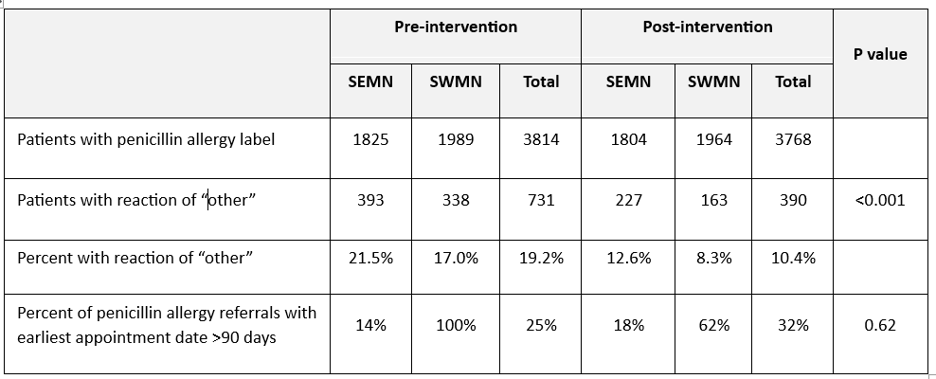
The project also measured the percentage of penicillin allergy referrals with appointment dates over 90 days, finding no significant change (p = 0.62). Limited availability of allergy consultations in SWMN remained a key issue.
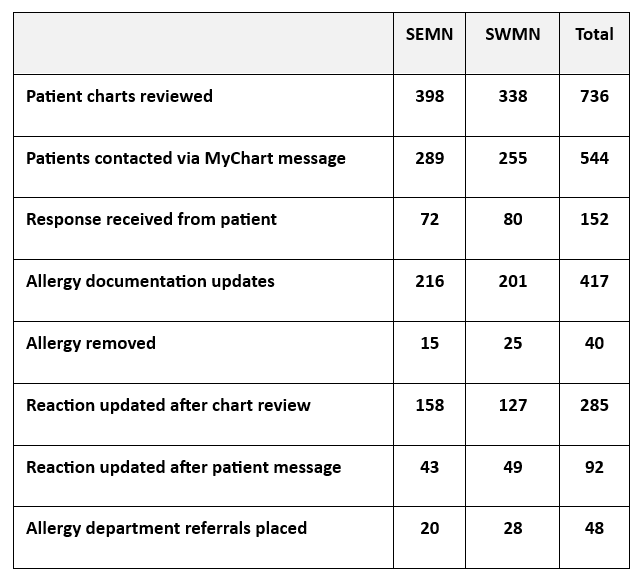
The project tracked the operational steps enabling documentation cleanup and de-labeling: charts reviewed, patients contacted via MyChart, patient responses received, documentation updates, allergy removals, reaction updates (via chart review versus patient message) and allergy referrals placed.
The underlying rationale is that penicillin allergy labels lead to increased use of alternative antibiotics, which may result in reduced efficacy, higher costs and an elevated risk of adverse effects. Consequently, enhancing documentation and eliminating inaccurate allergy labels can facilitate safer and more effective prescribing practices. This project demonstrates a significant improvement in documentation quality as reaction rate of “other” was reduced from 19.2% to 10.4% in the total population.
Implementation tips
- Start with a specific, measurable aim and a clearly defined population.
The project’s success was anchored by a narrowly defined aim (reducing the proportion of penicillin allergy labels documented as “other”) and a clearly specified patient cohort (patients with MyChart activated in specific departments over a defined historical period). Teams should similarly select a single documentation gap to address and define the population up front to simplify tracking and evaluation. - Use simple, scalable interventions before complex testing strategies.
Rather than relying on widespread allergy testing, the intervention focused on chart review and templated patient portal messages to clarify reactions and update documentation. This approach required minimal new infrastructure and allowed a large number of patients to be reviewed efficiently. Other organizations may benefit from starting with documentation cleanup and patient outreach before attempting resource‑intensive allergy testing programs. - Engage provider champions early within each target department.
Lessons learned emphasized that engagement of provider champions was critical to success. Identifying clinicians who support de-labeling and stewardship goals helps improve buy‑in, reinforce expectations and facilitate workflow changes within the department. - Pair patient outreach with staff education.
The intervention included education for nursing/rooming staff alongside patient messaging. Variability in allergy review methods and discomfort with de-labeling were identified barriers; focused education can reduce this variability and clarify roles for reviewing and updating allergy information. - Expect variable patient engagement and reinforce messaging during visits.
Patient response rates to MyChart messages were variable, highlighting the importance of ongoing allergy conversations at scheduled visits to reinforce portal outreach and capture additional history when patients do not respond electronically. - Plan for access limitations and sustainability.
Limited availability of allergy consultation appointments — particularly in SWMN — was noted as an ongoing challenge. Teams should anticipate referral bottlenecks and focus on what can be achieved through documentation review alone. Finally, implement a control plan with regular metric review and a defined trigger for re‑intervention to sustain gains over time.
Resources and tools
Mayo Clinic Health System Mankato Improving Penicillin Allergy Documentation (pdf)