
Building HIV Care in Rural America
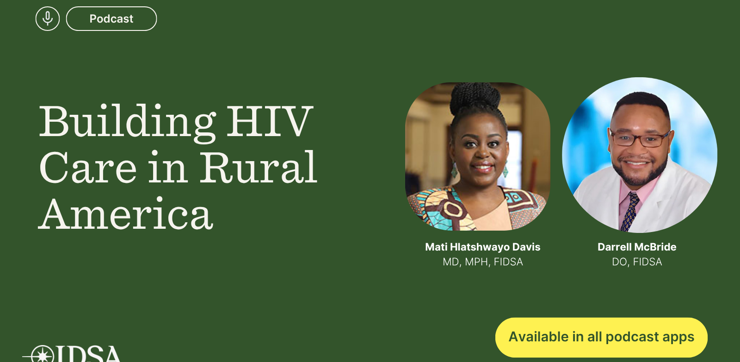

Host Mati Hlatshwayo Davis, MD, MPH, FIDSA, is joined by Darrell McBride, DO, FIDSA, former program director and founder of the Geisinger Ryan White Program, to discuss the realities of delivering HIV and infectious diseases care in rural communities. They explore barriers to care, the role of telehealth and public health partnerships, and what it takes to build sustainable, equity-focused programs in underserved areas.
Details


Mati Hlatshwayo Davis: [00:00:14] Hello and welcome to Let's Talk ID. My name is Doctor Mati Hlatshwayo Davis. I am the executive vice president and chief strategy officer for Missouri Foundation for Health and a current board member for IDSA. I'm so excited for today's podcast because joining me is Doctor Darrell McBride. Doctor McBride is an adult infectious diseases physician, former program director and founder of the Geisinger Ryan White Program and former regional assistant dean of student affairs at Geisinger Commonwealth School of Medicine. He is also an adjunct associate professor at Geisinger Commonwealth School of Medicine. Welcome, Doctor McBride.
Darrell McBride: [00:00:55] Hey. Hey. Very nice to meet you, everybody. It's wonderful to be here. And always a pleasure to be with you, Doctor Davis.
Mati Hlatshwayo Davis: [00:01:04] Well, I got to give him the unofficial bio, which is co fellow best friend, leader extraordinaire, one of the best diagnosticians I've ever had the pleasure of working with. Uh, singer. Chef. Have I missed anything, Doctor McBride?
Darrell McBride: [00:01:19] Oh, you might be giving me too much, baby. You might be giving me too much. But listen, I'm gonna take all of it, especially in 2026.
Mati Hlatshwayo Davis: [00:01:26] Listen, so we're gonna give it to the people. I'm so excited to have you here today because you have spent over eight years leading practicing in rural health care. And I just thought this was such a timely topic to bring in your expertise and your thoughts. So excited to dive in. So my first question is, you've spent over eight years building and leading HIV care through a Ryan White program that you actually built in rural Pennsylvania, which is a largely rural system. So when people talk about rural infectious diseases, what do you think they get wrong and what does it actually look like on the ground?
Darrell McBride: [00:02:05] Well, I mean, I think that's a wonderful question. You know, I'm going to take my spin primarily from HIV because that's what I really centered the beginning of my career on definitively. When I came to Geisinger in 2018, one of the things that I wanted to do there was really build up their HIV management and prevention care. One of the big things that I heard from the physicians who were working there is "HIV, like, why are you here? We don't have a lot of that here." I remember when I interviewed at the institution, my boss at the time told me he had a clinic of maybe 121 HIV positive patients. And I was like, well, do you have any surveillance data? Do you monitor those patients at all? Do you follow them? And the answer was no. There was no like way to really, truly quantify the amount of people living with HIV in that area. So one of the first things that I did, I don't know if anybody is an epic fan, but I looked at slicer dicer, and I found out that there were actually 2000 people just in the two years prior to that had utilized our epic system at Geisinger. So the fact that only 121 people were in care was like a really big deal to me.
Darrell McBride: [00:03:24] And then at that point, I started really reaching out, trying to leverage my resources to figure out the best way to get some funding to really start the Ryan White initiative. One of the major issues there is, first, the issue has to be believed to occur. So you have to understand that someone has to be around to at least visualize that it's actually there. To really believe that this syndrome could be in the vicinity. If you're not looking for it, then you'll never find it. That's the whole issue, right? So not only do you need HIV expertise in the area to be able to handle the disease process, but you need to be able to look for it and you need to know where to look for it. And you need to know how to screen. None of that was being done initially. So they weren't doing a surveillance screening. They weren't surveilling how many patients were actually rolling in and out of their clinic. They had no way to quantify any of that data. That was my number one thing to do was, how many people do we actually have rolling in and out of our system on a regular basis, and can we sort of coalesce them into our care? Now that you have an HIV expert on staff.
Mati Hlatshwayo Davis: [00:04:34] Wow. Love that answer. And I love how thoughtful you've been and reflecting on it, because it's as simple as just being open to the needs and then being willing to meet it. So we know that patients in rural settings often present later, right, and with more advanced disease. So where do you see the biggest missed opportunities in prevention and earlier diagnosis, particularly for HIV and other infectious diseases.
Darrell McBride: [00:04:59] Well, we know some of the main barriers for those who are HIV positive in rural settings primarily stem from, first of all, stigma, right? So not only do you have to have surveillance screening, you have to have the ability for a patient to come in and get screened for whatever you're looking for. That person also has to be confident in the anonymity of doing that screening. So the problem in a rural setting when it comes to stigma is anonymity. I would say. Geisinger employed 85% of the surrounding population. So patients who would come into the clinic, they could be seeing their aunts, their uncles, their neighbors as pars, as administrators, as custodial workers coming into the HIV clinic. That was a big barrier for them to even come in in the first place. So I think that's one of the first standing points. How do you structure your environment when one of the major employers of that area, number one, are the people who live there. Anonymity is a big one. I think another major issue that is well known in the field is transportation and just infrastructure issues. So transportation is a big issue in rural areas. There are no definitive processes unlike metropolitan areas where you have Uber, where you have public transit, whether it be substantial bus systems, subways, those don't really exist.
Darrell McBride: [00:06:26] I mean, in Bloomsburg, which is one of the surrounding areas, which I go, there was a guy named Carl who just drove Uber on the weekends, and he used to drive, you know, the drunk college kids back and forth from the bus. I mean, that was the one guy that they had. So in the crazy part is even if someone has a car, that doesn't actually mean that that car is functional. So if you were to do some sort of study looking at those who have cards and who don't have access to cars. I actually found 50% of my patient population had a car, but only 25% of those who had a car, it was actually functional. That was like a big insight to how big the transportation issue is. So they can't even come in. In addition to that, low resources, right? You don't have good public funding. You don't have good public transportation. You don't have expertise in the area. And in addition to that, you may not have up to date processes for interpretation. When I first came to Geisinger, there was no triple screening for STIs, the site based testing. There were no anal paps. The HIV initial testing was behind. We had to update that. So you're like fighting against structural issues with low resources in addition to access issues.
Mati Hlatshwayo Davis: [00:07:47] You know, I'm always going to make a plug. This is why I fight so hard for public health, because these very common, very basic, you read them in a textbook eons ago, social and structural determinants of health are the real barriers. And I was able to attend a really great presentation for Washington University's CFAR last week, where implementation scientists there were doing some really great work around those social and structural barriers to people coming to their HIV clinic in this setting, let alone. So I just think there's opportunities for us to continue to innovate around. Sure, it's a tried and true issue that we know about, but what how are we addressing it? What new data systems are we employing? But more importantly, what new and innovative approaches to dealing with it in rural settings? Right. Um, this new role that I have now expands my work into philanthropy, as you know, across Missouri. And I've started my visits into the Boot Hill, obviously now on the funder side, but everything you said is what we're seeing. Right. And so that tease us a lot for my next question for you, which is there's a lot of emphasis on telehealth and other technology abled models, right? Where have you seen those approaches make a real difference and where do they fall short in rural ID?
Darrell McBride: [00:09:03] Well, I'm going to be honest with you. I think that telehealth is the wave of the future. I think it's helpful. The problem is you have to implement it appropriately by understanding your patient population. And so what I mean by that is most of the patient population that I deal with in rural settings, slightly different demographically than metropolitan areas. And what I mean by that is my patient population is 60% Caucasian and 56% are above the age of 50. Right. And so we're dealing with people who may not be as technologically savvy, right, as some of the younger cohort that folk may deal with in more metropolitan areas. In addition to that, we're also in a large catchment area. So rural areas, unlike metropolitan areas, which tend to be really compact with tons of resources in the center, rural areas are very expanded. So there's a wide net of possibilities. So what I mean by that is you may have a very up to date savvy Farmer Bill, who doesn't just use a flip phone and is fine to do telemedicine services via his phone. But then you have, you know, Farmer Curley, who uses a fax machine, lives in the middle of nowhere and doesn't have wired internet. They use satellite whenever it works. On a cloudy day, you can't get in touch with them.
Darrell McBride: [00:10:29] So the model that we actually use was not only using, you know, access to smartphones, but also having sites, where patients can drive to still get that telemedicine service, but it'd be more locally. And it could be with someone who can help them with the technological issues, right. So it'll be, um, a clinic on site where they can just Teladoc service versus doing it from their cellular phone. So you have to understand your patient population well in order to be able to choreograph a decent success. I mean, otherwise you're, you know, spending, not understanding what's going on with your patient population and feedback is important. The way that I even got to that was by asking by doing surveillance analysis. How is this working for you? Is this amiable for you? What are some challenges in getting definitive feedback from your patient population? So yes, do I think teleservices or the wave of the future? I think we all should utilize them. But you also have to understand your patient population, how to implement them in a rural population, as well as understanding your patient demographic and what they're capable of.
Mati Hlatshwayo Davis: [00:11:40] I love that answer. So there's a lot of focus right now on building and sustaining the rural health workforce. From your experience, and again, I'm going to plug because you're too humble sometimes that you literally built a Ryan White program that didn't exist at Geisinger from the ground up. Um, I was one of those earlier calls. I'm proud to say that I took them. They now have a thriving program, right. So I know you have hands on experience in leadership in this area. What's actually worked from your experience and what hasn't translated as well in practice?
Darrell McBride: [00:12:11] Well, that's a really good question. You know, I think community building is the best way to do any program build. So I started at Geisinger in 2018. One of my main things that I wanted to do was understand the community. I'm from the city. I'm from Baltimore. There's not nothing I know about a rural anything. At that point, I hadn't grown any sort of anything. I had me in dirt was okay. It exists. I walk on it. I know that you need to grow things from it. But if you ask me how, I'm not going to give you that right. I can tell you how to get to the 711, though. Okay, so, um, I use Amazon Prime like a demon in the night. So I'm going to be very honest with you, there's not a lot that I understood about a rural environment. So I had to really sit back for like the first six months to a year and really listen to my patient population about some of the issues and not only my patient population, but other community resources. So we have other Ryan White, part B funded agencies, AIDS resource caring communities that have been working in the area for tens of years. Right. And they have been doing the work. And I asked them, I want to do this work too. What do you need for me as the medical provider? Because they were mostly case management focused. What do you need me for me as the medical provider to add to the resource, not take away.
Darrell McBride: [00:13:34] My job isn't to duplicate, but how can I add and really increase our catchment and our effectivity in this area. And so, you know, I build a bridge between not only patients, but some of the community vendors. And they gave me ideas on how to build this. Right. So first we need medical case managers. We can't get in touch with the physicians. We need labs. We need this, we need that. The physicians are too busy to call us back. So I'm going to use an intermediary. One of the first things I did was get a case manager. And Ryan White does not exist without case management. God bless. It does not exist. They are the heart, the cornerstone of it to begin with. That was the first thing that I did. I got two and I prefaced it. Medical case managers. These are people who understand the medical lingo. They're going to understand what viral load with CD4 counts, all of those things mean they're going to be able to relay appropriate information to our community partners so that we can better communicate. So that was like a big push and that really helped our success quite a bit.
Darrell McBride: [00:14:41] And then I built off the needs from that by creating constant conversation. We met every month for years. We had community building practices. We collated our resources, we did funding opportunities together. So it was something that I built collectively, not just with my institution, but the community and some of the program community programs and the surrounding area. And I will say, you know, I was fortunate enough to be granted Ryan White, Part B funding. I gotta tell you that Pennsylvania Department of Health, I can't love them enough. They really came to the rescue. They said, Doctor McBride, we see that you are motivated and we're here to help you. So they started me off with my first little grant. I subsequently have gotten five increases from them, where I topped in the 800,000 for a Ryan White B funding, and then eventually that was 2020 during the pandemic, which was fun. And then I acquired a part C funding in 2022 that was about 1,100,000 over three years. It really turned into quite a large entity, but it was because there was so much need and so much support. And I fortunately had the data initially to back all of that up by initially starting with slicer dicer, and then subsequently building my own HIV patient registry where I can monitor people effectively.
Mati Hlatshwayo Davis: [00:16:09] An incredibly powerful story. And you said, listen, as the primary answer to two questions. And community participatory approaches have become buzzwords that truly lack folks that I have either a. built the relationships in order to be able to lead in community participatory approaches. It's one of the reasons why I joined Missouri Foundation for Health, who have become trusted leaders across the state in specifically that and in health equity ecosystem building work. And I heard that in your approach, you didn't use that buzzword, but it's exactly what you did to build it from the ground up. And I often get frustrated when people are looking for new papers, new research, new data to document where we should be going here. And yet these are tried and true principles that we just haven't been consistent enough in implementing. The second thing I'm going to plug, and again, me and my soapbox, you are willing to collaborate with public health and with the public health department. And I think that is a failing and an opportunity. A lot of the times, and I think infectious disease physicians do this so well, is that we have the skill, set the lingo and understand the reasoning behind the necessity for that partnership. So I love so much. I want the viewers to know I didn't pay him to say this. I didn't even know what this man was gonna say. But I'm gonna be smug all day long, all week long and all month long, because these answers speak to my heart. Were there any things that didn't work as well, or any reflections or growth areas over that time? Because I think those nuggets can be as helpful for people who are starting to do this work, or considering this work in the future that you reflect on as well.
Darrell McBride: [00:17:48] Well, one of the things that, you know, as a, I would say a novice in really building a bridge, I was good, fortunately, at building a bridge with the community, the community outside the hospital institution. But I didn't really have a legacy initially of building a bridge with the actual medical institution and its leadership initially. I will say this, I think one of the big barriers that, you know, you just sort of have to learn on the job as a medical professional is you want to build something that has an institutional focus. You want to get the institution involved. But it's not just the grant department, it's the leadership. On top of that, it's the CFO and the CMO and the CFO.
Mati Hlatshwayo Davis: [00:18:34] You need that institutional buy in, yeah.
Darrell McBride: [00:18:36] Yeah, you definitely do. And it's not that I didn't have it initially. They just didn't understand the extent to which I wanted to spread what my plans were from the future. And the more that I incorporated them into my future plans, or I started having meetings that incorporated them pretty regularly, they actually were more edified on HIV in general. And then in addition to that, there were more willing to allow me to do some of the more outrageous things that I had planned that ultimately worked. But, you know, it took some convincing.
Mati Hlatshwayo Davis: [00:19:10] So I love that reflection because you are also a change management leader. You had to educate, you had to constantly come back. You had to gain trust institutionally and in community. That's a huge feat. But I love that you reflect on both as the key to your success. So I'm going to kind of bring us to a wider scope here, right? With the current push to prioritize rural health funding at the federal level, what would it take for those investments to meaningfully improve infectious diseases, care, and outcomes? And for folks who are listening and aren't as plugged in, there's been a lot of disinvestment in public health over the last couple of years specifically. But honestly, I don't believe the public health funding and resources have been prioritized as they should in this country for a long, long time. Right. The numbers are reflected at a federal level and across states. We're seeing now, though, a big push to bring federal funds this year into state funding. And the priority is for rural health care. And so as you're hearing about this, and as you're seeing some of these dollars starting to roll out, we've already started to see some of those preliminary dollars roll out here in Missouri. What would it take for those investments to meaningfully improve ID care and outcomes in your mind?
Darrell McBride: [00:20:26] I don't know on a scale from 1 to 10, the level of shadiness this might be, but I'm going to say, is it a push for rural healthcare? Is it truly? So you know, the one big, beautiful bill, whatever you want to call it, takes a substantial Medicare Medicaid cut, which I gotta tell you, as someone who worked in a rural environment for the last eight years, many of the hospitals in rural environments survive off of Medicaid reimbursement. They survive off of it. When you cut like $600 billion to $1 trillion in that over the next like ten years, and then you say, but wait, I'm going to add $50 billion over the next five years to rural settings only. I don't know how that can be an addition. They're adding something, but they've taken away more.
Mati Hlatshwayo Davis: [00:21:18] That's right. So it's a more complex thing than to say, can it look like a big number? But you have to take everything into context. You know, it's very interesting. We are fortunate enough internally and across the state of Missouri to have a lot of partners who need around policy decision making, and they've been saying some of similar things, right? You know, some of the things that we've lost specifically about around Medicaid and Medicare have distinct impact on rural communities who often have some of the lower socioeconomic status. You know, my prior role was director of health for the City of Saint Louis, and I had a lot of data that talked about the gap there. But when you talk about the boothill of Missouri, when you talk about some of the most disinvested areas of our state, that actually impacts them as significantly and in some areas even more. Right. With the push for these new dollars, at the same time that there are disinvestments around much needed priority areas around social and structural determinants of health and the resources there within. That's a very, very, very fair statement to make.
Darrell McBride: [00:22:22] I mean, in essence, it's sort of like cutting off both your feet, giving you back a toe and asking you to walk forward. Huh? How are you going to do that? So, hey, you know what I mean. Uh, how is that going to work if you take away my funding and then give me a little bit back, right? What kind of help is that going to be? The crazy part about it, too, is that people are being asked to anticipate a need. You have to write a formal write up for this money. It's not given to you to give whatever you want. No, it's given to states, surely, but the states are asking you then to write up a process for which you. So you're having to predict the future, unlike Medicaid, which is going to be a guarantee. It's going to be a reimbursement that you wouldn't have gotten otherwise. So tell me what makes more sense? Predicting the future in health care for what you'll need, or after money has been taken away from you or right just being reimbursed for what you do. So it's going to be more effective to be reimbursed for what you actually do. And then you can see potentially what you need in the future, what they need to do instead of cutting, they need to expand. That's what would help everyone out. So they need to expand. They need to give access to everyone, including the most maybe prioritized, the most marginalized, because that is where disease manifests. When you live in a low resource environment, like I did when I was in a Geisinger, it was a low resource environment. When you have 1 or 2 people enter with a communicable disease, it spreads like wildfire because people aren't getting tested. It just blooms. You can see that in West Virginia. This is data that exists.
Mati Hlatshwayo Davis: [00:24:04] Thank you so much for that reflection and for your leadership in patient care. But in the wider systemic approach, you've been very intentional about equity in HIV care. Can you talk a little bit about how stigma, race and other social factors show up differently, or do they in rural communities and how that should shape how we design programs.
Darrell McBride: [00:24:26] I would, you know, reframe maybe and say not differently. More pronounced what I found, you know, in my patient population. And again, I'm using most of this data based off what I know because it's what I did. Right. But our African American population is 27% of our overall right. But at Geisinger, there are less than 5% of African Americans are served by our system. So that means we're collecting a lot more African Americans who have disease than we are actually servicing. Right? That doesn't make a whole lot of sense. That's where the disparity comes from. In addition to that, based on presentation alone, they are far more prolonged in disease. They come in much more late stage than some of our Caucasian patients, which to me just shows even more lack of resources, I would say more pronounced, more definitive, and more severe. If you take a marginalized person and put them in a low resource environment, it only worsens the potential outcomes. And so that's what I saw when I initially came there. I mean, you know, I practiced at WashU. Coming to Geisinger, I diagnosed within my first year Kaposi sarcoma six times. I had only seen it once prior to. And that person was well controlled. And so I felt like I was transported back in time.
Mati Hlatshwayo Davis: [00:25:57] No, I can vouch for this because we're still in a fellows group chat that, uh, has been a source of great joy and comfort and support since our fellowship. And Daryl is the only one who had literal case studies literally just round the clock, right? We don't mean to say that in any sort of flippant way, but it just underscores what you're saying about how more pronounced, not necessarily different, and how real that is in rural settings. So I just really appreciate that reflection.
Darrell McBride: [00:26:27] And I will say in the inverse, the beautiful part about the Ryan White structure is it makes you focus on subpopulations that you wanted to monitor more closely. Um, and we had African American MSM and African American women. And what I will say is because of the focus that we had on the more marginalized, we had Latinx, we had LGBT, we had trans. These were some of the more marginalized groups we sought out and we focused on, we were able to increase their viral suppression. So initially when I started, the viral suppression rate at Geisinger was around 31.5%. And that's because they weren't routinely monitoring patients. You know, by the time I left in February of 2020, we were at 95% viral suppression. And in African American men who have sex with men 95% hitting the mark there. And with African American men, women 100%. So when you take the time to actually focus and support those marginalized populations, it does work. The data does show itself. I speak a lot of that to my staff at the time, to community activity, and focuses to increase education and to institutional support. All of those things really help that happen. That's something that I'm very, very proud of, because that's one of the reasons why I wanted to come into this work in the first place. I felt like there was a disproportionate amount of people who looked like me affected. And I am Black, by the way, just in case, you know, you can Google me to look me up. You know, that is one of the reasons that pushed me into this work in the first place. And so I felt really encouraged by that. And I do want everyone to know that there's definitely an increase. Whatever you saw in metropolitan areas, it's just going to be manifested to a more severe degree when you move out to the rural areas.
Mati Hlatshwayo Davis: [00:28:19] So if you could prioritize one thing for rural infectious diseases over the next few years, what would it be? Wow. I know that's impossible, but I'm gonna push you here.
Darrell McBride: [00:28:31] I know, but I feel like it's also obvious. I hate to be that guy, but I'm just gonna say funding how it was done and oh, b b b b was not the way to do it at all. We need to expand the resources. A random small amount of focus just on one area ain't going to cut it because people travel. It's an all or nothing. You have to put all of your resources into something or else you won't get anything done. It'll just be a band aid over a chasm. And that's not what we're asking for. We want definitive, active, and true thought processes when it comes to stamping out disease. We want people to be invested in eradicating disease. And that comes with moolah. That comes with money, that comes with legislation and that comes with action. And without those things, then we'll be dealing with the same issue. So money.
Mati Hlatshwayo Davis: [00:29:23] Doctor McBride. Word of the day is moolah. I want to say how much I've enjoyed having you while I have the pleasure to call you a lifelong colleague and friend, I hope for those of you who are getting to hear from Doctor McBride for the first time today, this has been an opportunity to think more deeply about how we are equipped to lead in rural health care, how we are needed to lead in rural health care, and how proud I am to be in a field where that is happening across the board with a lot of incredible leaders like you, Doctor McBride. So thank you for joining us. I will talk to you. See you. You will hear from me soon. Thanks, everyone.
Darrell McBride: [00:30:02] Thanks.