
Finding Your Place at IDSA: Why Getting Involved Matters
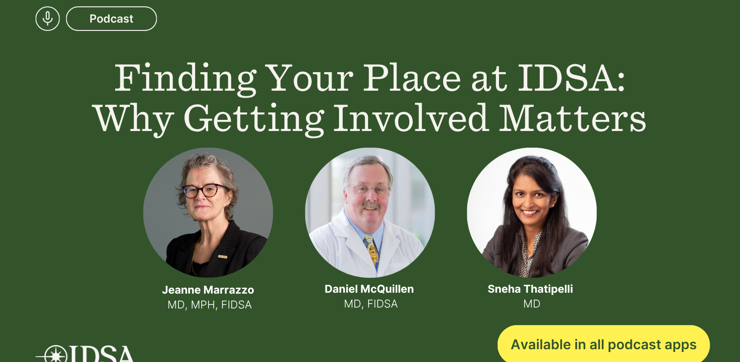

IDSA CEO Jeanne Marrazzo, MD, MPH, FIDSA, sits down with Past President, Daniel McQuillen, MD, FIDSA, and private practice infectious diseases physician, Sneha Thatipelli, MD, to discuss the value of volunteering with IDSA, finding the right opportunity and how getting involved can shape your career.
The 2026 IDSA Call for Volunteers is open now through Friday, July 31. Apply (member login required).
Details


Jeanne Marrazzo: [00:00:14] Welcome to Let's Talk ID. I'm Doctor Jeanne Marrazzo and I am the CEO of the Infectious Disease Society of America. I'm joined today by Doctor Dan McQuillen, who is the director of solid organ transplant in the division of infectious disease and also assistant professor of medicine at UMass Chan Lahey. He is also a past president of IDSA and currently serves as the chair of IDSA's Leadership Development Committee. As you'll hear, that's a committee that is really critical to deciding who moves forward for leadership opportunities at IDSA. My second guess is doctor Sneha Thatipelli, who is an associate physician at ID care, a private practice based in New Jersey. So we're doing this podcast today because IDSA's call for volunteers is open now through July 31st, the end of this month. I've asked Dan and Sneha to talk with me about how to get involved with IDSA and what made them decide to volunteer. Dan, let's start with you. Tell me about the open call for volunteers and what the Leadership Development Committee is looking for.
Dan McQuillen: [00:01:21] Thanks, Jeanne. It's very wide open. You know, the Leadership Development Committee itself was put together to have a more, I guess egalitarian is the right word way of picking people that work on the various committees that we have and also being a little bit more. Well, actually a lot more intentional about trying to be as inclusive as possible across all sorts of different kinds of metrics of how we're different. And that could be pretty much anything. The Leadership Development Committee itself is primarily in charge of selecting those that go into the board and the leadership track. That's our major job. But as well, we look through all the different committees and weigh in on chair, vice, chair selection. We don't at the moment get quite down to committee members and which ones, but we help out with direction of that. But this call for volunteers is really for the entire kind of base of what IDSA is. IDSA has transitioned, at least the time I've been involved, from more of a top down to a bottom up, uh, society. And there's really a lot more opportunity for people who might not have had a chance to get involved in the past to get involved. And so we'll talk a little bit about the different opportunities. I think one of the things I hear from people about volunteering is, oh, it's going to be a lot of work, and particularly in those that are primarily in practice, where a lot of their living comes from being in practice, there's always a concern that maybe it's going to be overwhelming.
Dan McQuillen: [00:03:05] And believe me, we have things that require very little time, effort, and some that require a lot. But all of them, I've worked through many of these levels, and you can find a way that you can do something that's really impactful, and it doesn't overtake what you do to make a living. And then just to talk about diversity. We use a really broad definition. It's not just race, ethnicity, and gender, but it's also where our members are located geographically. What kind of practice are they in? Are they academic? Are they employed? Are they in private practice, that sort of thing? And then what stage in the career they are? It's one of the difficult things to do is to try to find people who have a lot to offer, but really haven't been involved very much and get them involved. And what we're trying to do is widen that network and let people have opportunities because the more we do that and the more diverse people we get involved, the better off our society is. So that's kind of a long winded answer, but that's what I see about what we're looking for.
Jeanne Marrazzo: [00:04:12] Yeah. Thanks, Dan. I think that's a great way to open this discussion. And if I could just pick up on a couple of things you said, like, I've been involved with IDSA really most of my career. And I think one thing people don't often realize is that involvement in professional societies like this are a great way to grow your leadership skills because you're outside of your institution, you're exposed to people who you know, who are different and work in different environments. And the role modeling that you can experience, I think is really unparalleled and helps a ton in terms of professional development. I remember meeting you at one of our board meetings in Jackson Hole, and it was fantastic to get to know your work and what you did. And it was just really opened my eyes having come from a pretty academic environment as a physician, a researcher for most of my career. The other thing you mentioned that I'll just pick up on, and then I'm going to go to Sneha because I'm really looking forward to hearing her perspective. You know, I think there has been a perception that IDSA, in many ways, some of the leadership opportunities have been a bit of an inside club. You mentioned the top down thing, and that was maybe a little bit of who you know, I really want to point out how dramatically that's changed when I look at the leadership from even ten years ago. There is just a sea change in how you and your leadership and others have approached getting folks involved and really making leadership look much more representative of our membership, which is the goal. So I really want to thank you for that and look forward to hearing more of your thoughts, especially about the opportunities that we have. So Sneha, let's go to you. I would love to hear how you got involved with IDSA. And if you could tell us a little bit first about what you do and what your job is like and why you decided to pursue this opportunity.
Sneha Thatipelli: [00:06:01] Yeah, sure. So a little bit kind of about my clinical practice. I am in private practice in New Jersey. I work for a large private practice group called ID Care. And I'm relatively new out of fellowship. So I graduated about two years ago and first got involved with IDSA in residency, where I submitted a poster and got to present it at IDWeek, which is super fun. So a lot of my clinical duties are rounding in the hospital. I'm very clinical, and I do a little bit teaching for the residents that rotate with us. Why I chose to get involved with IDSA? I've always been involved with hospital leadership and administration and residency leadership and a lot of my training. So after finishing fellowship, it was kind of the next natural step for me to get involved with a professional society. And I completely agree with what you guys said earlier about how it's a great way to grow your leadership skills and kind of meet people working in different settings. I think without IDSA, I wouldn't have met people in ID working all over the country. I moved a lot for training, so I know a lot of people in different academic centers, but I've had the great privilege of working and meeting people, working in different types of settings and learned a lot through that. And right now, I am part of the executive committee for the Private Practice Community Practice in IDSA. And it's been really fun kind of working on different projects with some of the different members there. We are currently working on creating a specific web page for our community of practice, creating a pipeline for fellows to get more involved with, or learn more about private practice, if that's what they're thinking about doing. And we are also creating a specific job board for fellows looking for a job. So our whole focus is trying to be a resource for the workforce in private practice, for ID practitioners, and kind of being a resource for fellows interested in the area.
Jeanne Marrazzo: [00:07:58] That is so fantastic. I say that because I think when I was sort of coming up in the society, we've always had a healthy proportion of members who are in private practice but disproportionately poorly represented leadership. Right. And I think that is probably a multifactorial situation, one, I'm not sure the organization has always looked inviting because it's always been run by sort of, you know, I like to call myself a pointy headed academic. You know, that's kind of what I think about it. Not always. Of course. We've had some incredible leaders from private practice, but I think it's only been in the last several years that we have really, really emphasized that, you know, again, if we want to look like our members and if we want to serve our patients and our community, there's just no way that we can't have a really healthy representation of people who are doing what you do. So thank you for getting involved and getting involved so early in your career. I want to ask you a little bit. Something that Dan alluded to is the time commitment, because obviously in academics, to some extent, we have more flexibility in terms of where we do what we go meetings we can go to. But tell me a little bit about how you are juggling the responsibilities of your clinical career and your pretty enthusiastic participation in some of the commitments you've made to IDSA?
Sneha Thatipelli: [00:09:15] I'll be honest, I was a little nervous about the time commitment when I signed up, but to be quite honest, it's very flexible. I would say on average it's about ten hours a month and some weeks are a little bit heavier than others. When we're really working on a project deadline, trying to push something towards the finish line. A lot of it is collaborative, so I'm working closely with some of my committee members to work on, you know, this web page, this job board that we are creating. So it's honestly been kind of fun. And I think when work is fun, it's less work and more fun. It's been nice to just learn from people and their different perspectives of where they work at. So I would say the time commitment is really not that bad. And most of the meetings we take during the business day. There's not as much time commitment later in the day. We try to be respectful of each of our personal commitments outside of work. All in all, not too much of a time commitment. And it's also kind of what you make of the opportunity. So some opportunities, I think are a little bit more time intensive than others. So there's definitely very different opportunities along across the board. So whatever you're interested in, I think you just got to find the right fit.
Jeanne Marrazzo: [00:10:24] Yeah, thanks for that. And we're going to talk a little bit about that because our call for volunteers gives you quite a menu of things. The other thing I will say too, about the time commitment is that one of the reasons I've always loved working with IDSA is that the staff are truly unparalleled. I mean, the staff are just they go above and beyond to support all of the committees and all of the groups that are doing this work. So much of the heavy lifting is done by staff, and we have a lot of staff who support the key committees in particular. So we want to hear more. I mean, if we can adapt some of these processes to make it work better for people who are in private practice, we really would love to hear more because I think we do need to be more flexible. So thank you. Thank you for that. That sounds really great. Dan, I'm going to go back to you. You've been involved with IDSA for a long time. You came on board as president, I believe, as as the pandemic was raging. I would love to hear a little bit about when you decided to volunteer, what kind of volunteer position you've led, what has it meant to you, and how did you get to be the president?
Dan McQuillen: [00:11:31] I was thinking back, I think I started formally, I mean, I started going to the meetings and when I was a fellow and I think 1988 was the first one I went to. And at that point it was, you know, a tag on to ICAAC, a two day ballroom meeting with famous people, talking pretty much. And it eventually morphed into a bigger the annual meeting and then finally to IDWeek. But I started probably about 2004. So I'm past my fellowship by about 8 or 9 years, something like that. And I ran into a medical school classmate who was involved in IDSA and he said, you know, I'm going to be on the Clinical Affairs Committee. I'm going to be the chair. You should apply to that. And I said, I have the last couple of years, and I never heard a thing. So he sort of dragged me into that willingly. And I spent probably from then to, I think, 2011 on that committee. Now, that was sort of the original private practice committee in IDSA that did a lot of work of trying to elevate people that do what Sneha does and what I do in a different way. And we did a lot of things that brought a lot of topics that were really pertinent to people out in practice, to the forefront, and worked on trying to make things better for that in a lot of different ways. That has sort of morphed into what we have now as the Physicians Compensation Initiative and some other things along those lines. I got involved through that committee representing IDSA to the AMA process that values what we do eventually, and this is back to the staff you're talking about culminated at least so far in a couple of things.
Dan McQuillen: [00:13:11] That committee has developed materials that help people argue for better compensation, both in academics, but private practice. But also the advocacy group was key in getting a code from CMS that pays for extra work that we've always done with our inpatient work, and it's been just phenomenal in terms of increased revenue for all levels of ID doctors. And after being chair of clinical affairs, I was asked to be on the program committee selected for that and then eventually ended up being the program chair, I think, in 2016. And then I got elected to the board after that. And after that got elected into the presidential track. I didn't go to a famous medical school. I mean, it is famous where I was the Medical College of Wisconsin. So it wasn't like there was a benefactor shepherding me through this. And a lot of it came from just joining that group that Sneha talks about people that are really invested in this, that have fun doing it. Getting to know people contributing, and people recognize that. And then, you know, that helps encourage you to go further. I often tell people that I started out in research, and I've published more through work I've done with IDSA than I ever did in research, and it's been more impactful, frankly. And, you know, as the father of three daughters, I'm keenly aware of parts of our population that don't get recognized. And if people don't lift them up and get them involved, it doesn't happen. And so I've been trying to do that in a lot of the other leaders have as well. And you're right, it's light years different than it used to be.
Jeanne Marrazzo: [00:14:53] Dan, there are so many reasons we love you and appreciate you, but you've just encapsulated several of them in those comments. And I know your daughters are pretty fantastic. So, you've done a great job. You know, your comment about not having a benefactor. Is really critical because so many people, you know, really don't think they have quote unquote, the connections. And if I could destroy that assumption in these conversations, that would be amazing. I in the last six months that I've been CEO, I've done a bunch of talks. I'm really interested in mentoring young people, promoting leadership skills. And there are so many people who are not just ID physicians, but even our PhD colleagues, our advanced practice provider colleagues, our pharmacist colleagues who really want to get involved and recognize the value of the kind of advocacy we do, which you mentioned, has tangibly paid off in terms of getting us resources that we really deserved in the first place. So I want to emphasize that this is a really big tent, and we really want people to participate. I want to mention, and I think we were going to talk about this Dan, at some point, But the call for volunteer opportunities that came out is, I think, about six pages or something crazy. I mean, if you can't find a committee that you could embrace and enjoy, I would be surprised no matter what you do.
Jeanne Marrazzo: [00:16:13] There's everything from medical education to professional development to private practice to immunocompromised hosts. Standards and practice guidelines, quality, mentorship. So please take a look at that. The other thing I want to mention about this is that many people have said, well, how do I get involved? I haven't even seen a call for volunteers. That's because we haven't done a call for volunteers in a few years. And that's kind of a combination of factors coming off the pandemic, for sure, and then sort of trying to get things stabilized in a few other operational areas in the last couple of years. So this is a really big year. So we really want a healthy influx of people who can join and can do the kinds of things that we are hearing about from Dan and Sneha, so thank you. I also want to mention we have been talking a lot about our global footprint in infectious diseases. You know, we traditionally have been known, I think, as a very US centric organization. We have about 12% of our members are international, many Canadian, many from Latin America. In the absence of our participation globally in entities like WHO and some other folks, some other groups, I'm really eager to hear from people who would like to help us do that. So please consider that if you're listening from someplace outside the US, because it's a really important thing to grow. Sneha, I'm going to come back to you and ask if you would like to add anything to that discussion.
Sneha Thatipelli: [00:17:45] I would just emphasize the push for getting involved. I think you can really make a large impact in the work we do across the nation. I have always trained in very academic centers and now in private practice, I've kind of had the benefit of seeing both worlds, and it's been really fun to kind of get involved and engage with really passionate people, providing ID care for our patients. And I think you can just increase your footprint when you get involved in professional societies like this and have a large impact. So definitely encourage it.
Jeanne Marrazzo: [00:18:16] Plus, you know, we're a really fun group. We like to support each other. We like to have fun. I think I loved your comment about, you know, when work is fun, it doesn't really feel like work. And boy, that is so true. And I think infectious disease community is, I think truly has embraced that. So I think that's pretty wonderful. One other thing before I turn it back to Dan to see if he has any closing comments. Dan, you mentioned that you applied a couple times and you never heard anything. This is the thing that I have heard this year from people who have expressed some frustration about, you know, applying, not getting chosen, not knowing why they weren't chosen, not really hearing back. So we are really taking those comments seriously. In fact, Dan and I and Steve Schmidt, former president, are working on really trying to come up with a way to let people know what actually happened with their application. How can we support them to get involved, even if they didn't get selected for whatever they applied for? And we're getting ready to hire a new director of governance here at IDSA, who I think will be really helpful in that, because it takes a lot of time to apply to think about it. And we don't want people to be turned away when we need as many people as we can get to be engaged. So looking forward to that. Dan, any comments that you would like to close this out with?
Dan McQuillen: [00:19:34] Just a couple of things. I think one of the few good things that came out of suffering through the pandemic is that we discovered the ability to have people all over the country meet in online Zoom things to get things done. And so one of the problems with, you know, being on a committee and having meetings that you have to travel to is that takes an incredible amount of time. And you can basically arrange meetings that fit everybody that get a number of the things done. They're not as fun as being in person, but they get the work done without encroaching on your primary job. The other thing I'd say is we went through a governance restructure, I guess, where we had the classic thing with 60 or 70 committees that were a mile wide and about a foot deep, and basically collapsed that structure to make more sense in five big areas. There's the IDA&E committee, IDWeek program committee, professional development, practice and quality committee, and the public policy and advocacy committee. There are a number of subcommittees under these. And then the communities of practice fall in where they make sense. But all of it kind of relates up to the direction that the board comes up with in terms of our strategic goals, and is a good way of making sure what we're doing is actually pushing that forward instead of just going off and doing things for doing things. And I think, you know, it's still young, but it's starting to get there. I guess the one thing I would say about those different opportunities is the farther down you get towards community of practice, the less kind of stringent work there may be, even though there is a lot of work done.
Dan McQuillen: [00:21:17] And so one of the things that's available is basically a little summary of how many in-person meetings, how many virtual meetings, how much time do you think you would be called on to spend on these things, which I don't think we've done a good job of letting people know. Anyone can look at that and say, that's too much or whatever, but we like everybody who can give us an afternoon to get involved. And I think in terms of the committee I lead, one of the things we try to do is when we look at leadership candidates, at least for board and everything else, is divorce ourselves from where they are other than maybe state what institution there are things like that, and look at what they personally offer and try to pull up people that are in the spot where I was where nobody really knew who I was. And make sure we don't forget to talk about them. It's not surprising to me that some of those people bubble up to the top, just based on what we can see in them. And I think as part of the process that Jeanne was talking about reaching back out and saying, okay, here's your application and here's where it could have been better and where we were left wanting for things that tell us what was special about you.
Jeanne Marrazzo: [00:22:32] Yeah. Thank you so much, Dan. I think that's really, really very helpful. And I want to pick up two just quickly on your comment about using Zoom. You know, back in the old days, it was easy for people, famous people to just take off for a weekend because there was somebody at home to take care of the kids. There was often a secretary to take care of the office. That is not the reality for so many of us right now, and many of us want to be home, to be with our family. So trying to accommodate that and the way that our society has changed in a very positive way is really important, and we're very sensitive to that. Thanks to both of you for this really great discussion. And I hope to our listeners, it's really clear there are many ways to be part of the society. There's a place for everyone, no matter where you are in your career or what your area of focus is. I also want to emphasize, if you have questions about any of the opportunities, please reach out to me. I can find somebody to answer the question that you have about those committees. Maybe you want to wait till next year, but you're just trying to figure out what to do. Please reach out. We're here to help you. So our call for volunteers, as I mentioned, is open now through July 31st. Visit the IDSA website at idsociety.org to learn more about ways to get involved. And thank you again, Dan and Sneha and I look forward to seeing you both soon.
Sneha Thatipelli: [00:23:47] Thank you.
Dan McQuillen: [00:23:48] Thanks.