
From IV to Oral: What the COPAT Trial Tells Us
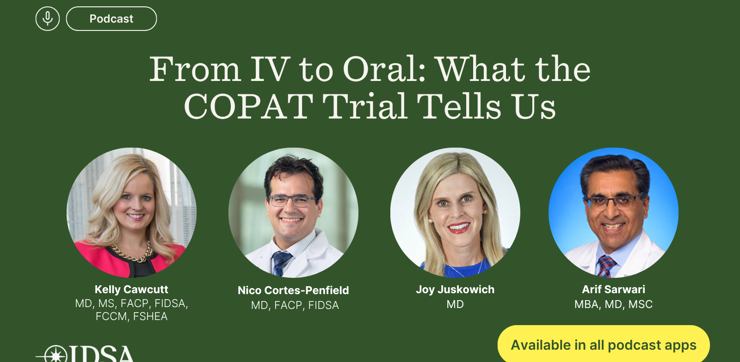

Meet the newest voices behind Let’s Talk ID. Infectious disease physicians Kelly Cawcutt, MD, MS, FACP, FIDSA, FCCM, FSHEA, and Nico Cortes-Penfield, MD, FACP, FIDSA, join the podcast as co-hosts for episodes focused on research published in IDSA journals. In their first episode, they speak with Joy Juskowich, MD, and Arif Sarwari, MBA, MD, MSC, authors of a Clinical Infectious Diseases study on early transition from IV to oral antibiotics and discuss its implications for clinical practice.
Details


Kelly Cawcutt: [00:00:14] Welcome to Let's Talk ID, a podcast from the Infectious Diseases Society of America. I'm Dr. Kelly Cawcutt, an infectious disease and critical care physician from the University of Nebraska Medical Center. And I'm delighted to be co-hosting with my colleague, Doctor Nico Cortes-Penfield.
Nico Cortes-Penfield: [00:00:31] Hello, I'm Nico, and I'm also an infectious disease physician at the University of Nebraska Medical Center. My work focuses on musculoskeletal infections in OPAT. Hey Kelly, remind me again, why are we on IDSA's podcast?
Kelly Cawcutt: [00:00:45] That's a great question. We're doing a new series of episodes for Let's Talk ID, highlighting some of the most exciting work that's been published in the IDSA journals, including CID, JID and OFID. We'll pick our new favorite articles from each journal and then invite their authors to come chat with us about their research and what they love about their work. Our goal really is to share can't miss new research from the field, and sometimes, maybe more importantly, to introduce the listeners to some of our brilliant and amazing infectious disease colleagues from all over the world.
Nico Cortes-Penfield: [00:01:19] That's right. Awesome. Speaking of which, thank you for letting me have the first pick of article. So I went with Clinical Infectious Diseases for this one. And my favorite CID paper from the past six months or so was the COPAT trial, or as it's titled, "Using the Comparing Oral versus Parenteral Antimicrobial Therapy (COPAT) Clinical Trial to Influence Institutional Practice Transformation Towards Earlier Transition to Oral Antibiotics." And so to tell us about their work, we've invited the first and senior authors, doctors Joy Juskowich and Arif Sarwari, both infectious disease faculty at West Virginia University in Morgantown. Joy and Arif, thank you so much for joining us.
Joy Juskowich: [00:01:55] Thank you very much for having us. It's an honor to participate in the first episode of Let's Talk ID. I'm Joy, an infectious diseases physician and the medical director of our COPAT, or Complex Outpatient Antimicrobial Therapy with Oral Agents program at WVU. For our COPAT program that is led to practice transforming clinical trials, I partner with Arif.
Arif Sarwari: [00:02:17] Hello everyone, and I'm Arif and I had the pleasure of partnering with Joy as we started our COPAT program during my tenure as chair, Department of Medicine at West Virginia University. My current focus is on the use of pragmatic infectious disease clinical trials themselves, not only to answer a research question, but also as a tool, as a deliberate strategy to try and change practice across a health system.
Kelly Cawcutt: [00:02:49] All right. Well, thank you both for being here and that introduction. But before we jump into your research, we want to get to know a little bit about each of you. So Nico and I are still workshopping the icebreaker part of this. But for today, Nico and I have come up with a question for each of you, and I get to go first. So a medical student interviewed me the other day and asked me a great question that I want to pose to you. And the question was, I'm considering a job in infectious diseases. What's the best part of your job as an ID doctor? And what's the worst part of your job?
Joy Juskowich: [00:03:24] The best part of my job as an ID doctor is being able to help patients and improve clinical practice. The worst part of my job, I have to say, is documentation. So writing ID clinic notes, I can potentially take time away from direct patient care and sharing all that we're learning with others.
Arif Sarwari: [00:03:41] I'm really fascinated by how infectious disease gets to see the most interesting clinical cases across the whole hospital system. Worst part is the challenge of repeatedly reminding our leadership of the value we bring to the table, because we are not heavy revenue generators.
Nico Cortes-Penfield: [00:04:01] Absolutely. A division chief who can convince the C-suite that ID is valuable is worth their weight in gold. We know there are all sorts of activities, mundane and exotic, that can give you an infection. Having sex, swimming in a lake, eating live snails, visiting California. When you can't even stay at home, Mandela says, being a homemaker is a risk factor for erysipelothrix. So ID docs have a reputation for developing these, let's call them idiosyncratic phobias from our work. So what's one thing that you will never do? Because as an ID specialist, you know too much.
Joy Juskowich: [00:04:33] So my best answer is having a big place for IV antibiotics. If I were to ever have an infection with good oral option. I also do not eat sushi for a few years and still rarely will after studying my work.
Arif Sarwari: [00:04:45] For me, it's definitely eating live snails or live anything.
Nico Cortes-Penfield: [00:04:49] Awesome. So let's get into it. For context, for the listener, there's been this big shift in the ID community over the past decade, favoring more in earlier use of oral antibiotics for serious infections, including bone and joint infections, even including endocarditis. And certainly, you can look back even further than that and find some smaller clinical trials that had randomized to oral versus IV antibiotics for these conditions, as well as some larger trials that reported orthopedic and cardiac infections in subgroup analyses. But I guess I'd argue you tell me if you think otherwise, that we really got strong, high quality evidence supporting routine use of oral antibiotics in endocarditis and orthopedic infections in 2019 with the poet and Aviva clinical trials. In that context, can you tell us a little bit about the origin of the COPAT trial, how it got started, why you felt it was needed? And I'm particularly interested in whether you perceived primarily there being a gap in the evidence or more of a gap between evidence and clinicians actual behavior.
Joy Juskowich: [00:05:48] Let me start out by sharing a little bit about our COPAT program in the setting of Covid-19, while Arif was serving as chair of department of Medicine. We started our COPAT program with early oral transition to help address inpatient bed scarcity. It was first implemented at our flagship J.W. Ruby Memorial Hospital, primarily in patients with substance use disorder with four weeks IV and two weeks oral. Arif asked me the question why not transition earlier? We did that and I started learning a lot from following these patients closely in clinic. As our program matured, more patients began receiving oral antibiotics earlier. We then strategically planned system wide capacity expansion based on antimicrobial stewardship principles of earlier oral transition is safer and shorter courses are better. For hospitals with ID faculty, this was accomplished through our COPAT trial.
Arif Sarwari: [00:06:41] This was always going to be a behavior change challenge. We recognized that this was not a data science, but an implementation science issue. At an academic center, our ID colleagues, skeptical with earlier transition to oral agents, were much more comfortable with the notion of referring patients to an IRB approved clinical trial. The science part of Codepath was extending what we learned from viva to almost all other infections, as well as looking at an earlier transition than the 7 to 10 days that had been studied. We all learned from our patients in real time, as this was an open label, pragmatic trial, and as the trial progressed, we observed behavior changing, with more consults being placed to the COPAT program itself.
Kelly Cawcutt: [00:07:40] Thank you. And I do have to say one thing that, you know, I thought every time I looked at this trial in your article and just calling out the Covid 19 pandemic is we have a lot of collective trauma from that time, right? And this is definitely a trial that's a silver lining in that timeline of kind of what was born out of a really difficult time, obviously, in medicine, in the country, in the world with all of that. So thank you so much for sharing that in that background. Now, can you give us a little bit of the ten thousand foot view on what the COPAT trial examined? Who were you enrolling? What were the randomization arms? What were the outcomes being followed? And then second, I'd love to hear you speak a little more about what that really meant in practice. How did clinicians decide whether an individual patient was an appropriate candidate for early oral therapy? Were there patients, ID clinicians, or other clinicians who were particularly reluctant about being enrolled in the study? And what did you do to get buy in from your ID colleagues and other clinicians at the study sites?
Joy Juskowich: [00:08:45] The COPAT trial was our first practice transforming open label, pragmatic, randomised controlled trial. It was conducted across five ID faculty staff at hospitals in one health system. WVU medicine. Target enrollment was 135 patients otherwise being discharged, with at least two weeks of IV antibiotics for all infection types except CNS infections. Patients were randomized 2 to 1 to receive early oral or experimental versus continued IV or control antibiotics. The trial had two primary outcomes. The first was therapeutic safety, based on adverse events related to antibiotic therapy or vascular access and or readmission for any cause in three months. The second therapeutic efficacy was determined by clinical cure or control of infection at three months. A secondary outcome of the trial was patient satisfaction measured by a survey of the six-week mark. We hypothesized that therapeutic safety would be superior in the early oral group, and therapeutic efficacy would be equivalent.
Arif Sarwari: [00:09:48] In practice, this meant partnering with our inpatient ID consult services, as well as our inpatient medicine teams. Our hospitalist teams were early adopters as they saw the impact on length of stay. Yes, some clinicians and services were reluctant, and we approached this primarily by referring to the available literature and the fact that we had very close planned follow-ups. People get a lot more comfortable knowing somebody else is going to be watching these patients carefully. For our teams at the other sites, we used our monthly study meetings and started discussing our study patients that we had learned from. These teaching sessions were rotated among the different sites. As clinicians, we learn through our clinical case conferences and that really helped a lot.
Nico Cortes-Penfield: [00:10:42] Can you tell us a little bit about the types of patients who were, were versus were not enrolled in the study, and what you think that means for the audience in terms of what they should take away from your trial when thinking about the generalizability of the results.
Joy Juskowich: [00:10:57] Our enrollment criteria were inclusive without selection according to infection site, with the exception of CNS infections or infecting organism. There was a predominance of bone and joint, followed by endovascular infections, which may be viewed as the most difficult to treat infectious diseases. Approximately half the patients had bacteremia, and Staphylococcus aureus was the most commonly isolated organism. Eligible patients had to be able to participate in routine OPAT and OPAT follow ups. It's possible that our study results may not be generalizable without these safety monitoring programs in place. Patients with active substance use disorder were excluded as they did not meet criteria to be discharged with the OPAT program. However, these patients may be among those who benefit most from the early oral antibiotic transition. Of the eligible patients who declined enrollment, it should be noted that over half declined randomization due to preferring oral antibiotics.
Nico Cortes-Penfield: [00:11:52] Yeah. I want to call out something there specifically, which is that this is substantially, I guess I would argue, a trial of the safety of oral antibiotics in severe staph aureus infections, which I feel like is what ID docs are most anxious about. And here we have clinical trial data showing similar efficacy. Granted, it was stopped early, but substantial safety benefit in that population. So kudos to you guys for that.
Kelly Cawcutt: [00:12:18] Yeah, I would agree that stuck out to me very specifically too, as a data point that is really unique in this study that really can change practice and opinion about practice of that transition to oral antibiotics for staph aureus bloodstream infections and bacteremias. So well, let's talk a little bit about the results. So the COPAT trial was stopped early, as we just mentioned. And it wasn't that enrollment was taking too long or that you ran out of money. Right. I mean, there was a planned interim analysis that identified a significant safety advantage in that early oral group with fewer central line related catheter complications in the patients who transitioned to those oral antibiotics. What was your reaction when the Data Safety Monitoring Board advised you guys that you could stop the trial? Was it something you were expecting, or not at all?
Joy Juskowich: [00:13:07] The trial was stopped early at the second planned interim analysis at two thirds enrollment due to a significant safety benefit in the early oral arm. We did not anticipate it would be stopped early. However, after implementing the trial, it became obvious that there was a safety benefit in the early oral group. It was obvious to us that early oral transition is safer for our patients, and they do well. The trial made us realize that we need to pivot from emphasizing oral antibiotic efficacy equivalence compared to IV, to improve safety, and no clinician deliberately chooses a treatment option that has the potential to cause more harm.
Nico Cortes-Penfield: [00:13:42] Absolutely. I do want to bring in a little bit of a kind of journal component in thinking about research methods. So I'm wondering if you can talk to us about how you approach interpreting a clinical trial that's been stopped early. So I imagine a lot of folks might reflexively think, oh, the trial was underpowered. Therefore the results don't mean anything. I expect you're going to tell me that's not quite right. Could you explain why it was appropriate to halt the study, and what is the statistically justified interpretation of your results? What is the early stop mean, also for the clinical efficacy outcomes part of the study.
Arif Sarwari: [00:14:17] That's a really good question. For COPAT, the statistically justified interpretation, was that continuing the trial to full enrollment had a very, very low probability of changing the safety results. Yes, one can argue that leaves us potentially underpowered to claim efficacy equivalence. But didn't we already answer that question in 2019 with Poet and Aviva?
Nico Cortes-Penfield: [00:14:45] Absolutely. That's super helpful. So again, just for the listener, we always have to think when we're looking at a trial that stopped early, why was it stopped early? Because that changes the interpretation of the results. And it may have different impacts on different outcomes that are being assessed. So for a study stop for benefit, you might have less confidence in the point estimate because there's greater imprecision because the sample size is lower. I would call it like the winner's curse. The effects might be exaggerated, but the likelihood that a true difference is not present is very small.
Kelly Cawcutt: [00:15:18] Well, I appreciate that great conversation. I think it's really important for everyone who's thinking about this study listening, or as Nico said, in chance viewing some of this discussion to really think about what that means and how we interpret that. And that can be a challenge. But I also don't want to skip the implementation science part of your paper. So why do you think patient stories were able to change those attitudes when huge non-inferiority powered clinical trials, like we've just talked about that have been published in the New England Journal of Medicine, haven't been able to do that. And have you observed a sustained shift in that prescribing practice, either amongst the internists or among your infectious disease peers since the COPAT trial concluded? Where are we today after all of this, and did it sustain or escalate from there?
Joy Juskowich: [00:16:07] ID and other physicians seeing their patients do well really makes a difference and boosts confidence during the copay trial. We tracked monthly ratio of consults placed to our OPAT programs. As more patients enrolled in the trial, this ratio increased significantly. And since the COPAT trial concluded, the enrollment in our COPAT program has continued to grow. The number of COPAT patients actively being followed now exceeds that for our OPAT program and discharging patients with COPAT program monitoring has become our standard of care. Our pharmacy leadership recently switched resources from two pharmacists on OPAT and one on COPAT to one on OPAT and two on COPAT.
Arif Sarwari: [00:16:47] Across our health system, we have seen a sustained shift among our colleagues as well. One could argue it should not take a clinical trial to prove that it may not be a good idea to send out rural Appalachian patients home on extended IV antibiotics. Even though we have great safety with both our programs, system wide practice transformation has largely been sustained by the focus shifting from efficacy equivalence to safety superiority and patient preference.
Kelly Cawcutt: [00:17:24] There's one other thing, and I'm going to admit that I'm going to throw you both for a loop, because I'm going to add an extra question in, but I think it's one that is really important in this study. When I think about how we educate clinicians or some of the implementation components and convincing clinicians to implement science and the best evidence, which is tell us a little bit about the jeopardy that you used in your study, how you chose it, how it worked. We don't have to go into a long component of that, but I think that's also a unique aspect that's called out in the paper that we haven't asked about yet.
Arif Sarwari: [00:18:00] The jeopardy was honestly a tool that we used slightly differently than traditional jeopardy. So we decided we are going to use clinical cases where we have a patient that has completed the trial. We have all the results. We asked a very simple question. Jeopardy slide one was, this is the information we have on this patient at the point we are approaching them for randomization. And the single question we asked all clinicians was, how comfortable are you at this point in time with transitioning this patient from IV to oral antibiotics? And we didn't tell them whether the patient was in the experimental arm or the control arm. And we categorize these patients under endovascular bone and joint skin, soft tissue. Different sites and then implemented the jeopardy session at multiple forums. We implemented it for the hospitalist team. We implemented it within the ID division. And just in case anybody is curious, ID was more conservative than our hospitalist team. Looking at these results, I think, number one, we began to realize that this is really a clinician comfort level issue. Clinician comfort level differs across subspecialties, across early training, later training experiences. And that once you recognize that it's a clinician comfort issue, you can really start honing in on, let me give you the experience of showing you how this patient did in the trial. And that's always appealing. I think as clinicians, we are innately built to continue to learn from a practice that puts the least burden on our patients so long as outcomes are not affected.
Nico Cortes-Penfield: [00:20:02] I have to say that does not surprise me at all. When I joined the faculty here at Nebraska and tried to make a push for more oral antibiotic use in bone and joint infections, the surgeons were by and large, you know, the response was, sounds great. I can discharge my patient earlier. I love it. You, the ID doctor says, that's okay, that's great. And the folks who had to kind of drag kicking and screaming, some of my own colleagues in the division. [laughs] But I think half a decade later, we're starting to get there.
Kelly Cawcutt: [00:20:30] I think we may have even shifted to more and more aggressive amongst certain cohorts of our group to of really early transition. But we can see that diversity in our own practice. Right. And I think that's part of that discussion. So thank you for entertaining my extra question about going into the jeopardy part of that a little bit more. I think that's a really great way to pose the question and then really apply those experiences and results of the patients to help shift that in that implementation side. I do want to talk to you a little bit more about how you interpret the trials results. So with patients in that early oral group transitioned at a median of four days, while comparator groups had a substantial portion of its total therapy orally later in the course is ultimately more a study of when to transition rather than if to transition at all. And then in that post-trial clinical practice, when are you guys switching those patients to oral therapy for serious infections? And are there circumstances at all that you're still reaching for those longer IV courses of therapy?
Joy Juskowich: [00:21:34] So in COPAT trial, the early oral group received almost 90% of the course with oral antibiotics. And as you mentioned, oral antibiotic transition occurred at a median four days. Even in the continued IV group, over a third of the course was completed with oral antibiotics, and this was reflective of the standard of care with our COPAT program at that time. The COPAT trial was intended to study even earlier oral antibiotic transition. We've continued this in our post-trial practice. So, for example, transitioning patients with Staphylococcus aureus bacteremia to oral antibiotics. Once blood cultures are negative at 48 to 72 hours, and most other patients transition as soon as they're taking oral medications. And nutrition blogger IB courses are preferred for those patients who are unable to absorb oral antibiotics or have an infection without a good oral option. So, for example, resistance.
Arif Sarwari: [00:22:26] We started the COPAT trial as an exercise in learning whether to transition and have now definitely pivoted to when to transition. The trial taught us that the early oral transition of antibiotics for most patients is not what we should only be thinking of when a patient is ready for discharge, but rather focusing on this from an inpatient quality paradigm. From this perspective, appropriate early oral antibiotic transition can be viewed as equivalent to timely removal of a Foley catheter. Timely removal of a central line. So the paradigm then shifts of how you think about this whole issue.
Nico Cortes-Penfield: [00:23:13] Amen to that. And in fact, there's some data I've seen from the NHS system that has looked at inpatient nurse time dedicated to administering IV antibiotics. That shows it's actually quite a time sink versus PO. And I even think about that when I'm thinking about frequency of dosing. I mean, putting someone on the floor on IV ampicillin every four hours is a huge may or may not be a waste, but it's a huge use of the inpatient nurse's time.
Kelly Cawcutt: [00:23:39] I was just going to say if I can also, I mean, as someone who is directly involved with inpatient quality in a directorship role and with infection prevention, that discussion about the impact of central line days, adverse events related to that with thrombosis or secondary bacteremias and other complications, I think is critically important because we do talk about duration of stay in the hospital. Even right days are different necessarily if they're on IVs, plus all those additional costs and risks of complications. And so I think it really does cross that spectrum even beyond just the clinical practice to, as you mentioned, those really important quality assessments and measures that we follow and are constantly trying to improve and that chasing of zero harm to our patients.
Arif Sarwari: [00:24:27] The trial did show us a two-day difference between the experimental and the control arm. The only thing is it was the sample size was so small that that was not a significant difference. But if you start talking about hundreds or thousands of patients over time. I am sure a two-day difference would be quite a significant difference.
Kelly Cawcutt: [00:24:48] That was one thing I noticed when I was looking through that, and I know wasn't the main focus of this conversation, but it is a great piece to point out in that study.
Nico Cortes-Penfield: [00:24:56] And a great piece to argue again with your colleagues in your C-suite. Saving money makes a big difference. There you get some buy in from leadership. I want to switch gears a little bit. I want to ask you about patient experience, because your patient, or your publication, mentions that the vast majority of study participants preferred oral treatment. I found that the patient experience and satisfaction with OPAT is kind of pitifully understudied, especially in the adult versus pediatric literature. The pediatricians and PID docs do a way better job of caring about, but at least writing and publishing about their patient's experience with antimicrobial therapy. So I'm curious, what did patients tell you guys? I mean, even anecdotally about how route of therapy was affecting their lives.
Joy Juskowich: [00:25:39] Patients in the COPAT told us that oral antibiotics are much more convenient and help them get back to usual activities sooner. We also use primarily once a day or twice a day dosing regimens to help improve adherence, and patients appreciate that.
Kelly Cawcutt: [00:25:55] Well, you've had the opportunity to present this data at IDWeek for fall of 2025. And now we're published right in CID and talking about it here today. And we imagine you've had to have some other discussions about this beyond that, with other ID clinicians at other institutions who feel compelled by this clinical data supporting that early switch for serious infections, but are facing that hesitancy and skepticism from their peers. And they may not have the same resources or infrastructure that you guys had as you set up the trial. And we're trying to help make these jeopardy components and sharing of data and the meetings that you guys had a structure for in there. So what advice would you have for clinicians who are listening to this and thinking about it now, what are practical steps they should start with? And have you heard other success stories from other institutions that we can learn from and share?
Joy Juskowich: [00:26:51] Patient-centered, well-designed, pragmatic clinical trials can transform, practice and improve patient care. This trial can easily be replicated as a tool for practice transformation. We've had discussions with other institutions with programs in developmental stages, and most have established OPAT programs and see the wind shifting. We're happy to collaborate and share our experience.
Nico Cortes-Penfield: [00:27:15] One last question from me. If listeners are only going to remember one message from our whole conversation, what do you want it to be?
Joy Juskowich: [00:27:22] That earlier oral antibiotic transition improved safety without compromising effectiveness. We can transform clinical practice across a health system using a pragmatic clinical trial. Improved safety at a decreased cost creates healthcare value.
Arif Sarwari: [00:27:39] I would like us to be reminded of a famous quote that reminds me about the challenges of hubris. It ain't what you don't know that gets you into trouble. It's what you know for sure that just ain't so.
Nico Cortes-Penfield: [00:27:55] Absolutely.
Kelly Cawcutt: [00:27:56] That is a great reflection on the practice of dogma versus evidence, I think sometimes that we talk about and live and see and experience. All right. Well, Doctor Juskowich and Doctor Sarwari, thank you so much for joining us today on this inaugural episode of the research part of Let's Talk ID and giving us an inside look at your amazing work, translating evidence into practice, and all of the details you shared with us about that and with the audience today.
Joy Juskowich: [00:28:26] Thank you. We've enjoyed talking with you. We'd like to mention our COPAT trial is now being followed by a second practice transforming pragmatic clinical trial. Does Staphylococcus aureus bacteremia early dual therapy improve outcomes for , which incorporates earlier oral transition. We look forward to the possibility of returning to discuss in the future.
Arif Sarwari: [00:28:49] Thank you very, very much for having us on.
Nico Cortes-Penfield: [00:28:52] I am very excited to hear about the results of that. Absolutely. We'll look forward to calling you guys back for another round. Thank you both for joining us. Thanks, everyone for listening. Doctor Juskowich's and Doctor Sarwari's CID publication and their accompanying editorial from Doctor Monica Mahony will be linked in our show notes. If you have any questions or feedback about our episode, please feel free to reach out to n.cortespenfield@unmc.edu. Doctor Cawcutt and I will be back soon with more great IDSA published research and insights from their authors. And in the meantime, remember, if you don't have source control, even oral antibiotics will be given in vain.