
ID Advocacy in Action: Shaping Policy Ahead of the Midterms
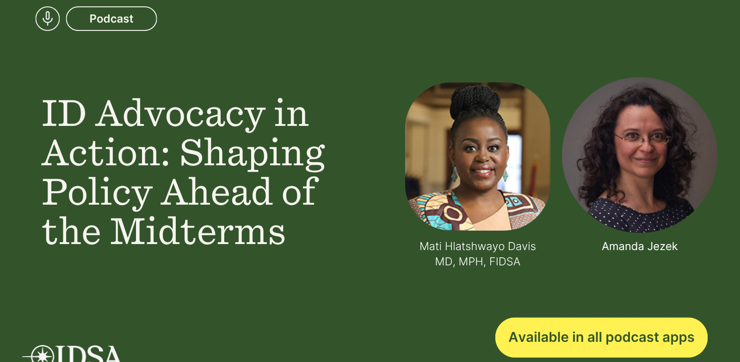

Host Mati Hlatshwayo Davis, MD, MPH, FIDSA is joined by IDSA Senior Vice President of Public Policy and Government Relations Amanda Jezek to discuss the policy challenges shaping infectious diseases, public health and research ahead of the midterm elections. They explore IDSA's advocacy strategy, recent policy wins and how ID professionals can build relationships with policymakers to drive meaningful change.
Details


Mati Hlatshwayo Davis: [00:00:14] Hello and welcome to Let's Talk ID. My name is Mati Hlatshwayo Davis. I'm the executive vice president and chief strategy officer at Missouri Foundation for Health. And I'm also on the board of directors for IDSA. I am thrilled to have Amanda Jezek with me today. Amanda is IDSA senior vice president for public policy and government relations. She's been with IDSA for almost 15 years and has spearheaded successful efforts to establish the first U.S. National Action Plan for combating antibiotic resistance, create the new Medicare add on code to increase ID physician reimbursement for complex care and position IDSA as a go to resource for federal policymakers on the full scope of ID issues. Prior to ID essay, Amanda lobbied for the March of Dimes and Mental Health America and worked on Capitol Hill. Welcome, Amanda.
Amanda Jezek: [00:01:10] Thank you so much for having me. It's great to see you.
Mati Hlatshwayo Davis: [00:01:13] I am thrilled to have you. As you know, you and I have worked together in this space for many years now. I credit you with training me and onboarding me into the world of policy and advocacy in a meaningful way. And I know that that is true of so many of our members as well. So I just wanted to thank you upfront for your leadership and the passion you bring to it. It has been an incredible time in our nation's history and watching you position IDSA to really have a voice and to advocate on behalf of our members and the people we serve has been a really beautiful thing. So just giving your flowers up front, Amanda.
Amanda Jezek: [00:01:54] Well thank you. I love getting to do this work, as I know I've told you so many times the idea that policymakers would be making decisions without the benefit of expertise from infectious diseases, clinicians and scientists across the country is terrifying. So it's really an honor to get to help make sure that our members perspectives and voices are reflected on Capitol Hill.
Mati Hlatshwayo Davis: [00:02:17] Well, let's start with the big picture. As you look at infectious diseases and public health and health equity leading into the midterms, what are the policy issues that concern you most? And where do you see the greatest opportunity to make progress right now?
Amanda Jezek: [00:02:33] So I think probably my biggest concern is this sort of overarching politicization of science and the mistrust of people who have expertise. It's almost like the more you know about scientific issues, the less certain people are willing to hear from you and believe you. And that has been reflected in so many different policies, you know, very recently, these changes to grant rules that will impact not only NIH and other research grants, but CDC grants for public health activities in communities across the country. Ryan White grants all sorts of things. You know, I think we see this play out in all the changes to vaccine policy and in cuts to federal funding. And this is so concerning because I think that these policy changes and the attitudes that underlie them can have a really long-lasting impact. But thankfully, there are also a lot of opportunities. I think the upcoming midterms elections themselves really present an opportunity. Right now, policymakers are listening to their constituents because they want to get reelected. So it is so important for everyone to have that voice to send an email, pick up the phone, go meet with your elected officials and tell them what issues are concerning you and what you want them to do because they work for you. They're public servants, or they're supposed to be. I also think that this could be an opportunity with the midterm elections to build something better. Out of all the destruction that we've seen across public health and research and health care, we know that even if we look back to what things were like at the end of 2024, things were far from perfect.
Amanda Jezek: [00:04:13] We had a lot of inequities in our system. We had a lot of people who were not getting what they needed. So if we've gone and taken a sledgehammer to an awful lot of that, which that's what's been happening over this last year and a half, let's not just try to erase everything that we've seen happen. Let's try to create a system from scratch that's actually going to serve everyone equitably. To help make that happen, I'm really excited that IDSA is engaging in the midterm elections in ways that we haven't before. So, you know, we because of our tax status, we cannot endorse candidates, we cannot endorse parties, we can't give money to campaigns. But our members as individuals can do all of those things. So we're reaching out to members who live in the states and districts with some of the most competitive races, the races that will help decide control of the House and Senate. And we're telling them, these are the candidates running in your area. Learn about them. Decide which one best reflects your values, which one is going to be the best, in your opinion, for public health and health care and research. And here are ways you can get involved in those campaigns in a meaningful way. So, you know, we're really excited to just keep building more opportunities for relationships with future and current policy makers so that we can better advocate for our field.
Mati Hlatshwayo Davis: [00:05:31] Really love that perspective. And there's so much doom and gloom. But one of the things I love that you said, and the reason I thought this conversation was so timely, is to give us room to talk about the midterms and give members the opportunity to reflect and see how they can impact big P and little P policy. Right? I love that you talked about the fact that we really overly focused on the valid and very true destruction over the last year and a half. But we don't talk about what was happening positively or negatively before that. You know, I remind people that the deprioritization of public health certainly didn't start with this administration. But what we've seen accelerated over the last year and a half, and some of the intentionality behind that has been certainly devastating. But to hear you reframe that as opportunity rather than us sort of staying in a helpless and hopeless place, and to see what IDSA has been intentional about and to work with you on the board around really positioning ourselves and thinking about where we're best fit to be impactful, to have a voice to fight back has been truly empowering.
Mati Hlatshwayo Davis: [00:06:38] So we've seen ongoing debates around Medicaid, around public health funding, around biomedical research, vaccine policy, HIV programs, and certainly with infectious diseases workforce. In a climate where many people feel like we're constantly playing defense, where has IDSA actually been able to move the needle in your mind? Like what wins are you most proud of over the last year specifically?
Amanda Jezek: [00:07:05] I think there are three things that really stand out to me. The first is kind of a big umbrella in that I'm really proud of IDSA's willingness to be bold in this environment, and I will say that has been scary. And it was not always easy to sort of get everyone on the same page to be ready to do that, because this is a climate in which there's a lot of fear of retribution at an organizational level for the society and at an individual level for our individual leaders and volunteers and staff members. But, you know, when I think about the day that we decided to file that vaccine lawsuit with a couple of other medical societies, and we were able to win stays that have blocked some of the really harmful changes to the pediatric vaccine schedule and to the ACIP. There's still work to be done. We still have to have our full trial. We you know, obviously the work is not done yet, but I think we've made some really important progress. And, you know, there are some people's lives that could be saved because of what we've done. And that's really powerful and exciting. The second thing I'm really proud and excited of was the bipartisan action that really grew out of the Senate last year to stop some of the really big funding cuts that had been proposed for NIH and CDC.
Amanda Jezek: [00:08:24] And that really only happened because people around the country took a stand. We had thousands of people calling and writing and meeting with their senators and representatives and saying, this is what our local community stands to lose if you don't protect these investments. And we're in the midst of doing that hard work again, because the federal budget is an annual process, and it's really important that we continue to do that and protect what is left of public health and research and our access to care. So that's, I think, the second area. The last one that I would flag is that we've been able to really increase bipartisan support for certain initiatives, things like supporting the infectious diseases workforce, combating antimicrobial resistance. There's still a tremendous amount of work to be done, but we've been getting additional senators in both parties, additional representatives in both parties to support those efforts. And that helps us make that, you know, slow and steady progress. We were able to get the administration to convene the Presidential Advisory Council on Antibiotic Resistance, the PACCARB, which is something several of our members serve on to really help guide federal AMR policy. And it looks like, at least so far, we've been able to, you know, protect that from politicization and allow it to move forward.
Mati Hlatshwayo Davis: [00:09:41] I think it's so important to ask that question, because I remember where we were in January of January 2025. And I'll be honest with you, some of the tough conversations I had with senior leadership, you and I had some really candid conversations around my concern. And, you know, I've always been a voice on the board around what tangible movements are we making around the priorities we espouse rather than, you know, what our members will start to maybe feel like is lip service or even inaction, right? And I really, really appreciate that the staff in IDSA have always listened, have always included members, and have always even taken accountability if there was a misstep. And I think that that has really propelled forward the work. And you see that in just these examples. It leads me to my next question, because one thing I think many of our listeners may not fully appreciate is how much advocacy happens behind the scenes. So when I reflect on the conversations you have, the great ones and the tough ones. When members like even myself at that time last year weren't happy and how it informed how you moved forward and how intentional you are about actively listening and embedding that into action. So without giving away the playbook, how does IDSA, under your leadership think strategically about influencing policy? How do you decide when to work quietly with policy makers, which sometimes you then have to get the flack from a lot of members who think we aren't doing anything right, versus when to take a more public stance like we did with the lawsuit. Can you talk a little bit about your approach and strategy?
Amanda Jezek: [00:11:18] Absolutely. So I would say that we are doing both the public facing and the behind the scenes work simultaneously all the time, and that the things that are really publicly visible represent really a small fraction of what we are actually doing. Because the truth is, if you want to move policy in this country, it is about convincing a lot of policy makers winning over a majority of people in Congress and large numbers of people at federal agencies, and that can really only be done with those one on one conversations that happen with our staff and with our volunteers who are constituents for these elected officials. So that is always kind of the undercurrent of what's happening for each issue. We sort of look at what are the goals, what are we hoping to accomplish? What do we reasonably think we can accomplish in the immediate term and in the long term? And then what are all the different kinds of tactics, both behind the scenes and publicly, that we can take to do that? And so, you know, for something like vaccines, there was a clear legal path to actually get something done that we thought was going to be feasible, that we thought we could achieve. And so it was worth it to take whatever risk of being really, really bold. But there are times when simply issuing a statement, maybe it makes us feel good, but it might not actually accomplish anything.
Amanda Jezek: [00:12:43] And in fact, it might alienate some of the people in the general public or some people in Congress who we need to try to win over. And it can be really hard to say, you know what? We may really disagree with some of the things that are being put forward. We may think that some of these ideas are contradictory to science, that they're going to lead to people losing their lives, that they are immoral. And yet the way that our representative government system is set up, we have to try to find common ground. And interestingly, when we go and meet with policymakers behind closed doors with their constituents, it is often easier to find common ground than I think many people would have expected. So, you know, we're always sort of weighing these different things. I will say we are always going to stand for who our members are and what our members believe in, and we will not back down and simply accept bad policy changes. But we will, I think, be very strategic about how and when and where we weigh in. And so if people think, oh, I wonder why IDSA didn't make a statement on, you know, X, Y, or Z 99% of the time, it's because we're working on it through other avenues.
Mati Hlatshwayo Davis: [00:13:57] Sometimes I feel like it's damned if you do, damned if you don't, because I was the one who was like, Amanda, we can't just be about statements, right? But then when you don't see the statements, it feels like we don't have positionality. That's why I wanted to give you the opportunity to kind of speak to this, because there is a strategy and it's something that I know that you think very, very long and hard about. I've watched you and you and I have vented about how difficult it can be to continue to push through when your personal beliefs or values may be here. And what you need to do requires moving with an entire group of people that may not always sit in that same space. And so I really appreciate you addressing those things head on, especially the statement piece, you know what I mean? Because it's like we've gone back and forth about that on the board too. And I thought I wanted to have a candid discussion to kind of pull the curtain open if you were, and allow members to really know some of the conversations and the thoughtfulness and the strategy and that there isn't always consensus. What's your approach to when there isn't always consensus? What's your approach, Amanda, when you kind of get the feeling that there's mixed feelings amongst the membership, how have you managed that over the years?
Amanda Jezek: [00:15:08] There are always mixed feelings among our members, and I think that that just speaks to the diversity of our members and the diversity of the field. Um, you know, people within ID do so many different things and based on, you know, where they live and what their professional role is, their priorities may look different from other members and their perspectives on issues may look different from other members. That diversity is a strength. Um, you know, does it mean that, yes, we have to spend more time really talking to people and understanding all these different perspectives. Yes, but it's worthwhile to do that because I think very often we are able to put together a strategy that I hope is really reflective of that diversity, and to be able to say, you know what these six different issues do all kind of fit together. Not all of them is going to be, you know, a statement or a podcast or whatever. Like each issue needs to have its own strategy that makes sense for what it is we're trying to accomplish even within an individual issue. Some members can have wildly different ideas of how bold we should or shouldn't be, or if it's something we even should be engaged in. What I can do is provide, you know, my perspectives on potential paths forward in terms of congressional and regulatory and legal strategies and kind of the likelihood of success and what types of work would be required for pursuing any of those. And then it's really up to the board. And I've just been so impressed when I, you know, sit in these board meetings to hear the, you know, respectful but very passionate discussions to try to figure out what is the path forward. It's never going to be perfect, but I think we all keep working at it with the best interests of our members and the patients and communities that they serve, really at the forefront.
Mati Hlatshwayo Davis: [00:17:00] Yeah, that's abundantly clear to me, and I've always appreciated having the opportunity to reflect sometimes the other box, right. My career reflects that. My lived experiences reflect that. So to have a seat at that table and for that voice to be heard and for it to reflect, you know, a certain group in our membership matters. And I've watched you be intentional about that. I've often worried about you, quite frankly, holding all of that and the responsibility there within. But I know you have a great team that you lean into as well. And that's what made me want to have this conversation leading up to the midterms, because I wanted the members to know how much work has already been done in the last year and a half, and how strategic you're being leading into this, that, you know, this has been on your radar, that you're having a lot of intentional conversations with many of the members leading into the midterms and beyond. To me, that gives a sense of comfort at a time where you always don't have something to hold on to that's tangible, that says, we have options and we have power and we have voice. So IDSA has, in my mind, built a reputation as a trusted voice on issues ranging from things we've talked about today like antimicrobial resistance, pandemic preparedness to physician reimbursement and HIV care. Looking ahead, where do you think advocacy can have greatest impact and what are the biggest risks if we don't get it right? And I'm thinking specifically about the midterms here.
Amanda Jezek: [00:18:24] I think the biggest risk is doing nothing. And so I would never want anyone to say, well, I'm not going to get involved in advocacy because I'm not sure I'm going to do it right. I'm not sure I'm going to say the right thing or know all the answers. Any of that. Staying quiet and staying out of it. That is the worst possible thing. The biggest risk that there ever could be. Because if you are not speaking up for yourself and the issues that matter to you, no one else is going to do that for you. In this environment, we often say, if you're not at the table, then you're on the menu. So if you're not speaking up for yourself, then you're a really great risk of losing. You know, the things that are so important. We've really proven, even in this challenging climate, that we can work successfully and often in coalition with a lot of other partner organizations to protect funding, as I talked about, for research and public health and care for vulnerable people. You know, I think we have to recognize a lot of these issues that they're bigger than just ID. So we do really value our partnerships and working with others.
Amanda Jezek: [00:19:25] But I think we also have a real responsibility and duty to our members to advocate for the issues that wouldn't have a voice without us. So things like investing in the ID workforce, addressing AMR. Those are issues that if we don't bring them to the table, they're not, you know, coming up, nobody else is doing that work. And these are still bipartisan issues. I think we have a lot of opportunity here, but only if we work really, really hard and only if we can get a lot of our members to really press their senators, their representatives, because these are issues that don't have a very large constituency. It's us. And so, you know, we really need to push as hard as we can, and we're trying to pull in more people because there are so many people across health care and public health that do depend on an ID workforce, that depend on the availability of safe and effective antibiotics. But, you know, it's hard because every organization feels like they're fighting on so many fronts just to protect sort of what they have. It's tough. And there's a lot that we really need to stand up and take responsibility for.
Mati Hlatshwayo Davis: [00:20:27] Thank you so much for uplifting how much the organization, I think, has really been intentional and grown in those collaborative partnerships. I think a lot of the big ways that we've been able to move forward is because of relationship building. And I often laugh, and I've reflected on this, I think, with you in the past actually, about how in my career, I was told a lot of, you know, the relationship building or communication skills were a soft skill. And I have to chuckle when I think about how that soft skill really became a huge deal in Covid, for example. Right? And I always talk about the fact that at least in my career, and especially where I'm seated now in the philanthropic space, there is a strategy and an operational skill set around relationship building. And I've seen that in the policy and advocacy space that you have been and your team have been so intentional about, again, this is behind the curtains. Members would never know this, but developing those relationships, meeting with people, being innovative about new people, and where it came to really benefit us is when we needed to fight hardest. In the last year and a half, we were able to sometimes be the lead organization or join other organizations or other organizations trusted us to have these collaborative efforts that increase the power of our voice. Some of the operational things that may not come to members minds as well. We seem like a big society from a membership perspective. How many people do we have on staff at IDSA?
Amanda Jezek: [00:21:53] All across the staff we have, I want to say a little over 90. Most of them are not doing this work. You know, that is guidelines and clinical affairs and communications, and it's the whole IDWeek. I mean, that is a beast in and of itself. Our education and professional development is all the suite of things that we do. So we're small but mighty.
Mati Hlatshwayo Davis: [00:22:13] Small, but super, super mighty. And I don't think that gets reflected on and maybe talked about enough is we're often making really hard decisions around what we all want to do and capacity, what we all want to do and resources. And so what you've been able to build around that partnership and other partner organizations as well has been integral to collective power and collective opportunity to move forward these priorities. So the last question I want to ask you for folks to hear is if every ID physician, every fellow, every researcher, every public health professional listening today decided to engage in advocacy this year and leading into the midterms, what is the single most important thing you would want them to do? I know that's almost an impossible question, but if anyone can tackle an impossible question, it's you.
Amanda Jezek: [00:23:04] Well, Mati, you actually set me up so perfectly for this because I think people might have expected that. I would say, contact your member of Congress, go meet with your member of Congress, something like that. And I feel like I've given that answer, you know, a lot when I've been asked this question in the past. But I think what people really need to do is build a relationship with their senator and their representatives. Yes, make that phone call, send that email, have that meeting, but keep doing it once a month or once a quarter. Reach back in and say, hey, I'm so glad we had that conversation, have you cosponsored this bill yet? Or, hey, there's an outbreak in our town. I wanted to make you aware of it. If you have any questions, let me know. Or, hey, you're probably seeing a lot about Ebola on the news. You know, if you have any questions, I'm a resource for you. Because exactly as you said, when we build those relationships, then people are there for us when we need them. And, you know, we've seen volunteers do this successfully. We can provide the tools to help. I probably should have emphasized that a lot more. We try to make advocacy as easy as possible for our members. So if someone is willing to send an email, make a phone call, do a meeting, build this kind of relationship, we can give you talking points. We can tell you who your representative is, who your senators are. We can join you in those meetings and support you every step of the way. But you know, these folks, they on Capitol Hill, they want to hear from their constituents. And that local perspective of what you're facing in your community is so valuable. You don't need to be a policy expert. You don't need to know the answers to all the questions. I promise you, as an IDSA member, you are already the smartest person in just about any room you would walk into. So, you know, have confidence in that and understand the value that you bring to that policy process.
Mati Hlatshwayo Davis: [00:24:53] I can't thank you enough for that answer. And you're right, I totally expected you to say the former, and I'm thrilled that you closed us out with that because so many people feel paralyzed and like they don't know how to be involved and to fight back. Please volunteer. Please join Amanda and her brilliant team. You can receive training. You can be a visible part of this. Also, just email us and ask questions. I often when I'm speaking to young people, I was actually lecturing at WashU last week and it's always the inertia. It's always the well, where do I go? Who do I email? How do I construct an email? What I'm so proud of is that we have those tools right here at IDSA. We can help you impact as local what's happening in your neighborhood, in your cities, in your states are as important, if not more important, than what's happening at the federal level. And it all comes together around impact. Amanda, thank you so much for joining us today. Thank you so much for the work that you've always done, but specifically leading into the midterms. Will you come back to give us an update after the midterms? I would love to have a conversation and talk more about what happened and how IDSA is moving forward.
Amanda Jezek: [00:26:08] I would be delighted to do that. Anytime you want to have me, I'm here.
Mati Hlatshwayo Davis: [00:26:12] Thank you so much and we'll talk soon. This has been Let's Talk ID. Thanks, everybody.