
Inside JID: Translational Science and the Future of Infectious Diseases
View Transcript

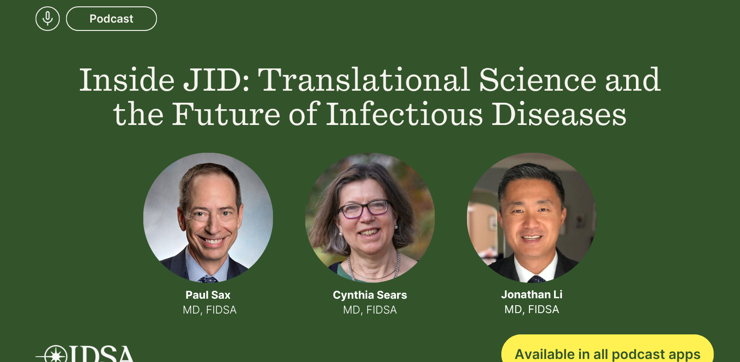
What exactly makes a paper a good fit for the Journal of Infectious Diseases? JID Editor-in-Chief and Professor of Medicine, Oncology and Molecular Microbiology and Immunology at the Johns Hopkins University School of Medicine, Cynthia Sears, MD, FIDSA, and JID Deputy Editor and Associate Professor of Medicine in the Division of Infectious Diseases at the Brigham and Women’s Hospital and Harvard Medical School, Jonathan Li, MD, FIDSA, join CID Editor-in-Chief and Let’s Talk ID host, Paul Sax, MD, FIDSA, to discuss the journal’s focus on translational science, new features, mentorship opportunities and some of the research they’re most excited about.
Details


Paul Sax: [00:00:15] Hi, this is Paul Sax, editor in chief of Clinical Infectious Diseases. And welcome to the Let's Talk ID podcast. Today, I'm delighted to be joined by two representatives of one of the IDSA key journals, and that's the Journal of Infectious Diseases, or JID. I have with me today Doctor Cindy Sears, who is a professor of medicine and an ID doctor at Johns Hopkins and is Editor-in-Chief, and doctor Jonathan Li, an associate professor at Harvard Medical School, a close colleague and Deputy Editor at JID. They're both friends, and they have come on today to talk to me about their journal, JID. So let's start out with how each of you got interested and involved in journal editing. Why did you want to take on a leadership role at JID? Cindy, start with you.
Cynthia Sears: [00:01:12] Well, I had the opportunity to work with Sherry Gorbach and his team, Mike Barza, at CID for 16 years as an associate editor. And just thoroughly enjoyed, um, doing the work and learning about the teamwork of editorial processes. So when the opportunity at JID came up and I spoke to Louise Ostrowski, who is the head of the committee, um, for recruitment. And then I had a conversation with the legendary, uh, Marty Hirsch. Um, and I, my interest was piqued and I applied. And then I was really fortunate enough to be selected and now working with the fabulous team and having a great time.
Paul Sax: [00:02:03] Well, terrific. And, uh, you know, Louis is one of the true polymaths of infectious diseases. And unfortunately, he's an editor at CID. Well, Jon, how about you?
Jonathan Li: [00:02:12] Well, I have to say, my interest in journal editing, um, probably started when I was trying to publish my papers. And these editors just seemed like folks who are the leaders in the fields who knew everything could and could really help me make my papers better. And I always think of it that papers are the fuel that drives the engine of scientific discovery. And the journals are the places where we make sure that the fuel that you put into your car is high quality and won't seize up your engine, and that that everything goes, goes smoothly. And I have to say, Paul, I have to I have you to thank for getting me started in the editor, um, field when you invited me to be an associate editor at this brand new journal at the time, Open Forum Infectious Disease. And it was such an amazing experience working with some of the most amazing researchers in the field and clinicians in the field and, and getting a chance to, to really help authors. I think my role is really just helping people and helping authors make their manuscripts better. And OFID has a special place in my heart. And, uh, when, uh, Cindy came on to be the editor in chief of JID and, and offered me a role, I jumped at that opportunity.
Paul Sax: [00:03:39] Well, John, thanks a lot and thank you for abbreviating, uh, it correctly. It's OFID, not OFID. So I'm going to ask you now, um, what when you took this position on this is a new position for you. Um what did you hope to preserve and what did you want to change when you took over? Cindy, let's hear from you.
Cynthia Sears: [00:03:59] Yeah, obviously, I wanted to continue the tradition of excellent science that JD has represented for more than 100 years, pushing 125 years. Um, in, in our field. Um, but it had been noticed that JID had drifted towards a lot of virology and malaria, which was something I learned during the interview process. And so a goal was to expand the range of microbiologic results and other types of studies to JID including earlier phase clinical trials. Um, and a smattering of other global health and other topics, um, that we wanted to do. We also went on to develop a mentoring program, which actually spread across all three journals. And John will talk more about that because he's taken a big role in that. And and then we started to think about different types of articles that we could develop to make the journal more attractive to a broader audience. We've always had, I think, trouble, if you will, uh, drawing clinicians and the ID field has spectacular clinicians to JID. And so we wanted to enhance the understanding of how the basic science or translational science of JID is really important to clinicians. So we started a topic called Viewpoints. We developed a perspective series that addressed our first one was on vaccine science led by Helen Chu. And that was really very popular. So we're working more on that. We changed our views into translational science updates, focusing on the last five years, and added to them clinical commentaries. And then, uh, every month I write a one pager, more or less on JID for clinicians trying to point out just salient points from a few papers within JID. And Jon probably has something to add.
Jonathan Li: [00:06:14] Yeah. I mean, I think that first of all, I just want to say that, um, getting a chance to work with Cindy has been, was an immense draw for, um, for me and why I, I went over to, to JID. I mean, as you can tell, she is a research powerhouse and has a vision for JID that was so compelling and exciting. And Cindy comes from a more bacterial world, whereas I come from the virology world. So there was a lot of synergy there. And I, um, had previously, uh, known and been friends with Marty Hirsch, the, uh, the legendary editor in chief of JID for many decades. And so I wanted to just make sure that we continued the legacy of, of JID and expand it and bring it into the 2020s and beyond.
Paul Sax: [00:07:09] Well, I mean, one of the concerns about when you call someone legendary is it makes them feel old. And Marty was one of the first people to actually be insulted when I called him legendary. So be very careful about that. All right, so let's talk about the specifics of the journal. I want to know the scope when when authors are considering submitting to a journal. What makes something clearly a JID paper?
Cynthia Sears: [00:07:33] It's the experimental side of infectious diseases. But we have increasingly been drifting towards trying to keep the focus on that word translational science. And by that we mean bench to bedside and back. So we've had, for example, a case reports that come in with a strong, uh, bench investigation that helped to prove what was going on, uh, in the patient. So, you know, that is of great interest to us. And then we've have experimental studies that start with a hypothesis, all in mouse, but then try to go back and see if you can find the singles in human tissues in the disease. So I like that to and fro. It's a pattern I've followed in my own work, and I find it just so rewarding to be able to try to better understand disease pathogenesis.
Paul Sax: [00:08:36] Great. So John, give me some examples. You've published in both CID and JID, your own papers. Give me some examples from your own work, where you think it's been, you know, targeted to CID versus targeted to JID?
Jonathan Li: [00:08:51] Yeah, no, that's a great question. I think for me, when I think about which journal to send, it really depends on, uh, where, what kind of data is part of that paper. Is that paper primarily focused on a clinical question with clinical data, or is there some more what we call translational data, where you're taking some data from the laboratory assays, and especially research based or even clinical laboratory based data and focusing more on that. And, and I think for us, again, the ones where these lab research based lab assays play a critical role as the main or secondary outcome of my paper and also papers that, in my mind, shed light on the mechanisms or biomarkers of diseases, treatments, and outcomes. And I, uh, will you indulge me for a second here while I take a little bit of a detour?
Paul Sax: [00:09:43] Sure.
Jonathan Li: [00:09:44] When I kind of started at JID, I read a editorial that Marty Hirsch wrote about the history of JID, and I found that to be an incredibly fascinating one. He wrote it on the 100th birthday of JID, which was in 2004. So JID is actually 122 years old, which I didn't know about until I read that editorial. So I, um, and it's so funny that the early papers from JID describe the pathogenesis of pneumococcal pneumonia. Measles isolated the first organism for Rocky Mountain spotted fever was was in JID. And then, uh, when IDSA was formed in 1963, it took over JID and, um, with Edward Kass as the Editor-in-Chief. And, uh, but because JID was really focused on original research articles, uh, the IDSA started a new journal called Reviews in Infectious Diseases that started taking more clinical papers, and that turned into CID in 1992, with Sherry Gorbach as the Editor-in-Chief. So that history can tell you a little bit about how JID started, but also how CID started and the different niches that each fills. Even today that JID takes mostly primary research papers, especially laboratory or translational papers, where CID is far more of a clinical focused journal.
Paul Sax: [00:11:14] Great. This is excellent summary. I'm going to now like ask you to hone in on what's actually in the journal. So let's start with new features. Okay. Um, Cindy, you alluded to some, but let's go in more in detail on some of these new features.
Cynthia Sears: [00:11:32] So, um, Viewpoints was something that I developed because during the pandemic, I realized that every day I get the JAMA table of contents. For too many Jama journals. A whole lot. But I found myself attracted to these really short pieces that they published virtually every day that are sometimes reflective of medicine, sometimes offering a viewpoint on some problem in medicine. And I said, you know, clinicians are so busy. I viewed it as a way to potentially grab some attention and get people to think about a particular topic and their 900 words. So they're quite short. Uh, so that's what happened. Um, with the expansion of the perspectives, it was organic, you know, it was in discussion and thinking about what we could do to display the work in vaccine science and hit upon the idea that serial papers over the course of a year on different topics, it's now an idea we're carrying into a second year, where the first set was more general in a variety of ways. The second set is focusing on each vaccine. Where are we? What's the gaps? What do we need to know type of articles. The translational science update, I went through every journal I knew, and looked at the length of the various reviews and hit on the idea that short recent reviews that connected us back to clinical medicine, again was, uh, probably a good formula. And then complementing that with the clinical commentaries. And then JID for clinicians was just to try to take the science and say why this was underpinning, um, our thinking on the floors or thinking looking forward, uh, into the field.
Paul Sax: [00:13:46] Great, great. And, uh, and Jon, you want to talk a little bit about your, your relationship with trainees and, and the mentoring program?
Jonathan Li: [00:13:54] Yeah. Each of the IDSA journals has an editorial mentorship program where we take on a couple of early career investigators as editors in training for a year. At IDWeek a few years ago during one of our kind of brainstorming sessions, um, that included the trainees, uh, one of the trainees, uh, Juan Calix, talked about, um, how the pipeline for translational investigators is leakier than ever. And we discuss ways that we can support early career investigators. And so we hit upon an idea for a trainees corner with a series of papers on career development, um, that are right now in various stages of development. We just published a paper on finding and managing a mentorship team and how to be a good mentee. We have another paper coming out soon on becoming a physician scientist how to build a translational research career. And then there are future articles on how to be a good mentor. So that's less for the mentee, but more for the mentor. And also another one on practical approaches to finding a physician scientist job. So we really hope that these articles will, um, help our early career physicians and physician scientists and provide goal posts for the next generation of clinicians and researchers alike.
Paul Sax: [00:15:11] Well, the two of you, I charged you ahead of this, but choosing a 1 or 2 favorite papers that recently have been in JID. And now you're going to have to explain it to me, who is a laboratory science lunkhead, exactly why the paper is worth my knowing about. All right. Go ahead. Cindy, you go first.
Cynthia Sears: [00:15:35] Well, um, a paper that came recently and John and I were discussing the other day was cefazolin inoculum effect and cefazolin microbiologic treatment failure in serious methicillin susceptible staph aureus infections.
Paul Sax: [00:15:51] Okay. I know about that. Good. Okay.
Cynthia Sears: [00:15:55] But here it was taking strains of MSSA and looking at the inoculum effect in the face of cefazolin. And intriguingly for me is the difference in the inoculum effect is really just ten to the fifth to ten to the seventh organisms, which struck me as fairly modest. But what it does in some strains through the blaZ genes that um, uh, are types of beta lactamases is change the mic from susceptible going up at least fourfold and being over 16 micrograms per mil. And what they showed in this paper, there's background information that suggested that it probably didn't affect mortality and that this is a large study. It had 259 or 89 patients. And what it was able to show is there was no mortality effect. It was about 20, 22% in those who had these strains that were affected by inoculum versus not. But in deep infections, abscesses, empyema, CNS, you know, privileged sites where the hypothesis has been that the inoculum effect might be more active. It had a dramatic effect on the, um, the ability to either cure the infection or prevent it from recurring. So it went from 21% treatment failure to 6% if it was an inoculum sensitive organism versus not. So the clinical suggestion from this is that examining this in the microbiology Clin micro Lab might help to the clinician to think about how they're going to address and maybe cefazolin is not the right drug, if this is an inoculum positive organism.
Paul Sax: [00:18:04] Well we have a cefazolin love fest right now because of the snap trials. So you wonder whether this is going to turn any people away from cefazolin. Okay, John. Your turn.
Jonathan Li: [00:18:16] All right. Um, in the earliest days of the Covid pandemic.
Paul Sax: [00:18:21] Oh, wait, wait, wait, you're not allowed to mention that I've got PTSD from that phase. All right, go ahead.
Jonathan Li: [00:18:29] Well, Molnupiravir came onto the scene as an antiviral. And actually it has effects across multiple viruses, RNA viruses, not just SARS-CoV-2. So it still can be used for still being tested for other viruses. But what's interesting about this drug was its mechanism of action, which increases the mutation of the viral RNA polymerase. And as it's replicating, um, but a paper by Shunta Zhou and Ron Swanstrom actually raised the concern that this drug could also potentially be mutagenic in mammalian cells.
Paul Sax: [00:19:03] Oh, no.
Jonathan Li: [00:19:04] And so it's I think the jury is still out here. It's still a bit controversial, but it does raise some concerns about the drugs within this class of activity. So to me that that was a paper that that really took advantage of like understood the mechanism of action and then could then look at whether there are specific side effects that may be seen in mammalian cells based on their mechanism of action. So you have to really know the that, the why and the how of the drug in order to, to try to figure this question out.
Paul Sax: [00:19:37] Yeah. Very interesting. You know, it's a drug that was controversial from the moment it hit the hit the research scene. And then the controversy continued even after its quasi approval. All right. So now I'm going to ask you to kind of look ahead. Uh, give me your plan, your 1 or 2 year plan for JID. 1 or 2 years or beyond that. Cindy?
Cynthia Sears: [00:20:02] Yes. So as we've sort of honed in on the idea that translational science may be our sweet spot, uh, for our field in JID. Um, my goal is to focus on that and to increasingly recruit articles to JID that will reinforce that. So I've been saying, because the last two issues of JID where I get to look at the table of contents in advance that having that 1 or 2 editorials to highlight important papers in the Journal, a viewpoint, a perspective, a translational science update is sort of my dream that we could pull that off in every single issue to give a range of things that might be of interest to our colleagues.
Paul Sax: [00:20:57] Great. Great. John?
Jonathan Li: [00:20:59] Well, one, we'd love to get more review papers. So these ID translational updates. So keep them coming in. We'd love to get them. Um, we are also having, in addition to the, um to the additional papers as part of the trainees quarter series, we also are having more calls for papers. For example, we recently had a call for paper for preclinical and early phase trials for long-acting art for HIV treatment. And there are a number of other calls for papers on the way. And in addition, I would love to see more cross collaboration between journals where CID, JID and even OFID are calling for similar papers. But within the spectrum of clinical to translational to to basic science all on hot topics of interest. So lots of exciting stuff happening at JID.
Paul Sax: [00:21:47] Okay, so, so great. I'm going to stick with you, John. Let's say you have an IDSA member, an ID doctor, who's not currently reading JID. What are they missing?
Jonathan Li: [00:21:58] Wait, those people exist? There's people not reading JID? [laughs] I would say, listen, we know that JID is the leading journal for translational laboratory based research, but it has tremendous value for you, too, as the clinician. Uh, you can, uh, specifically understand the why behind diseases, drug resistance, and figuring out the deeper scientific rationale behind choosing specific treatments and or durations of antibiotics or managing complex cases. It can help teach you about interpreting complex clinical trials. We know that clinical trials are not black and white and are highly nuanced when you're trying to interpret them. Uh, and, you know, if you want to anticipate the diagnostic tests and novel treatments that are coming down the line. I mean, overall, I would say, look, if you want as a clinician, if you want to understand why we make certain clinical decisions, then you should be reading guide. If you want to wow your trainees and students with your incredibly deep understanding of the mechanisms of disease and rationale for treatment, you should be reading JID. If you believe that physicians should not solely rely on AI and should be lifelong learners ourselves, that you know, and that we should understand more than just the surface level knowledge of disease, then you should be reading JID.
Paul Sax: [00:23:18] Good answer. Okay, I got one last question for you. One I'm going to surprise you with. What's your dream vacation activity? Cindy?
Cynthia Sears: [00:23:29] My dream vacation activity is always being outdoors and doing something active with friends.
Paul Sax: [00:23:36] Great. Great. Jon?
Jonathan Li: [00:23:39] I would love to go to Antarctica, but I get seasick very easily. So if there's a way to get me there without going through the Drake's passage, that would be my dream.
Paul Sax: [00:23:50] Awesome. All right, so Doctor Cindy Sears and Doctor Jon Li, Editor-in-Chief of JID and Deputy Editor of JID, respectively. Thank you so much for joining us today. Really appreciate the conversation.
Jonathan Li: [00:24:05] Thank you Paul.
Cynthia Sears: [00:24:06] Thank you Paul.