
Outpatient antimicrobial stewardship program
Ochsner Lafayette General Medical Center, Lafayette, LA
Populations impacted
Ambulatory, emergency departments, pediatrics, adults
Description
The outpatient antimicrobial stewardship program was developed as a proactive initiative to enhance patient safety, optimize antibiotic use and support clinicians across a rapidly expanding ambulatory network. As national guidelines continue to evolve and antibiotic resistance trends shift, the organization recognized the importance of a coordinated, region‑wide approach that promotes consistency, reduces variation and strengthens clinical decision‑making. The program was designed not to correct poor performance, but to elevate already strong practices by providing clinicians with streamlined guidance, real‑time data and a dependable support structure.
A core three‑person interdisciplinary team with representation from pharmacy, infectious diseases and infection prevention collaboratively lead the program. Pharmacy reviews emerging evidence and proposes updated treatment standards. Infectious diseases ensures alignment with best practices and provides final approval. Infection prevention serves as the program manager, facilitating implementation, overseeing data tracking and ensuring integration across all ambulatory locations. This collaborative model allows the program to remain agile, clinician‑centered and grounded in evidence-based care.
The program is built upon the Centers for Disease Control and Prevention Core Elements of Outpatient Antibiotic Stewardship and the Agency for Healthcare Research and Quality’s Outpatient Stewardship Model, integrating both into a practical, region-wide operational structure. Conditions identified as high volume or high impact in outpatient care, including upper respiratory infections, sinusitis, otitis media, pharyngitis, pneumonia, urinary tract infections and soft tissue infections, are tracked across primary care, specialty clinics, urgent care centers and emergency departments. ICD‑10–based identification within the electronic medical record enables reliable monitoring and trend analysis across the ambulatory settings.
A hallmark of the program is its innovative continuous educational feedback loop. Instead of traditional one‑time provider education, all clinicians receive a concise monthly update summarizing regional trends, condition-specific metrics, therapy accuracy and observed treatment outcomes. Each report includes high-level, root-cause insights and practical recommendations that support ongoing refinement of clinical practice. By providing timely, digestible data, the program delivers meaningful guidance without adding burden to clinicians.
Equally important is the program’s emphasis on two-way communication. Providers are encouraged to submit questions, request guideline updates, and seek clarification on specific cases or recommendations. Infectious diseases physicians respond individually to each inquiry, reinforcing partnership and ensuring clinicians have access to expert support. This structure positions antimicrobial stewardship as a collaborative resource, not a compliance mechanism, which has strengthened provider engagement and adoption.
Beyond appropriateness and accuracy metrics, the program monitors seven-day treatment failure rates and C. difficile infections occurring within 90 days of outpatient antibiotic exposure, allowing the team to identify patterns and refine recommendations with a focus on patient safety and long-term outcomes.
Through its coordinated structure, real-time data transparency and supportive communication model, the outpatient antimicrobial stewardship program has demonstrated that high-impact, region-wide stewardship is achievable with a small but focused team. The program enhances consistency across the continuum of ambulatory care while fostering a culture of partnership, continuous learning and clinician empowerment.
Impact and data
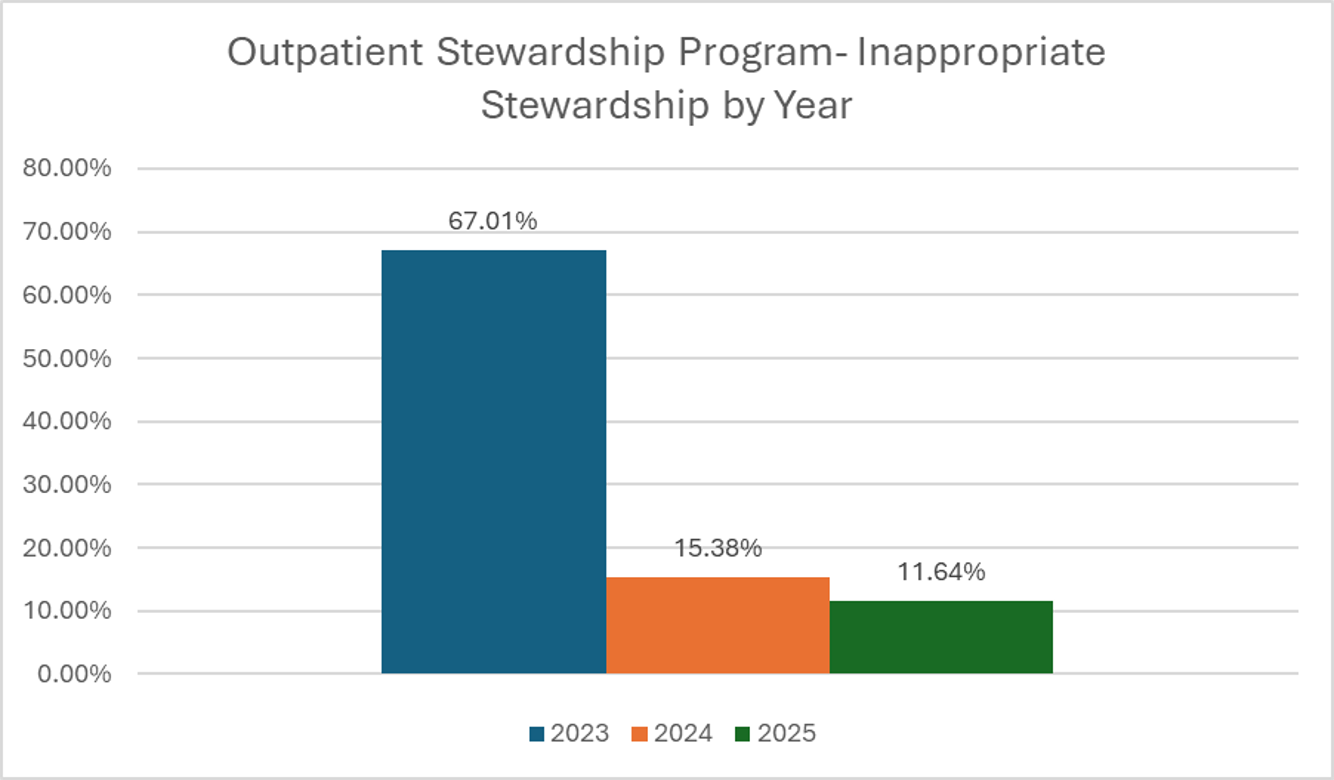
The program utilizes a comprehensive set of process and outcome metrics to monitor prescribing patterns, strengthen guideline adherence and evaluate the impact on patient outcomes across the ambulatory continuum. Key measurements include inappropriate stewardship (antibiotics prescribed outside guideline recommendations); therapy accuracy (correct antibiotic and duration when antibiotics are clinically indicated); prescription rates per 1,000 patient encounters; seven‑day treatment failure rates for pneumonia, urinary tract infections and soft tissue infections; and C. difficile infections associated with outpatient antibiotic use within the previous 90 days.
These metrics have provided a reliable framework for evaluating performance and identifying opportunities for support. The program’s antibiotic prescription rate was 275.21 prescriptions per 1,000 patient encounters, substantially lower than Louisiana’s 2024 statewide prescribing rate of 1,047 per 1,000 encounters reported by CDC. In 2025, the program’s inappropriate stewardship rate was 11.64%, well below CDC’s national estimate that at least 30% of outpatient antibiotic prescriptions are unnecessary. This data reflects strong provider engagement and the effectiveness of the program’s continuous educational feedback loop.
The impact on clinical outcomes has been significant. When comparing pre‑intervention to post‑intervention data, pneumonia treatment failures decreased by 76.19%, UTI treatment failures decreased by 69.7%, and soft tissue infection treatment failures decreased by 37.8%. Similarly, improvements in C. difficile outcomes were notable. One hospital experienced an average 25% reduction in community‑acquired C. difficile infections. Urgent care locations achieved a 100% reduction in C. difficile admissions related to outpatient antibiotic use, while emergency department–associated C. difficile admissions decreased by 72.6%.
These improvements translated into substantial patient‑level benefits. In 2025 alone, the program prevented an estimated 64 hospital admissions, approximately 14 sepsis‑related hospitalizations and at least 18 emergency department visits. These results demonstrate the program’s measurable contribution to patient safety and community health through accessible stewardship support, continuous feedback and reliable data transparency.
Implementation tips
Successful implementation of an outpatient antimicrobial stewardship program requires a structured, phased approach that emphasizes data clarity, provider engagement and operational sustainability. One of the most effective starting points is to gather preliminary data, even if full chart auditing is not initially feasible. Beginning with sample sizes or a small cohort of clinics allows teams to identify early trends, build foundational processes and grow the program strategically as capacity increases.
Programs benefit from tracking all CDC high-priority outpatient conditions simultaneously rather than limiting efforts to a single diagnosis. Monitoring multiple conditions at once creates stronger consistency in prescribing practices and leads to more cohesive guideline adoption across the ambulatory enterprise. The AHRQ Outpatient Stewardship Toolkit is a valuable resource for programs in the early stages, offering educational materials, ICD-10 audit recommendations and practical implementation guidance.
Once the program framework is outlined, assembling a small, dedicated group of key stakeholders, typically including pharmacy, infectious diseases, infection prevention and operational leadership, helps ensure alignment and shared ownership. Engaging directly with front-line providers early in the process is essential. Understanding their biggest challenges, barriers and educational needs creates a program built around support rather than oversight and fosters rapid adoption of recommendations.
Consistent feedback is critical for long-term success. Monthly data sharing, clear interpretation of trends and timely responses to provider questions reinforce the program’s value and keep stewardship deeply integrated into routine practice. Collaboration with local finance teams can further strengthen the program by providing total cost of care, length of stay, and utilization data to demonstrate clinical and economic impact.
Experience has shown that programs grounded in reliable data, responsive communication, ongoing feedback, and measurable pre/postintervention outcomes can remain sustainable, even during periods of rapid expansion or when additional clinics are added under the stewardship umbrella.
Resources and tools
Ochsner Lafayette Sample OP Stewardship Data Tracking (PDF)
Contact