
Teleconsult model for ID pharmacists and ID physicians in resource-limited and rural settings
Presbyterian Hospital, Albuquerque, NM
Last Updated
September 29, 2026
Populations impacted
Adult inpatients at regional hospitals
Description
New Mexico developed the pharmacist clinician (PhC) license to address a shortage of primary care providers in our geographically large, rural state. In 1993, the local College of Pharmacy supported legislation that made New Mexico the first state to allow specialty trained pharmacists to provide primary care services. PhCs are advanced practice pharmacists authorized to independently assess patients and prescribe medications under a broad scope of practice approved by both the State Board of Pharmacy and the Medical Board. Traditional PhCs work in the ambulatory setting, managing chronic disease states, but our program explored the feasibility of expanding this progressive model to the acute care setting as an infectious diseases-specific PhC.
Within the PhC scope of practice, we are authorized to collect medication histories, perform physical assessments, and order laboratory tests and diagnostic imaging. This scope also includes the authority to prescribe or modify drug therapy and formally document our recommendations in the electronic medical record. An ID PhC can leverage both ID pharmacotherapy expertise and prescribing autonomy to enhance patient care. Given the ongoing provider and specialist shortages in our state, many patients who are not directly seen by an ID physician may benefit from an ID PhC consult to assist with microbiological lab and culture interpretation, antimicrobial selection and duration of therapy.
Our health care system includes three main hospitals and six regional hospitals spread throughout the state (combined regional bed capacity of approximately 350). Following rollout at our primary hospital, we expanded the ID PhC consult model to the regional hospitals as teleconsults. These facilities may consult our ID PhC team, consisting of three ID pharmacists. After case review, we provide timely, patient-specific antimicrobial recommendations with documentation in the EMR to ensure visibility for the care team, when appropriate. We are also formally partnered with a local private-practice ID physician group, allowing collaborative discussion of complex cases and joint recommendations based on imaging, microbiology and pertinent clinical history. This model enables regional providers to receive coordinated input from both an ID physician and an ID pharmacist in resource-limited settings.
In addition to PhC consult-based services, we provide traditional antimicrobial stewardship interventions including management of restricted antimicrobials, de-escalation, intravenous-to-oral conversion, avoidance of duplicate coverage and optimization of therapy duration. Annual provider acceptance rates consistently exceed 94% for both ID PhC teleconsult recommendations and antimicrobial stewardship interventions. Overall, the program has been well received by providers, who have expressed appreciation for support in managing complex infectious disease cases.
Members of the ID pharmacy team conduct site visits to the regional hospitals once or twice annually. During these visits, we participate in patient rounds, provide face-to-face recommendations and strengthen relationships with inpatient providers. We utilize this time to educate providers on the latest Infectious Diseases Society of America guidelines, review hospital-specific treatment protocols and discuss clinical pearls relevant to local practice. We believe these in-person engagements are critical to sustaining provider trust and ensuring the long-term success of the ID PhC teleconsult and stewardship model.
Impact and data
All antimicrobial stewardship interventions are tracked within the EMR (Epic) using iVents. For each, the ID pharmacy team documents the intervention type (e.g., de-escalation, ID PhC consult, time spent, treatment recommendations, estimated cost avoidance and outcome [accepted versus rejected]).
Stewardship support at regional hospitals has existed for several years; however, it historically consisted of traditional post-audit and feedback activities. From 2015-2025, our enterprise-wide antimicrobial stewardship program reviewed 49,518 cases, with 24,814 documented interventions. Antimicrobial de-escalation was the most common intervention, with a 94% provider acceptance rate. Regional hospitals accounted for 7,813 cases (16%) and 4,537 interventions (18%), demonstrating sustained engagement across remote facilities prior to implementation of the PhC consult service. This established rapport facilitated transition to a more advanced, PhC teleconsult model.
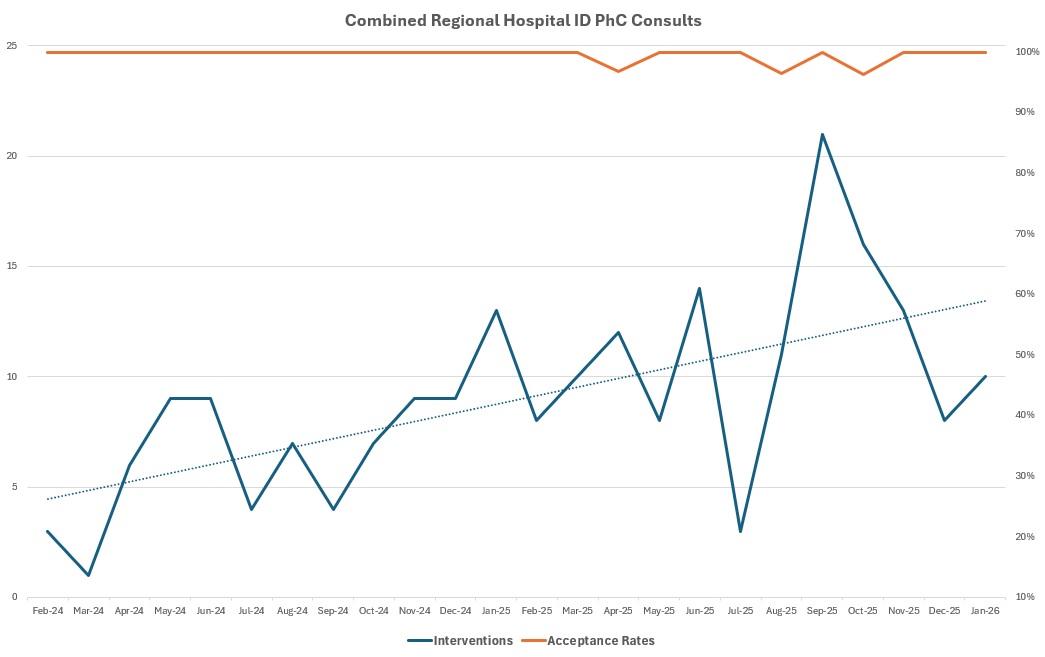
Following implementation of the ID PhC teleconsult service, both consult volume and clinical impact increased. In 2024, 68 PhC consults were completed for regional hospitals with a 100% acceptance rate. In 2025, that volume doubled to 136, with a sustained 99% acceptance rate. These findings suggest high provider trust and support the clinical value of a PhC teleconsult collaborative model involving both an ID pharmacist and an ID physician. The PhC consult service represents a shift from reactive stewardship to proactive, patient-specific clinical involvement with advanced diagnostic and therapeutic input.
Clinical scenarios where providers have found value in the PhC consult service include management of bacteremia, septic arthritis, osteomyelitis, endocarditis, multidrug-resistant organisms, antimicrobial allergies and evaluation of noninfectious mimickers. Regional providers often face additional challenges, including limited access to in-person ID consultation, restricted availability of advanced diagnostics (e.g., transesophageal echocardiography), and barriers to outpatient antimicrobial therapy related to infusion access and rural geography. The PhC teleconsult model provides a synergistic approach to support complex decision-making and enhance safe, appropriate antimicrobial use in resource-limited settings.
Implementation tips
Establishing a strong antimicrobial stewardship foundation and building provider trust were essential to successful implementation of the PhC teleconsult service. Prior to introducing PhC consults, our program focused on consistent delivery of core stewardship activities, including post-audit and feedback, to familiarize providers with pharmacist-led recommendations and demonstrate clinical value. We found that early engagement through education was critical. The ID pharmacy team conducted continuing education–accredited grand rounds addressing antimicrobial resistance trends and stewardship principles, emphasizing the rationale behind optimized antimicrobial selection and duration.
To further support behavior change, we developed provider-level antimicrobial utilization metrics, including targeted assessments of antipseudomonal prescribing for community-acquired infections, with benchmarking against peer prescribing patterns. These data were shared constructively and paired with education rather than punitive messaging. In addition, ID pharmacists provided regular educational presentations on infectious diseases topics during standing provider meetings. We recommend that programs engage regional hospitals in similar educational and data-sharing initiatives prior to launching consult-based services to promote acceptance and strengthen collaborative relationships. Whenever feasible, in-person rounding and on-site educational visits were particularly valuable in fostering relationships and reinforcing the teleconsult model.
Operational alignment with ID physicians is another key factor for success. Establishing dedicated time for joint case review and incorporating this collaboration into contractual arrangements supports sustainability and ensures consistent engagement. The collaborative approach with our ID physician group was pivotal to our program. Their oversight, particularly from a diagnostic standpoint, was incredibly valuable in our consults to enhance patient outcomes.
Finally, clear and visible documentation within the EMR was preferred by providers on more complicated cases. Providers expressed a preference for formal, easily accessible consult notes that outline recommendations and rationale. This transparency improves continuity of care, particularly during provider handoffs, and reinforces confidence in PhC teleconsult services.
Resources and tools
Presbyterian Teleconsult Note Template (PDF)
Presbyterian Teleconsult Note Example (PDF)