

 I still think about two patients.
The first was a man with chronic pulmonary symptoms and multiple discharging sinuses over his chest wall. In a tuberculosis-endemic setting, the diagnosis seemed straightforward. Even CT-guided fine needle aspiration cytology from the upper lobe showed granulomatous inflammation. He was treated as having TB. But he continued to worsen. When the diagnosis was finally revised to pulmonary blastomycosis, the disease had already progressed beyond recovery. We lost him.
The second patient arrived after completing a full course of anti-tubercular therapy and was still symptomatic. This time, we paused. We reconsidered. Further evaluation revealed skeletal cryptococcosis. Antifungal therapy was initiated, and the patient recovered, with no relapse to date.
These two outcomes — “one missed, one salvaged” — forces a difficult question: How often are fungal infections being masked as tuberculosis in endemic regions?
In high TB-burden countries, TB is not just a common diagnosis; it is a reflex.
An understandable approach but a consequential blind spot
Patients presenting with chronic cough, weight loss, fever or granulomatous inflammation are frequently labeled as having TB, even when microbiological confirmation is lacking in some cases. Negative GeneXpert, smear or culture does not always shift that thinking. Clinical diagnosis, shaped by local epidemiology, public health priorities and urgency, often takes precedence.
This approach is understandable given the burden and clinical urgency of tuberculosis. Global and national TB elimination programs have expanded access to diagnostics in substantial ways. Laboratories, algorithms and funding streams are largely oriented toward early detection and treatment of TB. However, this success has also created an unintended blind spot.
Diseases that mimic TB, particularly fungal infections, are frequently overlooked.
Endemic mycoses such as histoplasmosis, blastomycosis and cryptococcosis can closely resemble TB in both clinical presentation and radiological findings. Chronic pulmonary disease, systemic symptoms and even granulomatous pathology are shared features. Beyond fungi, other conditions such as actinomycosis and Pneumocystis jirovecii pneumonia in immunocompromised patients further complicate the picture.
In practice, without specific diagnostic testing, separating these conditions from TB is often not possible. The clinical overlap is striking, and without specific testing, these conditions are difficult to distinguish. At the same time, access to fungal cultures, antigen detection assays and molecular diagnostics remains inconsistent, particularly in resource-limited settings. Even where available, they are not always considered early. And in regions where TB is highly prevalent, it is not just a common diagnosis; it is often the first one we settle on. Treatment is started, and only when the expected response does not occur do we begin to question it.
By then, valuable time has often been lost.
Patients with fungal infections may receive months of unnecessary anti-tubercular therapy, exposing them to drug toxicity, financial burden and social stigma, while the underlying disease progresses untreated. Delayed diagnosis often translates into advanced disease, higher morbidity and increased mortality, as seen in the patient with blastomycosis. In other cases, fungal infections may coexist with TB or emerge as sequelae, such as chronic pulmonary aspergillosis following treated TB, further complicating clinical outcomes.
Making the gap visible
What changed the course for the second patient was not just access to diagnostics. It was the decision to question the initial assumption. We paused when the clinical picture did not fit. We widened the differential and pursued further testing. Access matters, but so does the willingness to reconsider.
This is where the gap becomes visible.
TB programs have justifiably focused on scaling up diagnostics and treatment. A similar emphasis is now needed for TB mimickers. Integrating fungal diagnostics into existing infrastructure, improving clinician awareness and building in checkpoints for reassessment in nonresponding patients could shift outcomes significantly. Recognizing when a clinical course deviates from expected TB response should not be an exception, it should be standard practice.
The epidemiology of infectious diseases is also changing. With increasing travel, migration and environmental shifts, infections are no longer confined to traditional geographic boundaries. Diagnostic reasoning needs to keep pace with this reality.
TB remains common, but it is not exclusive.
As you read this, it is worth asking: How many patients are still being treated for TB without ever having TB? How many are enduring prolonged therapy, toxicity and stigma for a disease they do not have, while the real diagnosis remains unaddressed?
Missing fungal infections is not rare. It is something we are encountering more often than we acknowledge. And until we begin to look beyond TB even in TB-endemic settings, these infections will continue to remain hidden in plain sight.
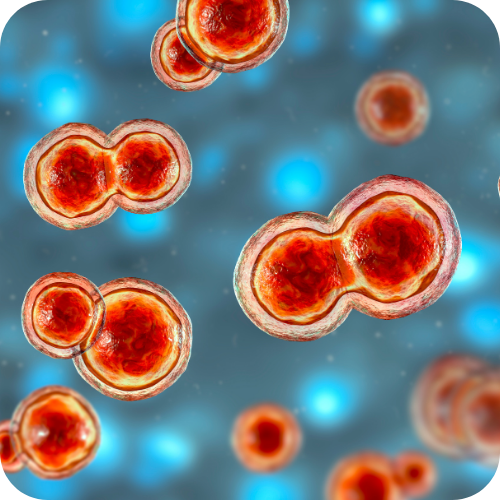
Image: Illustration of Blastomyces dermatitidis
Acknowledgement: Artificial intelligence tools were used to support language refinement during the drafting of this post. The intellectual content, clinical insights and final responsibility for the post remain entirely the author’s.

