

Molecular HIV surveillance is hard to explain. It involves using HIV genetic data from routinely collected laboratory results to identify viruses that are highly genetically similar, which may signal rapid transmission within interconnected networks. This information can then be used to guide public health action. This very technical and largely laboratory-based process can feel far removed from the experience of someone getting an HIV test or receiving care. Yet the data come from real people and communities.
That disconnect matters. When people do not understand what happens to their information, mistrust can grow, particularly in communities that today have many reasons to be cautious about government and health care systems.
The river begins upstream
Using these HIV molecular epidemiology tools, in 2021 Georgia public health authorities identified several networks, also known as clusters, of rapid HIV transmission among Hispanic and Latino gay, bisexual and other men who have sex with men in metro Atlanta. (1) The response brought attention to barriers our community partners already knew well: language, immigration concerns, stigma and limited access to culturally responsive services.
We now know that HIV diagnoses among Hispanic and Latino communities in Georgia had been increasing since at least 2014 (2), but this trend was largely buried within the overall surveillance data. Molecular data showing rapid transmission prompted a coordinated federal, state and local response. Working with academic and community partners, the response included community interviews and tailored interventions, from social media campaigns in Spanish to citywide peer navigation.
In Atlanta, molecular HIV surveillance helped identify rapid transmission and mobilize a tailored response. But as our team became more involved in HIV molecular epidemiology, we began to understand another side of the story: the concerns and mistrust surrounding these public health practices.
Mistrust is part of the story
Community advocates have raised concerns about molecular HIV surveillance for years, including questions about privacy, consent, criminalization and how molecular information might be used beyond public health. Furthermore, many people are not aware that their HIV laboratory results are routinely reported to health departments.
In 2022, the Presidential Advisory Council on HIV/AIDS called for stronger community engagement and plain-language communication about how molecular HIV data are used. (3) That idea stayed with us.
In conversations with community members, providers and partners, the questions were often very practical: How did the health department get my information? Who can see it? Why are you doing this? What happens after a network is detected?
We realized that simply telling people not to worry was not enough. We needed to show the process, including the parts that can be difficult or uncomfortable, and create space for people to ask questions and form their own opinions.
Why a river?
We began thinking about rapid HIV transmission, network detection, and response as a process and whether that process could be explained through the metaphor of a river. The River of Life is a participatory visual exercise that uses a river to map a journey or process, with different key characteristics such as currents, rocks, and bridges representing challenges, turning points, and symbols of support and connection.
We don’t often see a river’s headwaters. However, what happens downstream is shaped by conditions upstream. Sometimes the river moves slowly. Sometimes conditions change, and the current accelerates. In the same way, HIV transmission is influenced by forces that often begin long before someone enters a clinic: housing, transportation, stigma, immigration experiences, access to health care, language and other structural conditions.
Built with community
We did not want to create an infographic and then ask the community whether they liked it.
Community engagement happened from the start. Over nine months, through multiple iterations and bilingual virtual and in-person meetings, community partners, public health workers, and researchers collaborated to shape both the process and reach consensus on how the story was told, and how the process should ideally work. After the co-creation process, our group collaborated with Latina illustrator Cristina Yepez to create an infographic of the River of Detecting and Responding to Rapid HIV Transmission, which was subsequently adapted into an animation through a close collaboration with Intercultural Productions, a multimedia production company.
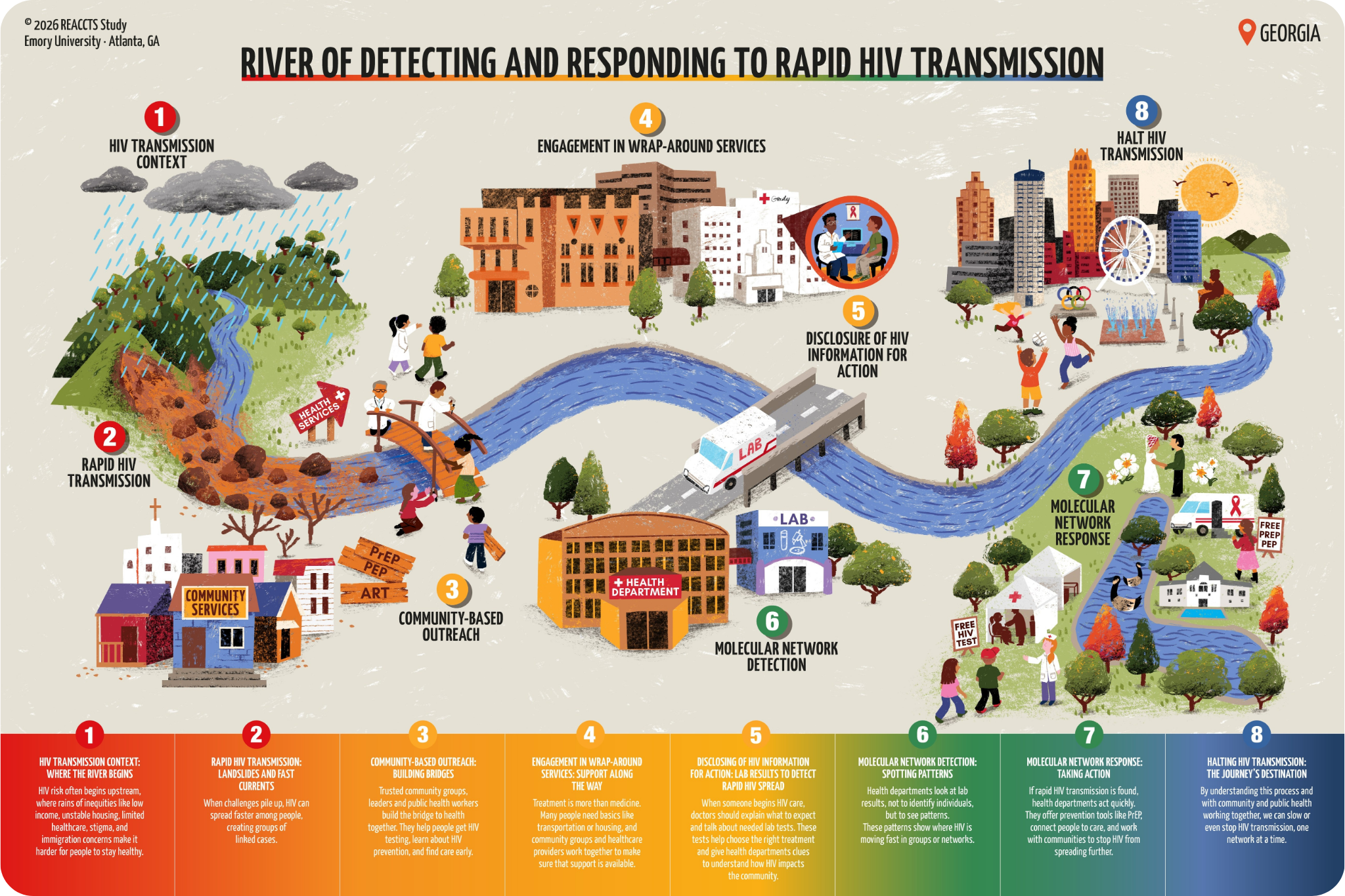
More than a research output
We initially thought we were co-creating a logic model to disseminate research results. What emerged was a tool for conversation with communities and health providers.
The River of Detecting and Responding to Rapid HIV Transmission works best when people navigate it together, in partnership and solidarity: an outreach worker with a community member, a clinician with a patient or a health department with its community advisory board. It creates space to point to any part of the process and ask: What happens here? Who receives this information? Why is it needed? What happens next?
This tool does not resolve every concern about molecular HIV surveillance, nor should it. Instead, it makes the process more understandable, so communities and health providers can ask informed questions and meaningfully participate in how these approaches are used. The product can be used as an educational resource, but also as a practical communication tool that bridges a current public health implementation gap by supporting dialogue, understanding, and trust across communities, public health practitioners, and health care providers.
See it. Use it. Adapt it.
The full River of Life infographic, animation and downloadable materials premiered at the 2026 United States Conference on HIV/AIDS and are available online in English and Spanish for use in trainings, community conversations, educational outreach, clinics and public health settings.
One of the most important lessons from this work is simple: The meaningful involvement of people with HIV and effective and appropriate communication are not separate from public health practice. They are a necessary part of public health practice.
If communities cannot understand how their information moves through the system, we cannot expect them to trust the system simply because we tell them to.
Sometimes we need to draw the whole river.
Acknowledgements
The River of HIV Detection and Response was made possible through the collective efforts of a diverse group that included people with HIV, community leaders, activists, advocates, community engagement specialists, certified community-based researchers, public health workers, clinicians, academic researchers, graduate students, artists, and communication specialists who contributed their expertise, experiences, and perspectives to co-create this resource.
We extend our sincere gratitude to the co-creators of the River of HIV Detection and Response, the REACCTS study team and its partners: Carlos S. Saldana and Jane Y. Scott (study’s co-principal investigators); Claudia E. Ordóñez (co-investigator and community-engaged research lead); Emory University team members Juan David Patino-Mateus (also narrator of the Spanish-language version of the animation and website designer), Victor Samuel Diaz-Sarmiento, Julian Santiago Ramon, Olakunle Ogunbayo, Aimee Rivera Solis; and community partners Masonia B. Traylor, Genesis Appiah, Latonia Wilkins, Dominiqué Cureton, Marcus Muhammad, Li Ann Sanchez, Nicole Fox, and Eric Rangel.
Special thanks to Professor Lenore Manderson and to the public health department staff who shared their expertise and insights throughout the process. We are particularly grateful to Cris Yépez of Cardenilla and Intercultural Productions for bringing the project to life through illustration and animation.
Finally, we acknowledge the support of the National Institutes of Health through the Emory Center for AIDS Research (P30 AI050409) and all project partners, funders, and supporters who helped make this community-engaged initiative possible.
References
- Saldana C, Philpott DC, Mauck DE, et al. Public Health Response to Clusters of Rapid HIV Transmission Among Hispanic or Latino Gay, Bisexual, and Other Men Who Have Sex with Men — Metropolitan Atlanta, Georgia, 2021–2022. MMWR Morb Mortal Wkly Rep. 2023;72:261–264. 2. DOI: http://dx.doi.org/10.15585/mmwr.mm7210a3.
- Georgia Department of Public Health, HIV among Hispanic or Latino MSM (ages 18–44), Georgia Data Summary Fact Sheet, 2014–2022. Published September 2024. Accessed: October 7, 2026.
- Presidential Advisory Council on HIV/AIDS. Molecular HIV Surveillance and Cluster Detection and Response Resolution. US Department of Health and Human Services; October 17, 2022. Accessed: October 7, 2026.

