

 Florida’s AIDS Drug Assistance Program faced a crisis that threatened access to HIV treatment for nearly 16,000 people with HIV in January 2026 when the state of Florida announced sweeping cuts to the program. Florida advocates and health care professionals quickly mobilized and ultimately were successful in largely averting the cuts.
Jose Rodriguez, HIVMA’s associate director of public policy and advocacy, spoke with HIVMA Board members Sheila Montalvo, PharmD, CPh, BCPS, AAHIVP, and Hansel Emory Tookes III, MD, MPH, about those who were at the center of the fight to understand what it took, what was at stake and what other advocates can learn from their experience.
When the Florida Department of Health announced the ADAP cuts in January, what was your immediate reaction?
Dr. Tookes: I was shocked by the policy change and saddened by the impact it could have on my patients. The most concerning part was the lowering of the income eligibility limit to qualify for ADAP to 130% of the federal poverty level. I knew that neither the state nor the community wanted Floridians to lose access to their lifesaving medications, so I was focused on finding common ground.
Dr. Montalvo: My immediate reaction was shock and concern for our patients who rely on ADAP to access lifesaving medications and care. We knew these changes had the potential to disrupt treatment for many people.
How were people in your clinic affected? How did you manage the stress of the situation while also mitigating treatment disruptions?
Dr. Tookes: These changes impacted every clinical encounter I had, so much so that the AI note writing software learned about the policy change and included details in my notes. Most of my patients were on Biktarvy, so I had to change everyone’s medication. But, at our request, the state allowed us to prescribe 90-day supplies of Biktarvy prior to its removal from the formulary, so there were no treatment disruptions for my patients.
Dr. Montalvo: The biggest challenge was the uncertainty. There was very little firsthand official information early on, which created confusion and panic among patients. In our high-cost-of-living community, the initial 130% federal poverty level cutoff forced many patients to choose between paying for housing and food or maintaining their health care and medications.
Our clinic responded proactively. We identified patients most likely to be affected; reviewed insurance and medication costs; explored lower-cost treatment options; helped patients access copay cards, manufacturer assistance and foundation support; and used medication samples to prevent interruptions in therapy. Our physicians, pharmacists, case managers and behavioral health team worked together to contact thousands of patients individually, answer questions and guide them through their options. We also collaborated with other health systems to help patients who were losing insurance coverage continue receiving care.
It was an incredibly stressful time, but communication, teamwork and keeping the patient at the center of every decision helped us navigate it successfully.
What factors contributed to the legislative win that largely averted the ADAP cuts?
Dr. Tookes: I had never seen HIV activists in action like this before. Their willingness to go to the Capitol to speak with legislators and share their personal stories was the most impactful action. The HIV community was incredibly effective in seeking a solution to the problem at hand, and the tenacity of our patients resulted in a major legislative win. Also, major credit to state legislators who were willing to listen and played a significant role in approving the funding.
Dr. Montalvo: The response was successful because of broad collaboration. National organizations, local agencies, health systems, pharmaceutical partners, advocates and patients all worked together to educate legislators about the real-world consequences of the proposed cuts. Once decision-makers understood that interruptions in antiretroviral therapy would harm both individual patients and public health, it became clear that a better solution was needed.
What role did HIVMA play in the response?
Dr. Tookes: HIVMA convened regular sessions with the community of providers, patients, organizations and activists. The information sharing in these sessions was remarkable and kept us informed of progress and setbacks. These sessions were late in the evening, and attendance was high because the stakes were high. The symbiotic nature of the relationship between providers and activists became salient, as the community stepped up without reservation to fight for their lives.
Dr. Montalvo: HIVMA was instrumental. It served as the unifying force that brought together clinicians, advocates, patients, health systems and community organizations. The weekly Florida ADAP meetings created a forum to share updates, coordinate advocacy efforts and develop practical solutions that prioritized patient care while recognizing fiscal realities.
Insurance premium assistance wasn’t restored in the final budget and is now codified in statute. What’s your read on that fight going forward?
Dr. Tookes: The work never ends.
Dr. Montalvo: While it’s disappointing that premium assistance was not restored, I remain hopeful. We now have stronger partnerships, more data and a clearer understanding of the impact these policies have on patients. I believe those relationships will be important as we continue advocating for future improvements.
What advice do you have for health care professionals in other states who may be facing cuts to their ADAP programs?
Dr. Tookes: Florida is the bellwether for the U.S. This policy change did not fly in Florida, so I’m optimistic that other states will have success in maintaining excellence in HIV care despite funding challenges.
Dr. Montalvo: Be proactive and start collaborating early with organizations like HIVMA, state and local agencies, and community partners. Educate elected officials before cuts are proposed, using patient stories alongside data to demonstrate the impact. Help policymakers understand that ADAP is not only lifesaving — it is also a cost-effective public health investment that improves outcomes and reduces long-term health care costs.
Florida’s ADAP win is an example of what’s possible when HIV advocates, the community and health care professionals join forces. For advocates who want to stay ahead of potential crises in their own states, the Save HIV Funding Campaign developed a practical guide, 5 Questions Advocates Should Be Asking About Their ADAP’s Fiscal Outlook, to support state ADAP advocacy.
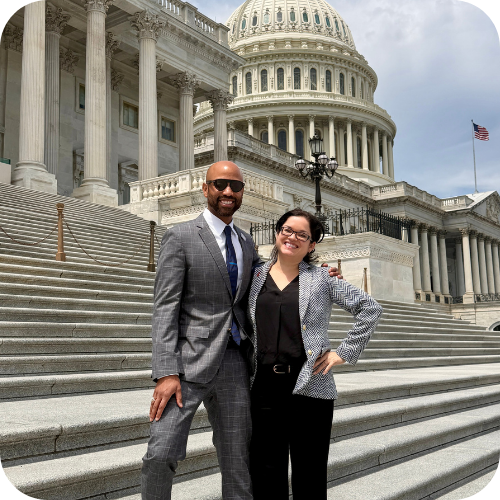
Photo: Sheila Montalvo, PharmD, CPh, BCPS, AAHIVP, (right) and Hansel Emory Tookes III, MD, MPH, at HIVMA’s Advocacy Day on Capitol Hill in May 2026.

