
 In this installment of the Health Equity Series, MarkAlain Dery, DO, MPH, FACOI, reflects on the current Ebola outbreak through the lens of his experience responding to the West Africa Ebola outbreak and what both reveal about global health equity.
I still remember the silence of doors not opening.
In Freetown, Sierra Leone, in 2014 and 2015, during the West Africa Ebola outbreak, I first served as the medical director of an Ebola treatment center before moving into clinical epidemiology with the World Health Organization. On paper, the job was simple: Find cases, get them into treatment centers, trace contacts and break the chain of transmission. In reality, it meant showing up in communities that had every reason not to trust the person at their door, carrying a case definition and a promise that this time, the system would not fail them.
Some doors opened in fear. Some opened in hope. Some never opened at all.
We call Ebola a “deadly virus,” but that’s incomplete. Ebola is a story about power — who hoards it, who is shut out, and how distant decisions determine who gets supplies and who gets body bags. The virus may be microscopic, but the inequities it exposes are not.
A decade later, the story is repeating itself
The current Ebola outbreak in eastern Democratic Republic of Congo and Uganda isn’t bad luck; it’s the product of policy choices, disinvestment and a world order that treats some lives as regrettable collateral damage. Extractive greed drives deforestation, pushing fruit bats into closer contact with humans, making spillover inevitable. The Bundibugyo virus behind these cases has no vaccine or targeted therapy, but what’s striking isn’t the virus — it’s the familiar inequity. (1)
In 2024, the U.S. sent about $1.4 billion to DRC — roughly $910 million in humanitarian aid that kept a fragile response going and made Congo the largest single recipient of U.S. humanitarian assistance that year. (2, 3) Then, on Jan. 20, 2025, a 90-day foreign aid freeze halted funding and disrupted critical services. (4) Pulling billions from fragile systems mid-crisis isn’t just changing a spreadsheet; it’s rewriting the reproductive number.
By 2026, by the time this current Ebola outbreak had surged and health systems were strained, funding for outbreak‑specific support had shrunk to something closer to a rounding error than a rescue plan. Of course, Ebola “happened.” You cannot drain the well and feign surprise when people show up thirsty. This is what it looks like when budget lines become epidemiology.
Trust, memory and another piece of the puzzle
Back in Freetown, people would often ask why communities seemed “reluctant” or “hard to reach.” Why would they not come to the treatment unit or tell us about sick relatives? If you had watched health facilities fail you for years and seen care arrive only when someone powerful somewhere got nervous, how eager would you be to trust the next Land Rover that appeared? Distrust is not a barrier to care in these settings; it is a form of memory.
Fast‑forward to this year, and we see another piece of the puzzle: where, and for whom, we build safety.
The U.S. is building a specialized Ebola quarantine facility at a Kenyan air base for Americans exposed in DRC. (5) Biocontainment units are being stood up, personnel mobilized and protocols harmonized. On paper, a triumph of coordination. On the ground, a 50-bed lifeboat next to a burning ship.
On its face, protecting health workers and citizens abroad is reasonable. But from the communities I served, it looks like a world where a high-tech facility appears overnight for Americans, while Congolese and Ugandan families struggle for basic care at the epicenter. Borders close in the name of biosecurity, even as we fly in equipment and fly out those deemed worth evacuating.
We have built a system in which mobility, treatment and safety align neatly with power, wealth and citizenship. Ebola does not just reveal those lines; it inks them in place.
In that light, “equity” is not an abstract aspiration; it is the difference between whose fever becomes a monitored lab value in a negative‑pressure room in Kenya and whose fever is managed at home with oral rehydration because the nearest clinic shut down when foreign aid froze. It is the gap between rapid deployment of biocontainment units for a small group of expatriates and the slow, conditional trickle of support to rebuild the health centers that Congolese communities will rely on long after the cameras leave. We have perfected the art of temporary safety for the few while leaving permanent precarity for the many.
Where those of us who work in infectious diseases come in
We’re comfortable debating R-naught and viral phylogenetics, less so how a 90-day aid freeze accelerates outbreaks or how building a quarantine facility for Americans while local health systems collapse is a policy choice about whose survival matters. It’s easier to debate personal protective equipment than to ask why some health workers have none.
If we want our response to align with our values, we have to broaden our field of vision. Most of us in ID don’t control aid budgets, but we can clarify what should happen next time.
- We can name how resources are allocated — calling out when outbreak funding props up surge response while public health services crumble and refusing to pretend abrupt freezes are anything but risk multipliers.
- We can name how “aid” is framed — calling out the charity narrative and saying plainly that cutting billions from countries like DRC today guarantees more dangerous, more devastating outbreaks for everyone tomorrow.
- We can name power — insisting that every response plan spell out who is protected first, who is expected to absorb risk, and how those choices must change before the next spillover turns from warning shot to body count.
In 2014, standing outside those closed doors in Freetown, I learned that trust is not built by heroic individual moments; it is built — or broken — by “patterns.” Who shows up before the crisis. Who stays afterward. Who is asked, yet again, to stay put and wait.
Ebola will keep finding the cracks we leave in our global systems. The virus is doing exactly what viruses do. The question is whether we are ready to admit that the real outbreak — the one we refuse to name — is an outbreak of concentrated power.
The pathogen is biology.
The “pattern” is us.
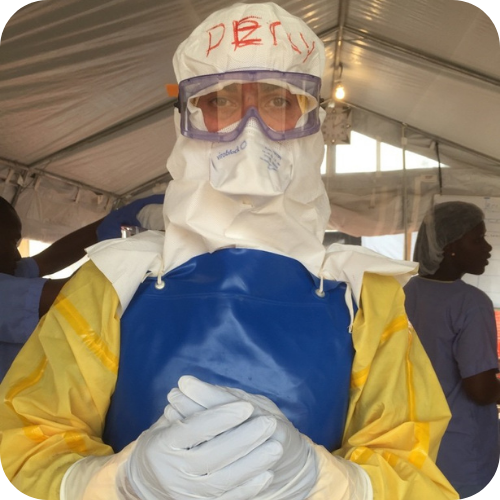
Photo: MarkAlain Dery, DO, MPH, FACOI, in Freetown, Sierra Leone, during the response to the West Africa Ebola outbreak.
Learn more about the Health Equity Series on Science Speaks and read other posts in the series.
References
- Ngongo N, Fallah MP, Dereje N, et al. Bundibugyo Ebola without vaccines or therapeutics: why public health fundamentals matter more than border closures. Nature Medicine. 2026.
- How much foreign aid does the US provide to Democratic Republic of the Congo?. USAFacts. 2025.
- United Nations News. Humanitarians uphold commitment to support civilians in DR Congo. Published Feb. 10, 2025. Accessed June 11, 2026.
- Cavalcanti DM, de Oliveira Ferreira de Sales L, da Silva AF, et al. Evaluating the impact of two decades of USAID interventions and projecting the effects of defunding on mortality up to 2030: a retrospective impact evaluation and forecasting analysis. Lancet. 2025;;406(10500):283-294. doi: 10.1016/S0140-6736(25)01186-9. Epub 2025 Jun 30. PMID: 40609560; PMCID: PMC12274115.
- Schreiber M. US building Ebola quarantine center in Kenya for Americans amid outbreak. The Guardian. Published May 26, 2026.

