
Oswald Avery Award
The Oswald Avery Award for Early Achievement recognizes outstanding achievement in an area of infectious diseases by an IDSA member or fellow who is 45 or younger (on Dec. 31 of the year preceding the IDWeek at which the award is given). The award is based on overall achievement, not usually a single study.
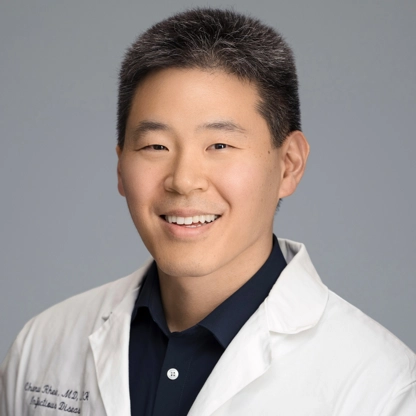
2026 Oswald Avery Awardee
Chanu Rhee, MD, MPH, FIDSA, FCCM, FSHEA
Chanu Rhee, MD, MPH, FIDSA, FCCM, FSHEA, is internationally recognized for his transformative contributions to sepsis surveillance and management. Through innovative use of electronic health record data and rigorous population-based research, he has generated foundational insights that advanced the understanding of sepsis epidemiology and shaped clinical practice, public health and health care policy.
Dr. Rhee is an associate professor at Harvard Medical School and a dual-boarded infectious diseases and critical care physician. He provides clinical care on the transplant/oncology infectious diseases service and in the medical intensive care unit at Brigham and Women’s Hospital, where he also serves as medical director of infection control.
Dr. Rhee’s early work demonstrated that much of the widely reported rise in sepsis incidence reflected evolving diagnostic and coding practices rather than true changes in disease burden. He subsequently led the development and validation of electronic health record-based methods for sepsis surveillance using objective clinical markers of infection and organ dysfunction. Applied across hundreds of U.S. hospitals, this work produced the first national estimates of sepsis incidence, outcomes, and trends using clinical data and informed the Centers for Disease Control and Prevention’s Adult Sepsis Event framework.
Dr. Rhee has also made seminal contributions to understanding the preventability of sepsis-associated deaths in U.S. hospitals, establishing hospital-onset sepsis as a major target for surveillance and quality improvement, elucidating the clinical heterogeneity of sepsis, and advancing more precise antimicrobial therapy through studies of how antibiotic use, spectrum and timing influence patient outcomes.
Among his contributions to the Society, Dr. Rhee served as a key member of the IDSA Sepsis Task Force, where he authored multi-society position papers that challenged rigid process-based metrics and advocated for greater emphasis on patient outcomes. He subsequently chaired the IDSA Sepsis Advisory Panel, leading the development of consensus recommendations on hospital strategies to advance more comprehensive sepsis care. Recognized for his thoughtful, evidence-based and inclusive leadership style, he has fostered collaboration across multiple professional societies on some of the field’s most challenging issues.
Dr. Rhee currently leads CDC- and CMS-supported efforts to build on the Adult Sepsis Event framework to develop the nation’s first digital sepsis outcome measure for hospital benchmarking. In 2025, he founded the Center for Sepsis Epidemiology and Prevention Studies at the Harvard Pilgrim Health Care Institute to accelerate research and innovation in the field.
Dr. Rhee graduated summa cum laude from Georgetown University School of Medicine in 2007 and completed his critical care medicine fellowship at Stanford University Hospital in 2012. He completed an infectious diseases fellowship in the combined Massachusetts General Hospital/Brigham and Women’s Hospital program in 2015.
For the breadth, originality and impact of his contributions, IDSA is pleased to recognize Dr. Rhee with the 2026 Oswald Avery Award for Early Achievement.
Past Oswald Avery Award winners
2025 Sameer Kadri, MD, MS, FACP, FIDSA
2024 Pranita Tamma, MD, MHS
2023 Talia Swartz, MD, PhD, FIDSA
2022 Nadine Rouphael, MD, FIDSA
2021 Michail Lionakis, MD, ScD, FIDSA
2020 Sallie R. Permar, MD, PhD
2019 Nasia Safdar, MD, MS, PhD, FIDSA, FSHEA
2018 Susanna Naggie, MD, MHS, FIDSA
2017 William J. Steinbach, MD
2016 Susan S. Huang, MD, MPH, FIDSA, FSHEA
2015 Eric R. Houpt, MD, FIDSA
2014 Sarah E. Cosgrove, MD, MS, FIDSA, FSHEA, and
Rochelle P. Walensky, MD, MPH, FIDSA
2013 Cesar A. Arias, MD, MSc, PhD, FIDSA
2012 Dan A. Barouch, MD, PhD
2011 Umesh Parashar, MBBS, MPH
2010 Eleftherios Mylonakis, MD, PhD, FIDSA
2009 Jean-Laurent Casanova, MD, PHD
2008 Vance G. Fowler Jr., MD, MHS
2007 Pablo C. Okhuysen, MD, FIDSA
2006 Cynthia G. Whitney, MD, MPH
2005 James E. Crowe, MD
2004 B. Brett Finlay, PhD
2003 Joseph Heitman, MD, PhD
2002 Matthew K. Waldor, MD, PhD
2001 David A. Relman, MD
2000 Michael S. Donnenberg, MD
1999 William A. Petri Jr., MD, PhD
1998 Joseph W. St. Geme III, MD
1997 Samuel I. Miller, MD
1996 David D. Ho, MD
1995 Michael Osterholm, PhD, MPH
1994 Mark Klempner, MD
1993 Claire Broome, MD
1992 Martin Blaser, MD
1991 Marcus Horwitz, MD
1990 Jerrold Ellner, MD
1989 Henry Murray, MD
1988 Walter Stamm, MD
1987 John Gallin, MD
1986 Charles Dinarello, MD
1985 Dennis Kasper, MD
1984 Adel Mahmoud, MD, PhD
1983 Anthony Fauci, MD
1982 George Miller, PhD
1981 Gerald Keusch, MD
1980 Robert Purcell, MD
1979 Stanley Falkow, PhD
1978 King Holmes, MD, PhD
1977 Lowell Glasgow, MD, MS
1976 Sheldon Wolff, MD
1975 Kenneth Warren, MD
1974 Malcolm Artenstein, MD, and
Emil Gotschilch, MD
1973 Frank Austen, MD
1972 Zanvil Cohn, MD
1971 Jonathan Uhr, MD
1970 Hans Mueller-Eberhard, MD, DMSc
1969 Robert Chancock, MD
1968 Robert Good, MD, PhD